Showing posts with label Home Ec. Show all posts

Tuesday, May 8, 2012

Occupy Facebook

 "Devil or Angel I can't make up my mind"

Wing makers and diadem polishers are busy, glow sticks are being fueled as new members of the pantheon of Mammon are about to be welcomed into the fold. What's most difficult for me is my inability to be clear about their belief system. The same people whom we sanctify as good guys, known by their support for OWS, expanded democracy, and the redistribution of wealth, are this very minute checking their insider status, their stock allocations, and lock-up dates for their soon to be public shares of Facebook. Many new members of the soon to be fabulously wealthy are exploiting the very systems that they decried last MayDay. 

Those not lucky enough to be insiders are calling their brokers looking for shares, checking the institutions that they own in their 401s to see if they are going to get any shares, and planning to get the jump on the trading as soon as it starts. Warren Buffett isn't going to play. He can't place a value on the company but he knows that all the noise is creating a "sense of value" that has no intrinsic worth. ( "Bubbles" aren't revealed when they burst. Bubbles are the everyday nature of a stock market that makes prices on a multiple of  expectations of unpredictable future activity). He may also have noted that insiders are selling nearly half of the offering shares. It is usually a negative sign when insiders express so little faith in the future fortunes of their company that they want to rush to the doors to sell their shares. 

Many of the so called "good guy funds", for this post I took Calvert, an early and successful cluster of funds that markets that they invest in sustainable and moral corporations, if history is any guide (they own Google, Apple, and many other new media cos) will be at the trough buying from Morgan Stanley (lead underwriter). JPMorgan Chase & Co., Goldman Sachs Group Inc. (GS),Bank of America Corp., Barclays Plc (BARC) and Allen & Co. also will help with the IPO, Facebook said in the filing. 

The story of Sheryl Sandberg's migration from the Treasury Dept under President Clinton, who she worked for along the way before becoming COO of Facebook, is documented on Bloomberg here. 
So now, if you have clicked away, you know that Facebook is Wall-Street and that only the most naive believe that Facebook is in the social change business, here or abroad. The temporary exploitation of Facebook as a tool to organize a meet-up, should not be confused with the greater and longer lasting function of Facebook as a means to expand through their advertising sales, the ever increasing materialism of new markets. 

"Money for nothing, chicks for free"

As for the expansion of democracy, the implicit understanding that shareholders after all control the companies they invest in, is contradicted by Facebook  using a little known means to retain control: Zuckerberg adopted a dual-class structure in 2009. He has 10 votes for every other shareholder’s single ballot. 


The larger picture is just as morally confusing. What does it mean when we invest almost 100 billion dollars in an activity as vacuous as Facebook. Discussions of the policy of less or more government, investment in infrastructure or education, or the military for that matter, become meaningless against the backdrop of a culture that expresses its true sentiment, aspirations and dreams, by entering the casino and betting up the value of Facebook. Cuz that is what you are doing. Investors have become suckers in the largest ponzi scheme on earth. 

The shortest course in the mechanics of an IPO: An individual or group begins some form of activity that has economic value, or the potential of profit. They can organize that activity in a variety of forms. One could form a partnership, a co-op, a non-profit, or a closely held corporation. Facebook chose stock corporation. Lawyers develop documents which register the company formally, describe the activity, where it will function and the initial owners and board members of that company. Other docs spell out meetings and elections, formats etc. Stock is registered and distributed. Most is kept "on the shelf". In the case of Facebook there are 2.48 billion shares registered at a value of 6 cents a piece. (337.4 million are going to be sold through this IPO). When an insider is awarded shares in lieu of salary, or for a bonus, that 6 cents is their basis price. At some point, enough activity has taken place that someone initiates a conversation about taking the company public. That is selling shares either from the shelf, or from insiders to raise capital. That capital might be used to expand the company, liquidate debt, make acquisitions, or enrich insiders who decide to sell their shares. A set of sell side "bankers" goes through a process of due diligence and writes up the findings. The corporation and their bankers make judgements about how they might price these shares, and how they are going to word the "red herring" the offering document to the public. If you ever read a red herring you will note that they say nothing but the worst about the fortunes of said company. They are not allowed to hype without evidence. It is the wink in the process. The company goes on a road show attracting investors to the IPO and obtaining subscriptions, commitments to purchase x shares. On a date specific the company under the auspices of the SEC offers the shares. The initial shares are distributed and then trading moves to the markets where those less fortunate are allowed to buy and sell shares. There is often a pop created by either a perfectly legal agreement on the part of the bankers to commit to purchase shares in the after market, or a purposeful shortage of shares available determined by bankers guessing the demand, and then not satisfying it. Insiders whose shares are not part of the initial IPO are locked out of sales for 6 months. Their sales into the market after lockout are the first wave of dilution, that is selling more shares of a company into a market after a price per share is being determined on a trading platform. Remember those millions of shares that Facebook retained on the shelf. They too can and will be sold in "secondaries" to raise yet more money and dilute the shares further. 


It is getting so hard to maintain even the semblance of liberalism in the face of such temptation. Before you sell your soul, or wish that you had I think it is important to consider one small excerpt from Wendell Barry's Jefferson lecture: excerpt from Wendell Berry's 2012 Jefferson Lecture 

"That we live now in an economy that is not sustainable is not the fault only of a few mongers of power and heavy equipment. We all are implicated. We all, in the course of our daily economic life, consent to it, whether or not we approve of it. This is because of the increasing abstraction and unconsciousness of our connection to our economic sources in the land, the land-communities, and the land-use economies. In my region and within my memory, for example, human life has become less creaturely and more engineered, less familiar and more remote from local places, pleasures, and associations. Our knowledge, in short, has become increasingly statistical.
Statistical knowledge once was rare. It was a property of the minds of great rulers, conquerors, and generals, people who succeeded or failed by the manipulation of large quantities that remained, to them, unimagined because unimaginable: merely accountable quantities of land, treasure, people, soldiers, and workers. This is the sort of knowledge we now call “data” or “facts” or “information.” Or we call it “objective knowledge,” supposedly untainted by personal attachment, but nonetheless available for industrial and commercial exploitation. By means of such knowledge a category assumes dominion over its parts or members. With the coming of industrialism, the great industrialists, like kings and conquerors, become exploiters of statistical knowledge. And finally virtually all of us, in order to participate and survive in their system, have had to agree to their substitution of statistical knowledge for personal knowledge. Virtually all of us now share with the most powerful industrialists their remoteness from actual experience of the actual world. Like them, we participate in an absentee economy, which makes us effectively absent even from our own dwelling places."


Tuesday, May 10, 2011

The Truth will save you bucks

Harold McGee was inducted into the James Beard hall of fame last night. For thirty years his book "On Food and Cooking" has been my go to guide when I wanted to know what was happening on the stove or in the oven. In addition to applying basic scientific understanding to the cooking process he is a great myth buster, and can save you a great deal of money if you heed his advice.

You will notice that I added his blog site to the roll on the right column of this page. I go there constantly.

One of his entries that I particularly appreciated was his discussion of the testing he did on cooking oils. When I could still watch the food channel I would cringe every time Mario would insist that you had to fry or saute in EVOO. It was clear what brand he was using and though I don't know that this was a product placement, it smelled of it. In any case the effect must have been to convince viewers that he knew what he was talking about, he was Mario. So McGee subjects a variety of cooking oils to the taster, smell, test as they are heated and concludes that his testers could not discern a difference between the oils he used. Something changes when you heat them and in fact olive oil scored poorly for taste when heated. Use olive oil for dressing and finishing food, not for cooking. There is more bad news re. olive oil. Most of the so-called EVOO isn't. This confirms an earlier test. In the course of the initial study Berio was consistently identified as an honest brand. Why pay more?

While on the subject of oil consider the idea that frying chicken at lower temps, 300 instead of 350 and up, is a preferred temp as it allows the interior moisture more time to dispel without burning the surface.
Here are some counter intuitive tips for deep frying.

The following article points up another frying practice that makes for better cooking:
"While European and Western cooks deep-fry with a single frying, the Chinese deep-fry in stages. After being marinated, foods are then deep-fried at a low temperature, maybe 290°F, and later finish-fried at a high temperature, 365°F to 385°F. This staged cooking increases crispness and color. Batters reduce surface moisture, and a dryer surface reduces initial boiling. In addition, batters add color, flavor, and texture to many deep-fat fried foods, with green tomatoes, eggplant, okra, and even ice cream being examples of foods that are battered before they are fried. A meunière is a thin, light breading, or flour dusting, often used on fish and popular in traditional French kitchens. But batters can also be thick, as in the case of double, triple, or breaded coatings used for fried fish and chicken." Mark F. Sohn enotes

David Chang changed many cooking practices for me. I had treated brining as a gimmick that never seemed to change the moisture content of turkey and so the concept was dismissed as ineffectual. Then Mr Chang suggested I brine my chicken wings in salt/sugar water for a few hours before I dried and deep fried them. You will taste the difference. The science is explained on this page from the Exploratorium in SF.
The contents of this page dispel another myth; searing meat retains its moisture. What happens when we heat meat in a pan is called the Maillard reaction. It is explained as the browning phenom that gives meat flavor as the heat caramelizes sugars on the meat's surface. You want this to happen but not because it retains moisture, it doesn't.

While we are on the subject of surface temperature lets dispel yet another myth; gas is a better heat source than electric. It might look cooler and the grates suggest real cooking is going on here but the fact is that gas is wasteful and in some cases unhealthy. Gas does not burn at 100 percent efficiency meaning that some noxious gases are released into the environment. It is no more accurate or controllable then an electric dial and the idea that it burns hotter is foolish as you don't want to use extreme high heat. High heat kills pans. I have praised the virtues of induction cooking and hope the price point drops as the stove tops and portables become more available.

Here is a truth that is so simple one wonders why anyone buys ersatz mayonnaise. Some will argue they can taste the difference between blender and hand whisked mayo. Harold, are you listening?

Tuesday, November 30, 2010

Leftovers


We just finished our leftovers and with the last serving we swore; never again to turkey. I don't care how good you are at cooking turkey the fact is, if you weren't hyped to death to eat or serve this bird to fill out the Norman Rockwell "way it's supposed to be" image of Thanksgiving, you would never eat it. When was the last time you ate turkey other than a holiday? The sides are fabulous. Serve them around a great pic of a turkey that you can stand up as a centerpiece and let that satisfy the photo op.

Below are two leftovers, a food thought and a re-post of a current outrage. I include the latter as food for thought. Mine was not the only table around which political discussions got heated. In tens of thousands of households around the country, newly matriculated freshmen were home from their first semester of, say, social studies 101. Heretofore in these families the opinions of the "heads" of the table were for the most part the orientation of the family. In this particularly heady times, hot on the heels of an election, one can imagine that some opinion was served with the slice of turkey. You can also assume that it was met with a disagreement. Headstrong in their new found contrary perspective, the recent initiate into the "liberalizing" experience of higher ed shot back his/her countervailing point of view. See this summary of research that supports the proposition that attending college has the effect of increasing; tolerance of diversity, the desire to do public service, and identifying oneself as "liberal". The impact of this interruption of the tradition of "father knows best" is only getting larger as more and more students join the ranks. Despite the pundits' acceptance of the lie that we are a center right nation, the trend seems to be in place for a meaningful shift to the left. It will require lots of truth telling. Some of which got left on the table.


Carrie posted a pic of a rye bread I baked for Thanksgiving. Her readers wanted the recipe.


The preamble to making this bread the proper way is to be acquainted with Jim Lahey's method of making yeast breads. It is a no knead bread, with an overnight fermentation(24 hr) and the bread, when baked is placed in a cast iron dutch oven (your crueset will work fine) which has been preheated in a very hot (500degree) oven.

The size of the dutch oven determines the size of the loaf. I use a very large Staub.You will more likely have a Lodge or Crueset or lookalike. If yours is 6 quart stick with the following proportions. If you have a larger dutch oven, 9+ quarts, you can double the recipe. The water ratio is key. It is not fixed. Start with the following amounts and if you have loose flour add another 1/2 cup. What you want is a moist dough. Incorporate the caraway with the other dry ingredients and use another tablespoon to sprinkle over the loaf after it lands in the dutch oven. I don't double the yeast and don't quite double the salt. After your initial rising you are going to turn out a really moist dough. Use a dough scrapper to fold it over on itself, cover and allow a second rising ( an hour). I do this on a pizza peal, or use a cookie sheet, so that I can transfer it to my now very hot dutch oven without burning myself. It will flop. It will look wrong. It is ok. The loaf will form out to fit the oven. Sprinkle the surface with the rest of the caraway seeds. bake for 1/2 hour then remove the lid and reduce the heat to 400 for another 20-40 minutes. Don't burn the bread but don't remove too soon. This is a judgment call. The loaf is easy to remove from the oven using tongs. Hold the loaf in a tea towel, thunk the bottom listening for that hollow sound that says all is well. It usually requires more time or there will be moist spots in the center. You can slide the bread directly back into the oven for another 10 mins to finish. I often turn off heat and let it the bread cool therein. Pumpernickel raisin is next. Lehey goes nuts in his book knocking off amy's semolina raisin bread. I have a better recipe I will share with you later.


Ingredients:
2 1/4 c Bread Fl
3/4 c rye fl
1 1/4 t salt
1/2 t yeast
1 1/3 c warm water
2 T caraway seeds
Rye for dusting

(The bread pictured was double the above recipe)
This is the link to see the original posting which changed so many peoples minds about kneading. I kneaded for YEARS and was known for the second best bread around in my territory. All those wasted hours!! This is BETTER.

If you need any further encouragement Google Jim Lahey no knead bread and read some of the entries. End of Carrie's e-mail

In the spirit of calling out the liars the following is an excerpt from the blog Lynnrockets' Blast-Off
I would have posted the whole entry but the use of a cartoon of Newt in Nazi gear is a practice I don't support. The posting however goes into detail re. the German health care system and is worth reading.

"Gingrich vomited a diatribe on what a truly great nation Germany is and why the United States should emulate its policies. How’s that for “American exceptionalism” and patriotism? What would Gingrich and the Republicans have to say if a Democrat expressed that opinion? When one of the show’s hosts agreed with him and then questioned if whether Germany’s universal health care system should also be applauded, Gingrich started with the lies and misinformation.
To begin, he claimed that Germany has a private health care system which is run by over 350 private insurance companies with minimal government funding, supervision or regulatory authority. He then lied by saying that German citizens privately purchase their own health care insurance policies from these private insurers and that they can change their plans and providers whenever they choose. In essence, Gingrich stated that Germany’s health care system is even more privatized than the American system was prior to this year’s health care reform legislation. In the words of Stephen Colbert, Gingrich’s characterization of Germany’s health care system was devoid of “truthiness”.
The truth is, that Germany has Europe’s oldest universal health care system which dates back to 1883 with changes made thereafter. Currently 85% of the population is covered by a basic health insurance plan provided by statute, which provides a standard level of coverage. The remainder opt for private health insurance, which frequently offers additional benefits. According to the World Health Organization, Germany’s health care system is 77% government-funded and 23% privately funded. Additionally, the government partially reimburses the costs for low-wage workers, whose premiums are capped at a predetermined value. Higher wage earners pay a premium based on their salary. Those higher earners may also opt for private insurance, which is generally more expensive, but whose price may vary based on the individual’s health status.
Germany has a universal multi-payer system with two main types of health insurance, public and private."

Friday, September 24, 2010

A Pox on Both Your Houses


The war against the poor is at once brutal, subtle, and rife with contradictions.


The life lessons that had the most effect on me came while I was in the field. None more profound than while on a recruitment tour for a new college my firm had bought and hoped to reform. The argument offered in our catalog was that essentially the administration of this new college has accepted the premises laid out in Donella Meadows publication, Limits To Growth.

If our new reality was that we were going to have to learn to do "more with less", then our curriculum was going to reflect a new set of studies, teaching methods, and evaluations. We imagined these reforms would afford our students a skill set that would serve them well in a world about to radically change.


For example we integrated studies, proposed team work as of the highest value, moved teaching staff from the front of the class to within the body of the learning community, and created courses that included problem solving, design and planning, even within the traditional humanities.


I brought my program to guidance counselors in high schools in MD, NY, and was satisfied with responses from students indicating they would apply. I had yet to meet with parents. I had family in Hartford, Ct and they agreed to host a gathering of prospective students in their home. On the given evening I greeted more than 50 parents and students in this suburban setting. The students were animated, asking tough questions, most of which centered on accreditation. (because of the changes we proposed, our accreditation was under review). There were a disproportionate number of lawyers in the group and this became apparent when the parents, having heard enough, rose up in revolt. Let me reduce it to one parent's statement that summarized the spirit in the room: "I am going to assume that all of your presumptions about the future are correct. More and more people are going to be chasing fewer and fewer resources. In such a scenario I am going to strongly advise my daughter to consider the Ivy league options she has available to her, and increase her competitive advantage." This statement was seconded by all of the parents in the room, and the generation gap widened during the course of the evening. The lesson for me was laid out in that room and learned: When the times get tough, the haves are going to hang on like crazy. These neighbors were friends of my relative, a Democrat, an elected official. This was the voice of the suburban left.


Program policies directed at the poor were traditionally premised on a belief that what had hampered the development of the poor was their lack of inclusion in an economic system that was otherwise sound. No matter the regime, if the political world view was that ours was a nation of plenty, though the methods might change as to how one might stimulate income gains, poverty could be eliminated by the poor gaining access to the system. Now we know that the push back that started with Reagan; rejection of affirmative action, welfare reform, emphasis on the language of so-called equal opportunity at the expense of equal outcomes, might have been embedded in the reality that middle class America was already trying to make do with less. Rather than assuming malignant intent to those who waged war on the poor from the right, it is more likely that they share with their brothers on the left, an awareness that the economy is indeed shrinking, the times are getting tougher, and self interest trumps goodwill every time.


There was something honest about the stated self interest of Dems in Ct. Not so the current harangue from the right that would have you believe that their interests are really not classist, they are concerned with the welfare of the nation. Their objection to the expansion of health care to the poor is to protect the budget. They are deficit hawks, or so they would have you believe. Their stance on immigration is really about homeland security and not a threat to their piece of an ever shrinking pie.


As the ranks of the poor are swelling the questions for us are: Has the forecast of limits been realized? What kind of curriculum do we want in place today? Do we have any responsibility to any of our neighbors? Is this a nation or a pack of dogs, fighting for what they fear is their last meal?


Thursday, August 12, 2010

Roll Your Own

A cruise through my local supermarket this morning revealed the following facts: Boneless beef sirloin steak, America's favorite, was on sale for 2.99 a pound, pork sirloin roast was 1.49, and split chicken breasts were .99 cents. For reference know that in the trade these are referred to as "prime cuts".

Across the aisle, in the ever growing sausage section, a survey revealed the following prices: Store brand Italian sausage was 3.19, "Gourmet" whatever that means, was 3.39, Jimmy Dean's Breakfast was 3.39, so called "all natural" was 5.99, and D'Artagnan's was 9.18 a pound. Different brands of sausage made from chicken all hovered around the 6 dollar price point. Specialty sausage, chorizo for example was 4.99 a pound.

Hebrew Nats were 5.80 a pound and franks you shouldn't even consider eating fell to as low as $1.29. A new item, uncured franks (no nitrites), sell for 6-7 dollars a pound.

Bottom line: The prime cuts are half the cost of whatever finally makes it into the sausage of your choice. You can be assured your commercial sausage contains no prime cuts.

The old joke re. the making of laws and sausage, you don't want to see it, still holds. The following was the most info I would share with you without totally grossing you out:
ABSTRACT:
"Spent layer chickens, an underutilized, inexpensive source of animal protein in the United States, were used to produce an acceptable all chicken frank following mechanical deboning of the chicken parts without pregrinding. The franks were subjected to shear tests and compared to two well-known commercial brands of chicken franks for overall acceptability by an untrained 59 member panel. The franks produced from mechanically deboned spent layer chickens (Lab franks) had greater resistance to shear than the two commercial brands and the panelists showed significantly greater preference for one of the commercial brands. Comments of the panelists indicated the texture of the lab-prepared franks was tougher than the two commercial brands. However, 12 members of the panel stated the lab-frank texture was tender. Collagen content of the spent layer franks was no higher than for the commercial brands. It is therefore concluded that the toughness could have been due to the nature of the myofibrillar proteins. Such toughness could be modified by tenderizing enzyme treatment of the raw material to produce varying degrees of frank softness or firmness depending on consumer preference".


Beef producers live with the daily fear that an incident of mad-cow entering the food chain is coming and the smart money is betting that it will be the result of bone material in beef that was "chipped off" and used for franks. That should be enough reason for you to consider making your own sausage.

You can go whole hog and buy sausage stuffing machines, casing, and learn to form sausage links while keeping the air out, or you can prepare your own recipe from prime cuts, control the additives by adding herbs and spices of your choice, add pure fat for flavor and mouth feel, and simply form a patty and fry or leave crumbled for pizza or pasta. The following is a site filled with recipes that you can adopt.

Here are my provisos. Use a food processor and make small batches that can be ground and mixed to a smooth paste. Always test a tiny bit in a hot pan to taste for seasoning.

For the truly food obsessed do the following. If you have a custom butcher shop, independent market, or slaughterhouse near by visit them and ask for caul fat. Here in Maine the way I obtained mine was to note a recipe on a restaurant menu that called for rabbit wrapped in caul. I called the chef and asked her to order an extra ten pounds for me. She did. I picked it up at the next lunch.


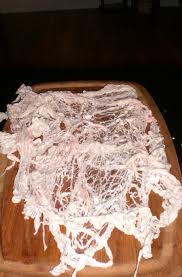
Caul fat is an inner organ lining the best of which comes from a pig. It is not greasy or smelly. In a ten pound box for example it will be squished together in a mass. Soak in a pan of water and start to separate the sheets. Lift a large sheet to a cutting board, and using a paring knife or scissors, cut 6 inch squares. (I pack what I don't use in small freezer bags). It won't be neat. It doesn't have to be. You can place a couple ounces of stuffing in the center, press to from a disk and fold the caul over. You can spread filling, tube like, across the caul and roll it like a frank. Fry over medium heat. The caul will melt away or leave just a trace of gorgeous netting. Once you have caul in your system you will discover a variety of uses. Here are pics of the ultimate chicken loaf.

Monday, August 2, 2010

Tomatoes

Tis the season.

Tomatoes are in and I want to help to keep things simple. A good first principle is that canned tomatoes are for cooking and fresh tomatoes are to be eaten fresh. Most of us will simply cut or slice a fresh tomato and add it to a salad or sandwich. Here is a preparation that takes longer to write about then perform and will significantly improve your summer tomato pleasure.


Filleting a tomato. The pics are self explanatory. Here are some essentials. Just barely score the flesh. Immerse in boiling water for no more than a minute (you will notice the skin start to curl).


The point is not to cook the tomato. Plunge in a bowl of icy water. Remove center core. Peel.


Cut from the top to the bottom of the tomato at the point where the flesh is thickest. Err on the side of thicker. You can always remove excess with your fingers. Sometimes you will create a quarter piece or often the whole will remain intact.


These fillets are obviously dryer and thus better on bread, lack uggies which freak most kids and some adults, and can also be sliced and or diced for a variety of uses. Your salsa will improve at once.


Collect the uggies in a sieve and press and strain them for juice.

Here is a fabulous recipe: Under cook 1/2 pound of pasta by a minute. Save a half cup of cooking water. Heat retained 1/2 cup juice in saute pan, add pasta, swirl in hot water as needed to moisten, stir till absorbed (about a minute), turn out. Top with sliced fillets of tomato, oil, some shredded basil, a crack of black pepper or red flakes, a sprinkle of salt, serve 4.

A side dish: Roma style tomatoes are grown because they have thick flesh, a high meat to juice ratio and thus are perfect for cooking. There is no reason to grow your own given the producers do a great job of the whole process, including canning.
San Marzano "style" tomatoes are Roma type and unless labeled DOP are grown here. A lot of time and energy has been spent tasting different canned tomatoes and conclusions are reached that might have you going out and spending 5 bucks a can in the belief that an Italian San Marzano is a better tomato. If we were eating them from the can (we don't) the expense might be warranted. Given that, at least, we will smash a garlic clove, add a pepper flake, and cook our tomatoes in olive oil for at least 20 minutes I defy anyone to distinguish the difference in the source of the tomato once cooked. More important is to notice the amount of sodium added to the can. It varies widely and you don't need the extra salt. You can always add your own.
Consider how you want your canned tomatoes to perform and purchase the appropriate style. Crushed, sometimes labeled "kitchen ready" are the simplest for a basic sauce. Italians buy jars of "passata" for their sauce which are essentially crushed tomatoes passed through a sieve. You might want diced to hold up a little texture for a cooked TEX/MEX salsa, and whole tomatoes can stew with a chicken and hold up.
Many eschew tomato paste as something less then authentic. Big mistake. For years I couldn't discern what it was that smelled so rich emanating from the back of checkered tablecloth "Ity" restaurants. I couldn't duplicate that aroma and I knew it was key to a successful sauce. Roberto Donna of Galileo in D.C. finally clued me in. Caramelize a couple of tablespoons of paste in oil with garlic till just lightly brown and then proceed to add tomatoes etc. Ah the love.

Wednesday, June 9, 2010

The Class of 2010


This blog space has intended to infill the gaps in the formal curriculum that you have just completed.
Prior posts have dealt with ancillary housing options, yet more shelter strategies, dorms as models of "real world" possibilities , economic survival options, and the ultimate in "sharing" programs.
I posted a short list of supplemental courses that I called "the art of crap detection" within this post.

All of the above pointed out that the most important lessons you were learning were informal; living in groups, being carless, the economies of scale, and that having access is more important than owning.
If you insist on leaving the "ideal world" you just inhabited, where you literally had it all, then consider the following my commencement address.

The decision you are going to make re. where to live is more important than your career choice. Typically, media stories will list cities that are attractive to recent grads and list the criteria supporting their choices. This story by Richard Florida goes so far as to cite that which is "important" to 20 somethings; bars, restaurants, and entertainment. (You are worth no more than your ability to consume). What everyone of the chosen cities have in common is that they are already what they are going to be. As a migrant to any one of them you are chasing a dream already realized by those who preceded you. You hope to become part of that which already exists. "I am moving to NYC cuz that's where the hipsters live". What you can't know, because your teachers like Richard Florida haven't a clue, is that you are about to participate in the "next biggest sucker syndrome". The person who is about to leave for someplace where she has a chance of actually carving out a living for herself, needs someone to whom she can sub-lease her too expensive 350 sq ft apartment. Don't be that person.

Its is going to take some backbone to resist the kind of marketing crap proffered by the merchants of cool so lets use some common sense.

The criteria that I would suggest you apply when considering where to live include: What is the total tax burden of the place you might live? What is the cost of auto; insurance, registration, and taxation? What are the rules regarding house sharing? What is the speed of the local ISP provider? What are the average utility costs? What is the fiscal status of the town, state in which you might reside? What is the cost to have a dental filling? What is the ratio of others to whom you might be attracted? Are there viable and independent media outlets? What are police practices regarding victimless crimes? Applying the above criteria would automatically rule out California.

The places that do qualify are invariably going to be the subject of bad news. You are going to hear about the abandoned, the broke and broken places that are the casualties of the economic collapse. This is exactly where I suggest you begin your quest. Only when a place is degraded enough does it become possible to have an opportunity for real growth. Consider that Georgetown, D.C., Harlem, NYC, The Mission, S.F., SoBe, and now the Design District in Miami, are examples of what were once neglected slums. Their reconstruction afforded their pioneers the opportunity for employment, new think, and identity. Now those very people couldn't afford to live in any one of these neighborhoods should they chose to move there today.

In a world where one can literally buy anything from anywhere and have it delivered, where the newest ideas are instantly available on the web, where affinity networks thrive, the pressure to be within the hip cores is unimportant.

The myth that there are "creative communities" belies the fact that the most significant wellsprings of art are often at a remove, giving the artist the space they need to create their own identities. Think Morgan Freeman, Clarksburg Ms., Dennis Hopper, Wilmington N.C., the crowd at Black Mountain, N.C. or Georgia O'Keeffe in Abiquiu, N.M.

More important than any of the shibboleths that are so indicative of mob think, absorb the most important principle you weren't taught during your college days, buy low! This is just as true in real estate as it is an adage in the stock market.

When a place has become cheap enough that you, or more importantly a group, can pool resources and actually gain a foothold, then you have a real opportunity. Exploit the social network you have developed, form a gang, and move somewhere. The wants and needs of that place and the opportunities will sort themselves out. This is exactly what happened in Hardwick Vt.

What a fabulous example of the success of people who went their own way. Other food oriented activities are located through Balle.

Get busy. There has rarely been more opportunity.

Wednesday, May 19, 2010

What to do, What to do?


anonymous asks; what to do, what to do?

An excerpt from a recent post of Les Leopold:
The ultimate insanity of our current moment is that the richest investors and the largest bankers in the world just crashed our system, got bailed out by taxpayers, grew even larger, and now are back to earning record profits and bonuses. They caused the biggest jobs crisis since the Great Depression and drove the entire global economy into a ditch–and they could do it again any minute. And now they’re telling us to tighten our belts and act more responsibly? from:

Les Leopold is the author of The Looting of America: How Wall Street’s Game of Fantasy Finance destroyed our Jobs, Pensions and Prosperity, and What We Can Do About It Chelsea Green Publishing, June 2009.


This from the NYT:
“This bailout wasn’t done to help the Greeks; it was done to help the French and German banks,” said Niall Ferguson, an economic historian at Harvard. “They’ve poured some water on the fire, but the fire has not gone out.”

"How to learn nothing from crisis"
is a must read article by Doug Henwood

Hero watch: Al Gore just added a forth estate to his collection, a 9 million dollar ocean view estate in Montecito Ca.

The above are just some of the latest in the continuing saga that is the documentation of our current crisis that spurs cries of; "what to do, what to do?".

What I am going to suggest we all do is get smarter. We have to understand how some of the fundamentals work so that we can either exploit them to our personal advantage or demand that they be reformed.

We have to learn to follow the money. When you read that the IMF is putting up a trillion euros to support the EU you have to understand that 25% of those monies are your dollars. Once again the beneficiary of your generosity is not the people, but the banks who hold the notes on the paper that blew up.

We have to know what really drives the markets and how to play them. The Fed is handing the banks profits, leveraged on our money. The "carry trade" is the trade that banks can employ that has them borrow our money at 3/4% (today's rate) and then, in a no risk trade, buy a 30 year treasury that yields 4.23 on 95% leverage.
Why would they lend to you and me and tie their money up when they can reverse this trade on a second's notice. Hedge funds don't get quite the same deal, but close.

Why does this matter to you and me? The most obvious answer is that in order to generate bank profits and make them whole again, we are expanding our debt. Second, and trickier, is those same hedge funds that brought us the last disaster, are leveraging into all manner of asset classes with cheap money. Thus the stock market, gold, oil, wheat markets, rise. Ride the pony if you dare. Here is the key proviso. When the Fed announces its first rate change, of policy, or worse an actual rate change, (the beginning of unwinding the carry trade) those of us holding any security must sell, that second. It is going to be a race to the door and it will precipitate the next crash. For a nation of people whose response to the last crash was not to open their quarterly financial reports this is asking a lot. You might want to get in front of the curve and be in cash, I-Bonds, TIPS, or a laddered portfolio of short term bonds.

For those who don't think they invest, and live within the confines of their cash flow, they must learn to recognize the impacts of a public policy that may harm them. Arizonians just voted for an increase in their sales tax. People in Maine are being asked to do the same. Here in Maine it is couched within a bill that reduces income taxes and is thus argued as neutral. Wrong! A sales tax, and God help us a VAT tax is regressive. Even the average citizen can shelter or delay some tax consequences on their income. 401's are not as sophisticated as the tax avoidance schemes of the rich but they help. But there is no escaping a sales tax. It is regressive. We are being asked to shoulder the burden of debt relief, not those who profited from the debt creation. This issue is high on the agenda of Europeans who have surfaced the fact that the rich are not paying taxes, and they are demanding justice. It is what they are demonstrating about.

All of the markets are indicating there is no risk of inflation. Why would you invest money in a 30 year treasury at 4+% if interest rates were going to rise? The principle on that investment will disappear. Trust the markets? Skip three paragraphs.

If we do enter an era of inflation, then you are going to have to learn an entire new skill set. An early trial balloon was sent up in California with the printing of scrip as a cash substitute and it didn't work. It did work in Argentina. Of course they were smarter about how they designed the system and paid a premium to holders of their funny money. Argentina is but one example of how a citizenry acted to protect itself. Those with money moved it off shore and into other nations currency. The same is happening in Europe today. The flow of euros to dollars is one of the factors keeping our interest rates low. (Fear that the Chinese will devalue the Renminbi keeps it from becoming an international reserve currency).

Another survival skill is the ability to index. Persons holding or dealing in any commodity are creating indexes to hedge the value of their commodity against devaluations. Iron ore futures are just the latest. When Argentines demanded to get paid daily for their labor and then exchanged their wages into another currency or bought a commodity they needed with that money, they were effectively hedging the costs of those commodities. No one wants to hold anything being devalued.

The lesson to learn is not to enter into long term contracts that fix your remuneration without effective, unconditional COLA adjustments built in. And you must demand independent third party regulators to determine the actual rate of inflation, be you a Social Security beneficiary, teacher, cop, WalMart employee, or seemingly secure IT worker.

It may be time to consider tax boycotts. Counties are considering boycotting state revenues, while real estate tax boycotts are spreading. The key to any such activity is to appreciate the need for solidarity. When it finally becomes clear that the persons getting shafted by this kleptocracy are us, then we may find we have more in common with the disenfranchised than we could imagine. When showdowninamerica.org gets their act together to identify the bankers, and protest their actions, it is not enough for us to sit in front of the TV and murmur or write a check. If we are really concerned about what to do we have to begin to join those coalitions we can tolerate and actually get in line.

Learn a new language set. Come to terms with "walkaway, bankrupt, boycott, self interest, tax avoidance, yuan".

"Yes Magazine" has been promoting a set of alternative behaviors. Peruse their splash page and determine where and how you might find ways to act to resolve this morass.

Friday, April 30, 2010

Two Views


Robert Irwin, the west coast artist most famous for his designs for the Central Garden at the Getty, said in an interview (Robert Irwin, "The State of the Real, Part 1," conversation with Jan Butterfield, Arts 46, no. 10 (June 1972), p. 48.) that he felt as if he was straddling a mountain; one leg placed him in "now time", the other in "real time." An example of what that meant to Irwin was the controversy that exploded when he "finished" the build out of the garden in 1997 and it was opened to the public. The public howled at what appeared to be the absence of plants, the lack of green, the barrenness of the landscape in "now time". Irwin had allowed for the garden to grow, to fill in, in the fullness of "real time", and now of course it is appreciated as one of the great gardens of the world.

We are burdened by two great calamities occurring in tandem. The links between the environmental and economic crisis are obvious when we have a "now time" event like the gulf oil spill threatening the shore line, and what are surely going to be the economic consequences of slowing down off-shore drilling.

What hinders resolution of either of the "real time" crisis, the profound problems of the environment or the world's economy, is the fact that the problems are even harder to imagine then Irwin's garden. It is hard for the average citizen to imagine the consequences of his/her acts. Even harder is imagining how invisible co2 emissions are warming the planet. The images that reinforce an "Inconvenient Truth" are either too removed; impacts are 50-100 years off, too remote; Greenland, or too special; polar bears, to have any profound impact on the way we live.

There is the attendant problem of denial when the implications are that one must change his or her behavior, exacerbated by "deniers" who supply an alternative reality. I learned not to jump to any quick conclusions about who those deniers might be. When I moved to Maine on a grant to work within the University of Southern Maine, I was asked from time to time to speak to groups of students. In every case I was forewarned NOT to be the bearer of bad news. Their faculty felt that the students couldn't take a nightmare scenario of environmental change.

We are learning that the effects of the economic crisis are more immediate. As troubling as the nightly "now time" news is, limited though it may be, a daily dose of evidence of job losses, foreclosures, and the failure of sovereign states, doesn't seem to have the impact on personal behavior that one might imagine. I believe that the same conspiracy of silence prevails among the chattering classes who fear that if the citizenry were aware of the depth of the "real time" problem, they would amplify the problem by say, saving, or scaling back their consumption. Their protest and rejection of the current regimes that brought them the end, if indeed it is the end, would be louder and uncontrollable. An example of a news organization at least trying to inform its public is evidenced by the BBC airing a story that all three of the parties running in the current election are underestimating how they would achieve fiscal responsibility by a factor of at least three. That is too say that each party's proposals to cut expenses and tax to raise revenues misses the mark by two thirds. Their burden of debt is not being addressed. The British will not have to face their real problems, yet.

If you are willing to dig a little deeper on matters of debt, toxic assets, and exposure you will find The International Monetary Fund is forecasting that global bank losses from the financial crisis will total $2.28 trillion, in 2010, a drop of $533 billion from an estimate made last October.


As this plays out on the world stage the NYT blog Economix asks if Europe can save itself? (answer no). By now you can see the similarities to those eco-issues that seem of another place, another time. They do not effect us.

And if we can't absorb the scale and meaning of the current crisis what of the potential of the next real crisis. This is even harder to imagine as the masters of the universe let us know in their congressional testimony. Included in that mind numbing exercise was a statement by one master that only the hedge fund guys know how it works, the "buy what the rating agencies endorse players" won't know. FYI that includes pension funds, trusts, endowments, states, the institutions we depend on to secure our lives.

An even larger example of what we can't get our heads around is the following: The WorldBank calculates that the world's GNP is roughly 60+ trillion dollars.

Now consider that the Bank for International Settlement, that keeps track of these things, calculates that the OTC Derivatives Market "Notional amounts of all types of OTC contracts rebounded somewhat to stand at $605 trillion at the end of June 2009, "

The value of these derivatives are ten times the world economy on any given day and they are not regulated. The potential for the next blow up is enormous. But I can't see it, I can't touch it, I still have a job, my house is still here, the cars run, the planes fly. Why worry? The nightly news reports the markets are up, consumer confidence is raising, home prices are stabilizing.

Sen. Alan Simpson got to the issue last night as he spoke about the new commission he co-chairs to deal with our national debt crisis:
"If we don't solve this problem, its not like we won't be here. We'll still be here. Its just that everything we know and love won't."

Monday, March 1, 2010

Social Studies


I wasn't prepared for my visit to Taos Pueblo. I had been schooled in all the proper cliches; cowboys and indians as a child, giving way to the tougher reality of Russell Means and the American Indian Movement as a radical younger man. I have experienced first hand the relative poverty of the Seminole in the swamps of the Everglades, and witnessed the growth of the casino culture that now permeates the tribes. I had my Native American education. While traveling in the Southwest I resisted the traditional expressions of Native culture, the "craft stores", the fry bread stands. It seemed all too scripted. I was more impressed with an installation in Santa Fe, "Art Without Reservation".


Here were new artists, drawing on their traditions but now clearly "modern" and integrated into mainstream culture.

I was talking to locals in Santa Fe, old friends, about this experience and they advised the trip to Taos. http://www.taospueblo.com/ I feared a Disney ride. "Stay away from the casino," they warned, the rest is the real deal. It's been occupied for 1000 years" For me the real deal was our guide, a 20 something college student on summer break and very secure in who he was. What he understood about the artists on display in Santa Fe was that their art was for us, the white guys with the money. They were about breaking through, crossing over, being respected on our terms. What he wanted Carrie and me to see, and touch, and taste was the core of his tradition. He wanted us to dip into Red Willow Creek, the stream that provides all the water for the Pueblo. He took us inside the jewelry studio of a wizened old craftsman, crafting the silver that the tribespeople wore. He feed us a "pickle" and sweet drink sold from a jug on a board spanned across two plaster buckets. "You are going to hear a ton of BS." he assured us "No one lives here anymore, everyone left for the creature comforts, that kind of thing." "Truth is people come and go. But they never leave the tribe." He showed how they powered everything they needed with propane. Told us they had been given exclusive rights to graze and harvest buffalo for a commercial meat market. He made sure we walked through the adobe buildings, "America's first condo", he joked, and then sped off in his pick-up at the end of his shift. It was complicated.

This from the wiki:
"The deep feeling of belonging to a community, summed up in their phrase, “we are in one nest,” has held the Taos people together. Both men and women are expected to offer their services or “community duties,” when needed. One should be cooperative and never allow their own desires to be destructive of the community’s interest. One of Taos’s strongest institutions is the family. Descent on both the father and the mother’s side of the family is equally recognized. Each primary family lives in a separate dwelling so when a couple gets married, they move to their own home. With relatives so near by, everyone is available to help care for the children. The elderly teach the young the values and traditions that have been handed down, which protects the integrity of the Taos culture."


It got more complicated when our friends suggested that we attend the annual corn dance in the Santo Domingo Pueblo. We were cautioned to appreciate the fact that what we were about to experience was not for our benefit. This was a centuries old tradition, not a pow-wow for consumption by gringos.

Hundreds of visitors sat on a berm on the edge of the plaza fronting the pueblo. Two elders walked carefully over the ground, I'm going to guess 4 acres, picking up small stones, anything that might impede the dancers. Then the sound, the roar of drums is heard. The drummers from one tribe enter the space. Then the babies appear. The children led by their elders, are adorned in tribal dress, some of their bodies are painted in adobe mud, and they are moving in the dance step they have mastered as young as three. Soon the plaza is filled with dancers, hundreds of family members, ranks and files, adorned with crowns, and bells, and rattles, and skins, all cued by the drums to move in an elaborate choreography, a thousand years in the making. Tribe yields the space to tribe (they have come from other pueblos) and the succession of dancers proceeds throughout the day. Suddenly it ends. We are not 4 feet from a row of dancers. A young man shape shifts before our eyes. He is back from the trance he has been in for the last hour and asks his buddy, "So I have to change and then we'll meet up, cool with you?"

The above is so not any piece of any curriculum I have been exposed to. This trip into the American reality is a must do for any and all of us and would be a critical "field trip" for me and my fellow students of any age. What is happening with Native American Studies to a great degree is concerned with the integration of the
Indian kids into the mainstream, or protecting their culture. Reforming the teaching of Thanksgiving seems to be a big issue.

What is not happening is the wider exposure to the life lessons to be learned by example, of the multigenerational "dance" and the meaning for the rest of us.

When a Native American professor out of Yale develops a revised curriculum unit in American History for implementation in a New Haven magnet school. I get interested.
It is troubling to say the least when you scan the curriculum at the school for which the course was prepared and find no evidence that it is present.

C.A. Bower, a professor of great influence for those of us concerned with environmental studies, has bemoaned the loss of tradition, in the name of neo-liberal transformative education.

The following is an excerpt from an article posted on his web site:

Title: Is Transformative Learning the Trojan Horse of Western Globalization?
Author: C. A. Bowers, Adjunct Professor of Environmental Studies, University of Oregon


It is important to acknowledge that the rise of liberal/Enlightenment ideas in the late
18th and 19th century led to basic improvements in the lives of the people of Western Europe who had been oppressed by feudal ideas and institutions—and by the authoritarian political systems that were equally resistant to change. The emphasis on the authority and power of critical reflection to overturn unjust traditions, the idea that change can lead to social progress, the view of the individual as having the power of self-determination, and the idea that new forms of knowledge will mitigate the ravages of the illness and the stultifying nature of work, led to important advances. But it also needs to be kept in mind that the widespread acceptance in the West of these ideas also coincided with the rise of the Industrial Revolution. And more importantly, these liberal ideas had no self-limiting principle. That is,the dominant motivation has been to achieve more and faster progress, more reliance on critical reflection (increasingly by experts promoting the development of new technologies and markets), more labor saving technologies (and now the elimination of the need for workers), newer drugs (and the control of the American Congress to ensure the growing dominance of the drug industry), and more self-determination—including self-determination in the construction of knowledge and values. The lack of any self-limiting principles, which made these liberal ideas even more problematic when they were merged with the market liberalism of John Locke, Adam Smith, and, later, Herbert Spencer, becomes especially evident when we consider the current drive to turn every aspect of the environmental and cultural commons into market opportunities—and to convert the entire world to a survival of the fittest business mentality.

What from the beginning of human history has been understood as the commons, and
which exists today in various state of viability in the diverse cultures of the world, is the only alternative to the way in which the West’s industrial culture is creating greater dependence upon Western style consumerism and technologies. The nature of the commons varies from culture to culture, and from bioregion to bioregion. What they have in common is that much of the culture’s symbolic patterns as well as the natural systems of the bioregion are available to the members of the community on a non-monetary basis. That is, they have not been enclosed—that is, privatized, commodified, monetized, incorporated into an industrial process, and so forth. This general account of the commons does not mean that all of the culturally diverse commons where entirely free of political systems that gave certain groups
special advantages—including the right to restrict the commons to the bare essentials for sustaining life, such as access to water, soil for growing small crops, animals, traditions of ceremonies, patterns of reciprocity, intergenerational knowledge of how to use medical plants, preparing food, and so forth. To make the point more directly, the commons should not be understood as always free of status systems and the unequal use of power. On the other hand, many of the cultural commons have been and still are characterized by local decision-making—an important phenomena that is now being undermined by the World Trade Organization and capitalistic forms of enclosure where decision about the use of the commons is now made by corporations and private owners who are unaffected by their decisions. The enclosure (privatization) of municipal water systems, as well as the corporate ownership and sale of supposedly “pure” bottled water, are examples of how the process of enclosing the commons also undermines local democracy.

What we experienced in Taos is a living example of an authentic commons in action. There are lessons to be learned there.

Wednesday, February 17, 2010

The Bell Tolls

It's a Start


I could hear it in his voice, the angst was palpable. My son called to tell me that he had just registered his son in kindergarden. He is in the midst of a book launch, otherwise happy as he could be. This brought him down. "Nothing has changed." "Same concrete block building, same drab colors, same florescent lighting, and that same authoritarian voice instructing us that we had to take this event seriously, brought it all back home." He and millions of others are beginning the process of handing their children off to the state. My grandson is about to be segregated from people not his age. He is about to enter the company of 20-30 other children and told to be quiet. He will be told to suppress his natural curiosity about his sexual identity. He will be fed horrible things at lunch. He will be introduced to the first phases of a curriculum guaranteed to dull and deaden the natural process of his acquisition of knowledge.

He is being conditioned to become a productive citizen, able to "compete" in the world's race for power and wealth. In the process he will be bullied, insulted, and graded. He will learn to compete against his fellow students. He will pass or fail.

What's the problem? We all went through it. We survived. We did OK. These arguments for the system are the best we can do. Or we can point to the failure of all previous attempts at reform. Or suggest there are no alternatives. Or, when alternatives do pop up i.e. home schooling or charter schools, we see to it that they are state certified. The issue isn't that some of us survive the system. The issue is what would we be if we grew in a truly supportive system that placed students needs first? Who might we have become? Super teachers write on this subject. Here is one you might want to consider.
One of the cruelest events in this mean season is the annual public humiliation of parents waiting, camping, suffering whatever it takes, to get their child placed in one or another magnet school. And for most of those who fail to get their child in the "better" school? They passively accept their fate as second class citizens. Tax paying citizens, paying for schools their children can't attend. An argument against the value of magnet schools was posted by a teacher in the NYT recently.


The more fundamental questions that are rarely asked or discussed would challenge the entire enterprise. Coming out of WW2 scholars questioned the role of public education in the formulation of mind sets that could create such horrors.
We might ask the same of our current reality. We could begin questioning a system of world organization that has half of the occupants of the planet living in poverty. I believe that it is just such an awareness that motivates most parents to try to secure an edge for their children in what they perceive of as a cruel world.

Times are tough and getting tougher for college students. As the protests begin it is evident that students have accepted the efficacy of their educational institutions. It is more access that they are demanding. Not alternatives.

When students struck Columbia U. in 1968, I and others offered an alternative in the form of what became the University of the Street. A qualified success it did however lead to the establishment of The Open University in America. A short term version of the same process, the matching of students and teachers and letting them run is taking place now. By the time persons reach their majority they can and do create alternatives. It is with the children that we are so frightened. What if we are wrong? Will this decrease their chances to get into Yale? How will they be socialized?


I inhaled Ivan Illich. This radical (ultimately defrocked) priest authored Deschooling Society in 1974. His ideas are summarized here.

He called for "convivial education". A system very similar to the processes of an open university available to everyone. Young and older. His ideas continue to be discussed. An excerpt from the above; "The importance of convivial institutions is recognized in the sustaining of community - but social capital, because it is also linked to economic advancement, can be easily co-opted in the service of non-convivial activities (as the involvement of the World Bank in promoting the notion may suggest)".

He is also criticized for not being more specific about how we might implement alternatives.

Imagine. A group of say 10 parents decides to pull up to 20 students from the system. These same parents advertise for a pair of "teachers" who are going to become the primary guides in this newly formed learning community. In today's employment environment it should be easy to find qualified and willing candidates. The parents raise 100K. The parents acquire access to space throughout their community. They pool their resources: computers, books, AV equipment, tools, work sites for situational learning, food, vehicles, Parents are asked to participate to the extent they are comfortable. One fear the parents are going to have is that couldn't agree on what the knowledge base for their children might look like. They must come up with a set of objectives that governs them all. They must seize control of this process. They must take responsibility. There is no way around it. When they assemble their working document then they contract with the guides. The group meets regularly. They fine tune. They grow. Now imagine thousands of similar groups. They have 6 months to get organized before they hand over their kids.

Tuesday, February 9, 2010

A House For All Seasons

Our shelter system thrives on instability. Developers, builders, real estate agents, mortgage brokers, and bankers profit when the market for shelter is in churn. For those too young to remember there was once a process called "block busting".

Move a black family into a stable white middle class neighborhood, excite fear that property values are going to be adversely affected, and watch the neighborhood change its complexion. The opportunity that arises for persons of less sophistication to now move up and out of the ghetto sets the stage for a sub-prime housing debacle. Lenders prey on people desperate to own a piece of the American dream.

The system requires demand. Natural disasters are pre-conditions for renewed housing demand. As are relaxed immigration standards for persons of means, or relocation programs on the part of employers. Nothing was as beneficial to the building industry as divorce. During the turbulent years in the later half of the 20th century new home formations generated by divorce drove the industry.

Looking to externalities to describe contributing factors of our housing crisis will not lessen the impact of cultural shifts regarding our shelter. In fact, when was the last time anyone referred to housing as shelter? We have commodified shelter. Housing is now an investment. The fact that at any given time a house is calculated as either a good or bad investment points up the cultural shift away from shelter as a necessity, to housing as something that is to be traded.

The idea of house as a tradable commodity is built into the modern system of shelter supply. We promote "starter" homes without giving a second thought to the implications of the process the buyer commits to once having "started".


As long as the industry could suggest that the buying and selling of housing was a good investment, then trading up was a positive social behavior. Up had many connotations. Up might mean bigger, showier, the trophy house. Up might mean our family is growing and we need a bigger house. Up might mean near to or within a neighborhood that has status. Here's a fun forum re. Beverly Hills as an example.

No matter what the motivation, the move occasions the loss of fundamental family values: The wrenching of the kids from school, the abandoning of friends, shifting of commerce from one set of stores to another, and most importantly the atomization of the family.

The re- release of the film Make Way for Tomorrow (1937) is heralded as contemporary in the VSL announcement:
With its rerelease on DVD (available 2/23), Make Way for Tomorrow has another chance to be appreciated. The film’s Depression-era plot couldn’t be more timely: An elderly couple must move in with their children after losing their home to the bank. Separated and out of place, these grandparents not only disrupt the lives of their children and grandchildren—they’re miserable themselves. http://www.veryshortlist.com/vsl/daily.cfm/review/1469/DVD/tomorrow-is-today/?tp
The reuniting of the family in the above scenario is portrayed as a negative.

Like so many facets of the new economy that have blown up, the housing bubble burst could be a precursor to a reexamined set of premises. What if we explored the millennium old tradition of multi-generational dwelling, not as a burden that one has to escape but rather a support network that can be trusted. I remember the first time I heard the phrase "home place". My auto mechanic in the Shenandoah Valley and I were becoming friendlier and he wanted to cement the relationship with a long pull of brew on the porch of his home place up in the hills. Five generations had been born and raised there and it was never to be sold. It served as a home base in tough times. Family could settle in and await the next opportunity without going homeless or uprooting.

Circumstances are creating similar situations for people who thought they had "outgrown" extended family. Boomerang adults are moving back in with mom and pop, children are assuming responsibility for the senior care of their parents, and grandparents are becoming day care providers. These are not negative practices. The key to the success of these activities is not to stigmatize them. Not to allow the media or the industrial housing barons to determine what is right for us. Some enlightened professionals can see the writing on the wall, but have yet to come up with solutions. We needn't wait for them.

I have addressed the possibilities of granny flats in this space.

That is but one form of housing modification that would work. It turns out that larger, higher end housing stock is suffering a slower recovery and is probably headed for steeper price adjustments. This could be the exact moment to pool resources and buy the homestead, a "forever house". The housing would have to be modified. Modifications to an overbuilt suburban McMansion might include child proofing, sound proofing, increasing accessibility, creating privacy zones, and reconfiguring common spaces to pool resources like computing power or entertainment centers.

I don't think the highest hurdle to such reconfigurations is physical. I think that a great many of us are victims of cool. We would rather die then live in a suburban setting. If we are going to create sustainable, stable futures for ourselves we are going to have to get smart about space, money, and a restored set of family values. Richard Florida isn't going to write a book suggesting creative types should live in a suburb, but the Coastal Conservation League may provide an example of context. They propose retrofitting existing suburbs into livable places. Theirs is but one example of planners trying to save what's left of the landscape by building up what already exists on the grid. Now its up to designers and builders to retrofit the individual house on that grid to make it livable.