Showing posts with label Educational models. Show all posts

Thursday, February 7, 2013

Divestment


Bill McKibben is heard to say that he is thrilled to see the "kids" on campuses all over the country taking on the divestiture challenge.


Here is the local press reporting on Sterling College divesting as a way to avert global warming. 
Following up on my last post I want to note what isn't being said to the students who are pushing for divestiture on their respective campuses.
Let's start with the most basic understanding of what a divestment entails. You sell the stock of company X out of your portfolio to another buyer. The net number of shares, or capital position of the underlying company doesn't change. So you haven't done a thing to halt global warming. You have done the least you can do, a symbolic gesture that may feel good, but as I have contended, actually saps the energy and responsibility away from actions that might actually make a difference. 

The professional journal The Chronicle dealt with the issue from the perspective that divestment will not have a negative impact on its member institutions' portfolio performance. 
A letter from a faculty member (music department) in response speaks to the morality of divestment regardless of portfolio performance. 
This august organ says nothing about the underlying issue; what to do about the reduction of our carbon footprint?

As I set forth in the previous blog, production is a by-product of demand. Want to do something about the burning of fossil fuels? Stop consuming them. If one were truly interested in a mass movement that might have an impact, rather than divest (a meaningless gesture) from a consumption group, say auto manufacturers, an organizer would move to reduce sales of the vehicles of consumption. But then that organizer would run headlong into all the vested interests arguing that the economy was saved by the bailout of the auto industry. We are up against the double bind again. 
It gets worse. The colleges that have signed on to divestiture are small and remote and totally dependent on autos and trucks, burning fossil fuels, to get their students hither and yon. If their faculties were alert to the implications of divestment a grand discussion could be joined that would make visible this hypocrisy and the greater problematic (classist and racist) issues of stopping "development" in other places. Maybe some sensitivity could be stimulated for those persons who live in other remote areas of this country, or who are desperately trying to enter the 21st century as developing countries. 

Organizers of divestment movements like to point out the success of actions against South Africa in the attempt to undo apartheid. There was a commonly held agreement that apartheid was an evil practice and by withholding economic activity one could sway the government to alter its behavior. There is no parallel in selling one's stock in a fossil fuel producing firm. 

What is required, and what is feasible, is the changing of the basic patterns of consumption, of these students in particular. When I arrived in Maine to try to develop a model of how a university might create incentives for students to get out of their cars, I was informed that car pooling just wasn't part of the culture of Mainers. We couldn't even get bike sharing started without a fight. When we were students car sharing was normal. Ride to/from boards were posted in student unions all over the country to assist moving students home for the holidays or weekends. No more. On a larger scale students could and should be organized to demand the alternatives be developed. But, they should be schooled in what is practical and affordable. They should be schooled in the real costs of burning fossil fuels (throughputs) so that they can make rationale judgements about what they are willing to spend to secure their energy future. And they should never ask others to do without something they are unwilling to sacrifice for themselves.

Tuesday, September 6, 2011

Rotten to the Core


The school year has begun. It reflects the triumph of the "reactors" to the cultural changes that were behaviors of the actors of the 60's. Nowhere is their impact more keenly seen than in the new "national core standards of education" that is being adopted around the country.


The curriculum doesn't reflect any accommodation to the real world implications of the universal accessibility of knowledge, cross border economic activity, environmental degradation, or full earth pressures on the capacity of the earth to sustain its ever rising population. It is as if the last 50 years of educational progress never happened. This curriculum guide would look familiar to any educator from the 60s. There is lip service paid to some diversity in the suggested readings that teachers might pull from, but the thrust, tone and temper of the core curriculum is red state, Kansas, conservative. It is a finger up the ass of the reformers who would have our children integrated, capable of speaking to others in their native tongue, aware of the moral and ethical responsibilities of being a passenger on spaceship earth, and sensitive to the gender, race, ethnicity, age, class, and specific history of their fellow human beings. It is a testimony to the persistence and perseverance of those for whom change is a threat. It is the perpetuation of the school as factory, with universal evaluations, and the denial of individuation of students in the process. It is a political and contemptuous document. It is a perfect representation of professionals caving to the mean spirits of the reactors.


Though we are constantly told that reactors hate the elite liberal establishment and that it is the dominance of those persons who have stolen their country from them, that provokes their ire. I believe the objects of the reactors' contempt are not so far afield; They hate their own. While they dwell in/on the over written, over studied, over analyzed, fin de siecle, what is most galling to them is that their own children continue to turn on them with a fury. (Footloose 2 is about to be released). I thought that was history you say. Can't we get past those persistence analyses of the culture wars? The fact is that those wars have never ended. Their children elected O'bama. Their parents reference back to Reagan, harboring a desire for a big daddy that will spray hose the protestors, and reaffirm the cowboy tradition,


The turn against status quo happens in waves. That is why it is so persistent. Whereas coastal inhabitants of big integrated cities were the hot beds of the breakout of counter culture, it is only recently that, let's find the appropriate symbol, earrings started to be worn by local postmen in Salina, or full sleeve tats are seen on the arms of the short order cooks in Wichita.

In 2004 Thomas Frank, What's The Matter With Kansas, got real smart and historical about the process of the conservatives effectively taking over a group of people who should, by all rights, loath them. And that was before the Tea Party, before Obama, before the financial crash that threatens the very ground they plow on. Now they are only more entrenched.


Liberals fear these people. They fear the push back. They accommodate them despite all the evidence that they have been rendered ineffectual. They tolerate their rights to have hair brained opinions, their pro any business activity, their anti science, anti compassion, anti democratic, venomous rhetoric. The Core Standards is evidence of the depth of the fear of alienating these radicals.


No one I speak to has read the Core Standards. "They" take the time to write them. We should take the time to read them. Here are written the specifics of how it is that we will condemn our children to a life of missed opportunity. It has been so refined to conform to the 'taste" of the reactors, certified by the professionals who vetted it, and passed the political stress test, that it insures our students will have no tools to effectively negotiate their world.


The debate re. the effectiveness of this curriculum, see comments in the NYT is joined by those persons on the front line of the impacts of these dicta. Teachers argue with administrators re. whether teachers will be hand-cuffed by these standards and how they will be evaluated.

No one challenges the content of the curriculum. The chapters on English language skills and how through them students will also touch on social studies through readings in non fiction are so moribund as to be hilarious. Take for example the reiteration of a curriculum component I suffered through all those years ago. "The ability to write logical arguments based on substantive claims, sound reasoning, and relevant evidence is a cornerstone of the writing standards, with opinion writing—a basic form of argument—extending down into the earliest grades."

Now I imagine two alternatives to this standard: 1. Crap detection. By subjecting students from the earliest years to media hype, exploitation, hyperbole, exaggeration, outright lies, false claims, bad data, and marketing ploys, students will learn how to recognize these propagandistic means of mind shaping and develop the tools to resist them, They will also study political speeches, legal arguments, and debate techniques that are designed to obfuscate the truth. or, conversely 2. they will study the techniques of the big lie, the exaggeration, the creation of bad data, the fallacious argument, and marketing technique. They will make them their own.


Of course reactors are victims of and perpetuators of the big lie so when you peruse the non prescriptive but suggestive reading list you see the continued veneration of the founding fathers, the Bard, and the mundane. So Twain is represented by Tom Sawyer not Huck and Orwell's reading suggestion is Politics and the English Language not How the Poor Die

A Prof at Va. Tech looked at the "standards of learning" from 2009 and formed the following opinion re. how they are so much self serving propaganda.


There are alternatives, effective parents are going to have to create them. All of the following examples fall neatly into a world of ideas that so gall the reactors.

Bucky Fuller used to give a talk to that began with his blowing up a balloon on which was printed a globe. He tossed it among the children and asked them to find the spot where they were from. He grounded them on earth, and suggested that they work from the grand to the particular when learning their sense of place. It begins an understanding of where am I and shifts away from the parochialism of state citizenship. Having established that we live on a water planet we might build an aquarium in every learning environment and in the process create a microcosm that requires sensitivity to the delicate nature of eco-balance. By placing learners in a position of care re. the health and welfare of this micro environment we establish a baseline of human responsibility. We drill down into this environment and allow students to examine the structural nature of this/their world. As they examine the building blocks of life forms they are introduced to the concept of their place in the continuum of life. As the living elements in their aquarium have adapted so too have the creatures on the earth and the myriad of those forms are identified at least in the largest categorical forms. Moving through an overview of the evolutionary process they come to terms with the "family of man". We have begun the examination of "who I am". As we have come to appreciate the variety of adaptation of the creatures in our pool, we can begin to appreciate the same adaptive practices on earth. We examine the flexibility and mutability of creatures in their struggle to survive. We observe the art and culture that are the building blocks of adaptation. We realize that individuals live within the context and frameworks of groups. Within those groups there is shared responsibility and by sharing, the greater good for all is obtained.


You can see how this evolves. It is but one alternative to the linear, hind-bound, curriculum of yesterday. I wouldn't even broach english as a subject.. I would teach form, style, and manner in the context of substantive content.


I would introduce "foreign" language at pre-school, and again, as I have said in this blog, I would pull my kids out of school, form a cluster of up to 10 others, hire a teacher set, and turn them loose.


Monday, June 13, 2011

Commence

This June every student will participate in some form of graduation or more precisely gradation; to arrange in grades or gradations; establish gradation in. That's what our students have been doing for however many years they have joined in the process. They have allowed themselves to be gradated in carefully calibrated beakers. They have absorbed the most critical component of their respective curricula, they have come together and agreed to participate in the ranking game.
The curriculum itself has always been perceived as but a means to the end. The practice of the curriculum contained little of inherent value but was set up as a way and means of developing obedience and conformity. The fact that battles are fought over what constitutes a core curriculum reveals how arbitrary it really is. One side wins, gender studies or evolution theory is thrown out. Another side wins and Thackeray is exchanged for Naguib Mahfouz.
Students have moved through a nationally agreed upon process whereby it will be determined who amongst them will win the prizes that were held out as the values they have worked so hard for. Or not.

Some of those prizes are now being re-evaluated:
The next, more exclusive level of on-going formal education is being examined from a cost/benefit perspective.
At a post graduation, material level, a single family house for example, once considered to be the great storehouse of wealth (the estate) has lost its primacy in the hierarchy of "things". A broad portfolio of blue chip equities has taken a hit as has prospect of retirement in comfort. Some of the more mundane prizes, the gourmet meal, the high priced wine, the flashy car are like pins in the lane, about to be knocked off as their underlying value is challenged, or realized to be unsustainable, going the way of the lynx wrap.
At a corporate level (the employer of the winners), the ability to maintain advantage is being challenged by a whole new set of players. The prospects are not good that business as usual, the curriculum in practice, will sustain them.
At the governmental level, the power centers from which the corporation and the prize winning individuals are protected, the process of sustaining themselves seems to be cracking as the numbers of losers and their ability to coordinate swell.

Not surprisingly, given the ends are being questioned, the means are being scrutinized. It is being observed that students are being stressed out in the "Race To Nowhere" as the documentary film of that name points out. Don't expect too much from this effort. The "deal" that has been struck by the parents who screen and then discuss this film is that; I won't make the changes by myself. Only if we all agree to stop the resume inflation, cheating, achievement by any means possible, will I relent. I am not going to put my child at a competitive disadvantage by doing the right thing.

No one questions the lesson plans. More math, more science = better rocketry, more fire power, more stealth, better spying technology, these are the core elements we need to "win the future". No world language, no geo-political reality, no deep cultural studies of others, no family practice, no diet and nutrition. We can't afford art, and physical exercise is reserved for the combatants. No peace studies, no alternatives to violence, and no alternative to so-called free market economics.

Paul stopped by to check and tune up the furnace system he installed two years ago. He came up from the basement slightly ashen. "Have you been aware of a bang when the furnace cycled on?" he asked. Yes, we thought it was normal. "Well it isn't normal. What has happened is that there is a leak at the gas fitting and when the ignition comes on it burns off that excess gas. I have to replace the ignitor." What he didn't say and that I could surmise was left un-repaired the house and its contents were at risk. Paul doesn't have an advanced degree. Paul inherited the business from his dad. Paul's value to me and the society is immeasurable.

Thursday, March 10, 2011

Fat Tuesday

In the run up to Mardi Gras the urge for cajun cooking gets extreme. I was craving red beans and rice. You don't make small quantities of red beans at home. Good beans require you add at least one smoked ham hock to the pot. That means you gonna cook up a mess. This is a good example of deferring to an institution to do the cooking unless you intend to feed a mob or eat red beans for a week. nola.com ran a column on the places to get the best red beans and rice in New Orleans. Popeyes made the top 5. It wasn't the first time someone had recommended them. So Monday, red bean day, we drove the 25 miles to the only Popeyes in the state of Maine. What was I thinking? What are the so-called experts thinking? For those who don't know, one is handed a covered foam cup in which two tablespoons of rice are placed over a red paste of something. I'll stop there.

By the time any chain opens the third store, I don't care what the product, it is not going to warrant the drive. Subway proudly announces it has more units than MickyD. That doesn't say a thing about the quality of the sandwich. And none can compare with the hands on, one off, of say this piece of work at the Num Pang Sandwich Shop.
To say that bigger is not better is to state the obvious. Why then the insatiable urge to grow? In business terms the enterprise trades off quality for profit. In the public sphere the world is far more complex. You will concur, after you read this, that it is obvious to say that the entrepreneurial spirit invades the bureaucracy. Unless you experience it however, you can't appreciate the scale of the behavior. Government agency heads read their budget projections with sweating palms. They fear a cut-back, celebrate an increase, and these numbers have little to do with the delivery of the service they are charged to perform. Bigger is just better. They sit at the cabinet table in ranked order of whose agency is bigger, how large the budget, how huge the staff. They often fund projects with an eye to "continuation of effort", the opportunity to continue the project, not with successful completion. It is how we got where we are.

The behavior of bureaucrats at the local level is no less insidious. Given that the school allocation is always the largest item in any municipal budget it is no wonder that here is where the heat is rising as we contemplate cutbacks. Teachers are front and center of this discussion; fire them, cut their pensions, curtail their ability to bargain. Very little attention is paid to a real budget buster, the building program. School buildings are mortgaged and thus amortized over the life of the instrument. A thirty year building bond appears on the budget in increments. It doesn't feel, or look so bad. Fact is, it is an enormous contributor to your total tax bill. And that bill is brought to you by the same gangsters that brought you the end of the world as you know it.

When we were in Virginia we lived through this way up close and personal. The arguments for shutting down the neighborhood school that had worked well for the previous 70 some years came down to consolidation is a good thing, it will improve the delivery of services because the new bigger school can deliver more, fill in the blanks. There was no empirical evidence to support those claims. It was accepted, not without a fight. The protesters lost. Ground was acquired from a friend of the board at a price that set a record for a land sale at that time. Architects and builders went at it and a shiny new school rose in a farm field and the old time school was abandoned.
Closer to home the same process has just repeated itself. This is what we lost:
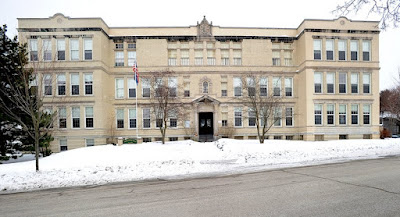

After the memorial for the old school, the weeping grads that came back to praise it, and testify as to how they will miss it, blithely accepted the new reality.
This is what we got. Plus a bill for 14+ million dollars.


NEW SCHOOL’S FEATURES
• A prominent principal’s office with large windows overlooking the front entrance, which will be the only public entrance. It will have a closed vestibule with a key-card system for staff members and a two-way communication window to screen visitors.
• Classrooms clustered around four open, carpeted areas with skylights, where teachers can work with students one-on-one or in small groups. Classrooms are in two, two-story wings, with lower grades at ground level.
• Several single-user bathrooms in each classroom wing, meant to increase privacy, decrease the distance from classrooms and reduce the potential for students to misbehave in “gang” bathrooms.
• Various energy-saving and environmentally friendly features, including a roof drainage system planted with greenery, solar-powered hot water and a dual-fired heating system that will allow the school to burn oil or gas, whichever is cheaper.
• A teachers’ lounge and workroom – something Clifford lacks – and a health clinic with a bathroom that’s larger than the nurse’s room at Clifford.

The following is excerpted from an article In The Portland Press Herald:

A tour of the school reveals more features.Each hallway is lined with an occasional grooved tile that reflects the theme of the wing. For instance, the ocean wing has tiles with embedded fish scale patterns.Jenifer Richard, an interior designer from WBRC Architects, said children enjoy running their hands along walls, which is why each wing has special hand tiles.Richard said the other wings' themes are agriculture, forest and mountains.The floors also reflect wing themes. The Ocean Wing floor tiles resemble rippling water. Forest wing floors look like bark with spots of leaves on them.
Another article re the school budget process in rural Maine, contained the following:

If the transition goes smoothly, it will bode well for future building projects, school officials said. They're working on plans to replace or renovate several of Portland's 10 elementary schools, depending on availability of state funding.
They're also preparing to tackle the controversial subject of redistricting within the next few years, which could force residents to reconsider their definition of neighborhood schools.
"We need to communicate with parents and students to make sure this transition goes well," said Jaimey Caron, chairman of the School Committee's facilities subcommittee.
The article provoked the "humble farmer" to write the following letter to the editor:

Robert Karl Skoglund 02/28/2011 06:24 AM
Fifty or so years ago the people in St. George, Maine voted to go into a school administrative district with Thomaston. This is like sending a weekly check to a man who lives with your wife and raises your children.
You might well ask how intelligent Maine people could be suckered into such a con game.
The basic premise is something for nothing. It is absolutely impossible to fleece people unless they are convinced that they can get something for nothing.
Here’s how the school con works.
You, the taxpayer in Maine, give the State and Federal Government your tax dollars. Then, if you do exactly what the government tells you to do, they will give back to your school some of your money.
You smile and feel pretty good that you got all that free money from the government.
Here’s how the school con started.
Building contractors convince top officials in the education business that it’s cheaper to educate children in large central schools. For years Maine people have raised chickens in large, centrally located henhouses. The more chickens you can jam into your henhouse, the more money you can make. The grain bin is right by the door. It’s efficient. So folks very quickly bought the argument that it would be cheaper to educate kids in consolidated schools.
It was a good argument, but there was one hitch. No chicken farmer in his right mind would vote to spend the amount of money it was going to take to build those expensive gyms and playing fields. Because most anyone would ask, “What’s gymnasiums and football fields got to do with education?”
But the wonderful part about the whole deal was that the towns wouldn’t have to pay. The state was going to pick up the tab. So even the most frugal chicken farmer jumped right in. He was suckered, you see, with the promise of something for nothing.
His town sent his tax dollars to Augusta to pay for all the schools in Maine. But there wasn’t enough money to build and run schools in all the towns. Who would believe it?

Maine people who were very frugal, Maine people who would never in their right minds vote to replace their present excellent local school, voted to go into school administrative districts. They might attend church in a building that was built in 1850, but thought that their children couldn’t be properly educated unless it they were housed in a shiny new building. And they wanted to get their share of that money out of that big money barrel in Augusta before their sticky fingered neighbors in the next county got it.
It was cleverly done, wasn’t it? But like any con game, it had to work because most taxpayers can be convinced that you can get something for nothing. Forty years ago we had communities in Maine. When you lose your school, you lose your community. And when you farm out your child’s education by getting into a school administrative district that will “save you money” don’t be surprised to discover that you might be paying for that education twice.

The humble Farmer

Monday, October 4, 2010

Waiting for Supermen


Screeners of the new film documentary, "Waiting for Superman" have been told to bring towels. As if the audience had no idea of the state of public education in America. It is true that there are those who live at such a remove from troubled school districts that they may have never actually been in a central city school, those living in rural Montana for example, but the rest of us have either fled them for cause (Obama fesses up) or their cable has been cut for the last 50 years. I spoke on this blog in February to some of the issues.

Let's allow the possibility that what these kids haven't been getting is absolutely known to all of us and we have chosen to do nothing about it. People within the Washington D.C. metro area who are old enough will remember "massive resistance" and those that don't ought to read this link. It is a perfect example of a very public expression of an area of the country saying no to integration because they knew that children of color were under educated in sub par schools and whites were not going to be forced into those schools. They didn't pretend they didn't know what was going on. They had supported keeping those kids in their place. And white kids were not going to that place.

But let's get some perspective here. To make the leap from; we are keeping the black and brown folk down, to, we have a broken system. is the height of public manipulation. Let's get some facts on the table before we get caught up in the great public diversion away from our other problems:
There is not one vacant seat in any of the colleges and universities in America. Evidence includes a discussion group that identifies the acceptance rate at leading universities and includes a discussion of Cal Tech. Cal Tech applicants come from California public schools.
There are millions of highly qualified, educated persons, standing in unemployment lines.
The economic success of the BRICs is not because their schools are better than ours. They have a work force that will work for less.
We are not losing our ability to compete in the world because some inner city kid is being trampled.

Another set of behaviors, educational outcomes, is more interesting to me:
The people who implement all the current forms of "massive or passive resistance" are highly educated.
The persons who designed and built the killer drone unmanned aircraft are all Ph.D. engineers.
The persons who designed and implemented the ad campaign for "Sugar Smacks" were all college grads.
Supreme Court Justices Roberts and Kennedy to name but two, are law school grads who voted to extend to corporations the rights of individuals.
All of the bankers and insurance company executives that have brought the world as we knew it to an end are business school graduates.
The Unabomber is a Harvard Graduate.
The geniuses that destroyed the American auto industry were all graduate engineers.
The persons who are asking for your tax dollars to support a manned mission to Mars, to sustain the thread of life that will expire on Earth, are all graduates of schools of higher education.
The generals that brought you Vietnam, Somalia, Iraq, and Afghanistan are all graduates of West Point.
The software engineers that gave you the ability to reduce human existence to the banality of tweets are all highly educated.

After the current round of the education debate is over, refueled by the guilt instilled by the latest film documentary on the subject, I am going to be asked to divert my money away from some form of self indulgence to support the improvement of the educational circumstances of under-privileged kids in city school systems. I will "resist". What I am more than ready to do is give up meat to challenge the efficacy of American higher education. I want my money to be used to create a set of objectives for our graduates that includes ethics, morals, and a sense of responsibility to our fellow human beings on this planet. Moral college graduates will not tolerate the destruction of others. They will improve education.

Monday, July 12, 2010

World of Work

You know a problem is getting "serious" when the NYT does a feature on its front page, American Dream Is Elusive for New Generation. The story is a profile of the agonies of 2008 Colgate grad Scott Nicholson, the unemployed millennium gen, solid son of the solidly middle class. The latest example of an economy gone bad. Comments attached to the piece
and the letters to the editor that followed, give him and his family a pretty swift ass kickin. He appears self indulgent and his family enable him.

No one in this story, or the related comments, challenges any of the basic premises underlying Scott's predicament. He must be thankful for any job offer. He must get out of the house. He might move to Europe where the job possibilities might be better. Scott must get better at becoming a wage slave to a system that doesn't need or want him.

During the same week Alternet picked up a story from Psychotherapy Networker / By Mary Sykes Wylie, appropriately titled: Has the American Dream Become our Nightmare?

That title could be thought to be the first of a set of fundamental questions that needs to be asked and answered. Other questions that we all have to ask include: How might Scott spend his days in ways that don't make the rest of our lives materially worse? What is it that we need, if anything, that Scott might help us acquire? How might Scott evaluate what he really needs? What are Scott's lifetime ambitions; where does he want to be, with whom, and how many of his ambitions involve money? Obviously none of the answers to these questions or even how to pose them were part of Scott's education.

Colgate senses the angst in their graduates. Their response in justifying $54.000 in annual costs to attend include assisting the host community by buying up buildings and placing University offices within them, publishing studies that demonstrate the Colgate grads do better salary-wise then many peers, and bringing back Alumna with a job to share their experiences as a demonstration of "you too can do it." In this case the alum is a vp at MTV.

What Colgate might do: They could rethink their curriculum in terms of 21st century reality. They could sponsor teach-ins on the most critical issues of the day. They could assist their students in conceiving of and moving into a world that was sustainable, ethical, and elegant. They could strengthen their career counseling department. To be effective they have to anticipate the world their graduates are going to enter. The university could provide transitional housing for grads while they determined their next moves. They could incubate entrepreneurial alternatives to traditional job searches. The university might provide goods and services: health care, senior activities, child care, food service, art activities, to their neighbors, enriching the entire community. Any number of grads might be part of the delivery mechanism. Most importantly the university is going to have to become the well spring of alternatives to a system that is so fundamentally broken.

The best example of what is required is exemplified by the award winning documentary film, TEE Shirt Travels, embedded here.

Filmed in Zambia, this film explores the unintended consequences of western do-gooders shipping second hand clothing to a nation in "need". In the process we wiped out their indigenous textile industry and created a nation of re-sellers. It is heartbreaking. And just when you think you can't stand it any more you have the testimony of the stated dream of an unbelievably hard working Zambian young man. His ambition is to have a car. We have shortened the distance between the continents. We have shortened the timeline of civilization.

Monday, June 28, 2010

Field Studies

The garden is starting to yield. Parsley, basil, mint tops, and early lettuce have all been picked and the first lesson of gardening is in hand; you must be a brutal realist.


Pruning and Thinning. Salad greens are topped, flowers are dead headed, and herbs are pinched back every day. If you harvest early and often you increase your yield. So by eating more mint, I get more mint?! Yes. You delay bolting and the plant going to seed. It is counter-intuitive.
When sowing seeds there are two major schools: One lays out rows, drills holes for individual seeds and assumes they will all be vital. The other plants the entire seed packet, waits to see which seeds produce sprouts and then thins the row to the proper spacing. You lose half or more of your sprouts. You get more yield.
When growing fruit trees you learn to prune back, to thin, in order to increase quantity and quality of yield. You mean if I knock or pick off every other apricot on that tree I will get more apricots?! Oh yes, and fuller, more flavorful fruit and a tree that can bear the weight.
Dead heading, (removing drooping flowers and their seed stems), your petunia, pansy, geranium plants will increase their blooms and their blooming cycle.


All of the above require intense hand labor. Determine how much you want to work and plan the size of your garden accordingly. End of lesson one.


You will learn to kill. Is it killing if I don't see my prey? Carrie, a near Jainist, will turn her fingers green with the bodies of the dead aphids she strips from her roses.
Pest control often evolves in the following cycle: Squirrels are cute, they are part of the scheme of things, it's fun to have them in the garden. Lets get a HavaHart and move the critters out. Does the city allow air guns within its borders.

Gardening will turn your world view upside down. No matter the scale, be it a single pot or a plot, you will never bemoan another rain shower. You will monitor frost warnings. You will learn to be sensitive to direction of and intensity of sunshine. You will become attuned to the vagaries of nature. There are going to be far more complications to this process than you imagined. The easy acceptance of the concept "organic" is going to be challenged. You will understand failure in new and important ways. You are not in control of your environment despite your best efforts. When all else is failing you will spray with chemicals, or, you will retire from the field. You will come to understand that every crop you plant is the result of genetic modification. The horror stories and the resulting rampant fear of GMO's may or may not be warranted. The patenting of our food supply is terrifying.

A garden is never "vital" for our sustenance, that is our privilege. It can however become a classroom for understanding the larger forces at work in the world. That is the promise of school based garden curriculum elements. They stop way short of the kind of truth telling that our citizens need to learn to appreciate where their food comes from. You get no second chance in a crop field. It is not a classroom. End of lesson two.


Promises of the learning power of the garden that won't be fulfilled include your understanding of your connection to the earth. At best you have a patch, a highly controlled and defined space. It is no more a microcosm of the earth than a goldfish bowl is to the sea. Growing a successful tomato in no way informs your understand of how you are going to sustain yourself in November. Gardens are not agriculture and large scale gardens, despite our desire to believe, are not capable of feeding us. Some of us may be able to afford $40 a pound greens but in the scheme of things that is irrelevant. Thomas Jefferson had most of it right at Monticello and in his design of The University, The Academical Village. From the time of Plato's "groves of academe," gardens have been linked to the contemplative and scholarly life as well. Jefferson described the University as a set of buildings "arranged around an open square of grass and trees." The Pavilion Gardens provided both a place in which to study and a subject of study. Jefferson wrote that "such a plan would afford the quiet retirement so friendly to study." As I continue to harp on the University as the available model of how we might live in the real world visit the UVA web site and appreciate that faculty and students alike fight to stay within the Village.

Monday, March 1, 2010

Social Studies


I wasn't prepared for my visit to Taos Pueblo. I had been schooled in all the proper cliches; cowboys and indians as a child, giving way to the tougher reality of Russell Means and the American Indian Movement as a radical younger man. I have experienced first hand the relative poverty of the Seminole in the swamps of the Everglades, and witnessed the growth of the casino culture that now permeates the tribes. I had my Native American education. While traveling in the Southwest I resisted the traditional expressions of Native culture, the "craft stores", the fry bread stands. It seemed all too scripted. I was more impressed with an installation in Santa Fe, "Art Without Reservation".


Here were new artists, drawing on their traditions but now clearly "modern" and integrated into mainstream culture.

I was talking to locals in Santa Fe, old friends, about this experience and they advised the trip to Taos. http://www.taospueblo.com/ I feared a Disney ride. "Stay away from the casino," they warned, the rest is the real deal. It's been occupied for 1000 years" For me the real deal was our guide, a 20 something college student on summer break and very secure in who he was. What he understood about the artists on display in Santa Fe was that their art was for us, the white guys with the money. They were about breaking through, crossing over, being respected on our terms. What he wanted Carrie and me to see, and touch, and taste was the core of his tradition. He wanted us to dip into Red Willow Creek, the stream that provides all the water for the Pueblo. He took us inside the jewelry studio of a wizened old craftsman, crafting the silver that the tribespeople wore. He feed us a "pickle" and sweet drink sold from a jug on a board spanned across two plaster buckets. "You are going to hear a ton of BS." he assured us "No one lives here anymore, everyone left for the creature comforts, that kind of thing." "Truth is people come and go. But they never leave the tribe." He showed how they powered everything they needed with propane. Told us they had been given exclusive rights to graze and harvest buffalo for a commercial meat market. He made sure we walked through the adobe buildings, "America's first condo", he joked, and then sped off in his pick-up at the end of his shift. It was complicated.

This from the wiki:
"The deep feeling of belonging to a community, summed up in their phrase, “we are in one nest,” has held the Taos people together. Both men and women are expected to offer their services or “community duties,” when needed. One should be cooperative and never allow their own desires to be destructive of the community’s interest. One of Taos’s strongest institutions is the family. Descent on both the father and the mother’s side of the family is equally recognized. Each primary family lives in a separate dwelling so when a couple gets married, they move to their own home. With relatives so near by, everyone is available to help care for the children. The elderly teach the young the values and traditions that have been handed down, which protects the integrity of the Taos culture."


It got more complicated when our friends suggested that we attend the annual corn dance in the Santo Domingo Pueblo. We were cautioned to appreciate the fact that what we were about to experience was not for our benefit. This was a centuries old tradition, not a pow-wow for consumption by gringos.

Hundreds of visitors sat on a berm on the edge of the plaza fronting the pueblo. Two elders walked carefully over the ground, I'm going to guess 4 acres, picking up small stones, anything that might impede the dancers. Then the sound, the roar of drums is heard. The drummers from one tribe enter the space. Then the babies appear. The children led by their elders, are adorned in tribal dress, some of their bodies are painted in adobe mud, and they are moving in the dance step they have mastered as young as three. Soon the plaza is filled with dancers, hundreds of family members, ranks and files, adorned with crowns, and bells, and rattles, and skins, all cued by the drums to move in an elaborate choreography, a thousand years in the making. Tribe yields the space to tribe (they have come from other pueblos) and the succession of dancers proceeds throughout the day. Suddenly it ends. We are not 4 feet from a row of dancers. A young man shape shifts before our eyes. He is back from the trance he has been in for the last hour and asks his buddy, "So I have to change and then we'll meet up, cool with you?"

The above is so not any piece of any curriculum I have been exposed to. This trip into the American reality is a must do for any and all of us and would be a critical "field trip" for me and my fellow students of any age. What is happening with Native American Studies to a great degree is concerned with the integration of the
Indian kids into the mainstream, or protecting their culture. Reforming the teaching of Thanksgiving seems to be a big issue.

What is not happening is the wider exposure to the life lessons to be learned by example, of the multigenerational "dance" and the meaning for the rest of us.

When a Native American professor out of Yale develops a revised curriculum unit in American History for implementation in a New Haven magnet school. I get interested.
It is troubling to say the least when you scan the curriculum at the school for which the course was prepared and find no evidence that it is present.

C.A. Bower, a professor of great influence for those of us concerned with environmental studies, has bemoaned the loss of tradition, in the name of neo-liberal transformative education.

The following is an excerpt from an article posted on his web site:

Title: Is Transformative Learning the Trojan Horse of Western Globalization?
Author: C. A. Bowers, Adjunct Professor of Environmental Studies, University of Oregon


It is important to acknowledge that the rise of liberal/Enlightenment ideas in the late
18th and 19th century led to basic improvements in the lives of the people of Western Europe who had been oppressed by feudal ideas and institutions—and by the authoritarian political systems that were equally resistant to change. The emphasis on the authority and power of critical reflection to overturn unjust traditions, the idea that change can lead to social progress, the view of the individual as having the power of self-determination, and the idea that new forms of knowledge will mitigate the ravages of the illness and the stultifying nature of work, led to important advances. But it also needs to be kept in mind that the widespread acceptance in the West of these ideas also coincided with the rise of the Industrial Revolution. And more importantly, these liberal ideas had no self-limiting principle. That is,the dominant motivation has been to achieve more and faster progress, more reliance on critical reflection (increasingly by experts promoting the development of new technologies and markets), more labor saving technologies (and now the elimination of the need for workers), newer drugs (and the control of the American Congress to ensure the growing dominance of the drug industry), and more self-determination—including self-determination in the construction of knowledge and values. The lack of any self-limiting principles, which made these liberal ideas even more problematic when they were merged with the market liberalism of John Locke, Adam Smith, and, later, Herbert Spencer, becomes especially evident when we consider the current drive to turn every aspect of the environmental and cultural commons into market opportunities—and to convert the entire world to a survival of the fittest business mentality.

What from the beginning of human history has been understood as the commons, and
which exists today in various state of viability in the diverse cultures of the world, is the only alternative to the way in which the West’s industrial culture is creating greater dependence upon Western style consumerism and technologies. The nature of the commons varies from culture to culture, and from bioregion to bioregion. What they have in common is that much of the culture’s symbolic patterns as well as the natural systems of the bioregion are available to the members of the community on a non-monetary basis. That is, they have not been enclosed—that is, privatized, commodified, monetized, incorporated into an industrial process, and so forth. This general account of the commons does not mean that all of the culturally diverse commons where entirely free of political systems that gave certain groups
special advantages—including the right to restrict the commons to the bare essentials for sustaining life, such as access to water, soil for growing small crops, animals, traditions of ceremonies, patterns of reciprocity, intergenerational knowledge of how to use medical plants, preparing food, and so forth. To make the point more directly, the commons should not be understood as always free of status systems and the unequal use of power. On the other hand, many of the cultural commons have been and still are characterized by local decision-making—an important phenomena that is now being undermined by the World Trade Organization and capitalistic forms of enclosure where decision about the use of the commons is now made by corporations and private owners who are unaffected by their decisions. The enclosure (privatization) of municipal water systems, as well as the corporate ownership and sale of supposedly “pure” bottled water, are examples of how the process of enclosing the commons also undermines local democracy.

What we experienced in Taos is a living example of an authentic commons in action. There are lessons to be learned there.

Wednesday, February 17, 2010

The Bell Tolls

It's a Start


I could hear it in his voice, the angst was palpable. My son called to tell me that he had just registered his son in kindergarden. He is in the midst of a book launch, otherwise happy as he could be. This brought him down. "Nothing has changed." "Same concrete block building, same drab colors, same florescent lighting, and that same authoritarian voice instructing us that we had to take this event seriously, brought it all back home." He and millions of others are beginning the process of handing their children off to the state. My grandson is about to be segregated from people not his age. He is about to enter the company of 20-30 other children and told to be quiet. He will be told to suppress his natural curiosity about his sexual identity. He will be fed horrible things at lunch. He will be introduced to the first phases of a curriculum guaranteed to dull and deaden the natural process of his acquisition of knowledge.

He is being conditioned to become a productive citizen, able to "compete" in the world's race for power and wealth. In the process he will be bullied, insulted, and graded. He will learn to compete against his fellow students. He will pass or fail.

What's the problem? We all went through it. We survived. We did OK. These arguments for the system are the best we can do. Or we can point to the failure of all previous attempts at reform. Or suggest there are no alternatives. Or, when alternatives do pop up i.e. home schooling or charter schools, we see to it that they are state certified. The issue isn't that some of us survive the system. The issue is what would we be if we grew in a truly supportive system that placed students needs first? Who might we have become? Super teachers write on this subject. Here is one you might want to consider.
One of the cruelest events in this mean season is the annual public humiliation of parents waiting, camping, suffering whatever it takes, to get their child placed in one or another magnet school. And for most of those who fail to get their child in the "better" school? They passively accept their fate as second class citizens. Tax paying citizens, paying for schools their children can't attend. An argument against the value of magnet schools was posted by a teacher in the NYT recently.


The more fundamental questions that are rarely asked or discussed would challenge the entire enterprise. Coming out of WW2 scholars questioned the role of public education in the formulation of mind sets that could create such horrors.
We might ask the same of our current reality. We could begin questioning a system of world organization that has half of the occupants of the planet living in poverty. I believe that it is just such an awareness that motivates most parents to try to secure an edge for their children in what they perceive of as a cruel world.

Times are tough and getting tougher for college students. As the protests begin it is evident that students have accepted the efficacy of their educational institutions. It is more access that they are demanding. Not alternatives.

When students struck Columbia U. in 1968, I and others offered an alternative in the form of what became the University of the Street. A qualified success it did however lead to the establishment of The Open University in America. A short term version of the same process, the matching of students and teachers and letting them run is taking place now. By the time persons reach their majority they can and do create alternatives. It is with the children that we are so frightened. What if we are wrong? Will this decrease their chances to get into Yale? How will they be socialized?


I inhaled Ivan Illich. This radical (ultimately defrocked) priest authored Deschooling Society in 1974. His ideas are summarized here.

He called for "convivial education". A system very similar to the processes of an open university available to everyone. Young and older. His ideas continue to be discussed. An excerpt from the above; "The importance of convivial institutions is recognized in the sustaining of community - but social capital, because it is also linked to economic advancement, can be easily co-opted in the service of non-convivial activities (as the involvement of the World Bank in promoting the notion may suggest)".

He is also criticized for not being more specific about how we might implement alternatives.

Imagine. A group of say 10 parents decides to pull up to 20 students from the system. These same parents advertise for a pair of "teachers" who are going to become the primary guides in this newly formed learning community. In today's employment environment it should be easy to find qualified and willing candidates. The parents raise 100K. The parents acquire access to space throughout their community. They pool their resources: computers, books, AV equipment, tools, work sites for situational learning, food, vehicles, Parents are asked to participate to the extent they are comfortable. One fear the parents are going to have is that couldn't agree on what the knowledge base for their children might look like. They must come up with a set of objectives that governs them all. They must seize control of this process. They must take responsibility. There is no way around it. When they assemble their working document then they contract with the guides. The group meets regularly. They fine tune. They grow. Now imagine thousands of similar groups. They have 6 months to get organized before they hand over their kids.

Friday, January 8, 2010

Crap Detection

Recent college graduates fail to realize the promise of their education; a job.


Robert Galbraith / Reuters
Christine Chase, 24, searches for a job on her computer in her apartment in Campbell, Calif. Chase was laid off from her contractor job at AT&T in the Silicon Valley in August.


This problem is worldwide as this story will show.

Graduates scream foul when their degrees prove worthless. When this happens, you see educational institutions scramble to reform their product mix to appeal to new recruits. Then they are accused of being no more than Vocational Ed shops.


A feature in the NYT Saturday
addressed the issue and interestingly, had the audacity to suggest ten areas that look good to the writers, for job prospects in the future. The problem with these predictions is that they have no more chance of being accurate then the options that were offered 5 years ago to students who are now unemployed graduates.

The institutional response to students' demands for relevance results in one of the sorrier aspects of the process; the total abdication of any presumption that there is someone who actually knows more then the students about what it is that a student might need to know. Students may chose not to take philosophy courses but then where are they to learn ethics, values, or moral behavior?

The problem is exacerbated by the fact that economic collapse also affects the University and in tough times something has to give.

The Humanities always suffer in times like these. Courses that don't appear to have any market value are dropped. At UC Berkeley, a campus roiling in controversy, the very unpopular President Mark Yudoff commenting on students protesting raising fees, dropped classes, and reduction in admittance, said; "despite the outcry, I still don't have any money." There may be structural forces at work here. There always were for blacks, browns, and women. Now the crisis of the world's economy is being felt at the previously solid middle class level. In the words of Ananya Roy, also of Berkeley, "We have all become students of color now." If the conventional degree is proving worthless then what are students' alternatives ?

Harvard can afford to keep their wits about them and there is no pull back from their insistence on a core curriculum requirement or a new General Ed studies program. Theirs is a model of required study within the Humanities.

But for all of that, it is important to note that the Harvard graduates' record of integrity of late leaves a lot to be desired. Investigators were all over graduate Jeffery Skillings ( CEO, ENRON) for example, trying to draw out how he missed picking up ethics, or a conscience while a student. For those who might have missed it, the tapes documenting the behavior of that firm are here. It occurs to me that the unstated premise of the Business School curriculum is "how to get the suckers to part with their money".
Now we have a new set of graduates who have brought us the end of the world as we knew it.

If the best and the brightest are not being educated to be responsible leaders then it seems to me that the rest of us need a set of skills to survive them.

I am developing the following course offerings for non credit.

The Art of Crap Detection:
For academic applications consider a guide by Nathan P. Gilmour

For the more pragmatic needs of our students we have courses in:

They know nothing: experts who aren't and how to identify them.

Resistance: how to deflect the marketing strategies developed by the graduates of business schools.

NASA: Why you won't be selected to go and why you shouldn't pay for it.

Money: Folds neatly under the umbrella of Crap Detection.
No one knows a thing about how to invest for wealth.
Jobs: The myth of the nobility of work
Money Management:
Investing: How to read a 10K
What is a public stock company (what is shelf registration, what is dilution)?
How to cover your nut. What is your nut?
The truth about debt management. When is cash king? When to leverage up?


Effective consumerism: What's the better value; one 6.5 oz can Tuna @ 69 Cents, 12 oz can same brand tuna 1.60?

Group: Ending the myth of the rugged individual
Why sharing information is not cheating
How to give a dinner party

Reproduction: baby making, child care
Sexual behavior
Stimulant management
Urdu (a list of languages and the numbers who speak them)

We will keep you up to date on course development and how you can obtain lesson plans.

Wednesday, December 9, 2009

Salad Spinner

Grand baby West is 4 today!

Last Friday, in the middle of his play day, he marched into the kitchen and asked if he could have the salad spinner. His dad passed it to him, West retired to the living room, and we could hear the whir of the spinner as it wound up and down. A peek around the corner revealed the little guy poised over the tool, head bent to see the interior. A minute later he returns to the kitchen, and places the spinner on the table around which we are seated. He can now see the spinner at eye level. So can we. What West has done is place his three favorite "Match-Box" cars in the spinner, locked down the lid, and pumped them up into a fair simulation of the Metrodrome, Wall of Death. We are mightily impressed.


Another little guy getting ready:


I ask West if he has a paddle ball. He rummages around the toy chest and produces one. I hold the rubber band 4 inches or so above the ball and ask him to watch closely. I slowly start to spin the ball and sure enough the ball rises to orbit around my finger. "Now look at my mouth West. Say centrifugal force." He does and runs to repeat to his father, "centrifugal force".


West will start kindergarten next September. When he does he will be locked into a space with a bunch of other 4 year olds, and one adult. Where did that madness come from? Bonnie Moen in her excellent paper; "Multi-age Education -- Time for a Change" sets out the history. Horace Mann imported the concept from Prussia in the 1840's and it has been the norm ever since. This practice interrupted thousands of years of successful multi-age education.

Later that day West was drawing on the side walk. We asked him what he was drawing. "The Planets" he said.