Showing posts with label Community. Show all posts

Friday, October 28, 2011

Myth Busting


Myth Busting

For the first 6000 years of human organization armed forces were required to enslave or indenture a workforce to break their bodies doing something they didn't want to do; Build a pyramid, a temple, an edifice that ennobled the "king" who managed to employ those forces. Now we have evolved to the point that thousands line up for the privilege of enslaving themselves. We have instituted a set of fundamental myths that reinforce the process of self enslavement: There is a protestant work ethic that purports to demonstrate a person's grace through the observation of their hard work. Thank you Martin Luther.
We have instilled in the culture a corruption of Spencer's observation of natural selection and reduced "survival of the fittest" to a mano-a-mano fight for life.
We have embedded "what do you do for a living" so deep into our language that our job is now synonymous with our human value and the lack of job implies death.
Compensation for labor is said to be proportionate to the value of the earner and, as if you didn't have millions of examples of that myth, the new data by-product of OWS is proof enough, that those who have the most, do the least.

Of course 6000 years of this has made us insane and thus we contradict ourselves. We worship at the feet of the lucky; the heirs, the attractive, the criminal, those who have done nothing to deserve the inordinate wealth they possess. We devalue the uncompensated work of the people that perform our most critical tasks; rearing our young, or being companions for our aged. When we try to reform these behaviors we deflect from the personal to the general and get caught in the impossibility of revolution. There is nothing wrong with Marx's foundation logic. He nailed the issues all those years ago. What confounds his intellectual heirs is that portion of human activity that seems to bred in the bone, or worse, is excited by behavior en-masse, our fears and demons.

The myth of scarcity has forced us into a hoarding behavior. If there is not enough to go around, I must ensure mine.
The myth of the rugged individual is actually getting some juice from the Republican campaigns. Thank you Ayn Rand. We are not going to march 7 billion people across a prairie and settle them in single family homes. We are linked to each other from the womb to the grave and its time to acknowledge that mutuality.
The myth that people will not perform critical tasks necessary for our survival is belied by the fact the majority of us take out the trash, mow the lawn, read the bedtime story and make the coffee. The way we compensate for those tasks that require special talents or for which people will not volunteer is upside down. Why the basketball player, who would do his/her job for nothing makes more than the garbage man is absurd. We should compensate inversely to the degree the person doesn't want to do the job or perform the service. I love it when on a snow day the announcement goes out, "all non critical employees" need not show up for work today. They should never show up. They should be paid to stay home and save us the fortune it costs us in infrastructure to support them.

First Principles:
To fill the policy vacuum being created by OWS lets begin at the beginning and establish a set of first principles upon which we can build a workable society.
My first principle is that people have choice and the behavior of others is, (with few exceptions) none of my business. Intentional communities can come together to articulate common objectives, distribute responsibility, and achieve their objectives. Self selection happens everyday in the lunchroom, the disco, the neighborhood, the place of worship. So be it. The tribe, the club, the gang are viable forms of small scale groups that have the ability to unify around common cause. They don't delegate or elect representatives. They assume direct responsibility for the preservation of their lives.
Let's start here. We can determine how we get to the bigger issues later. For now small groups inventory our stuff, our capacity, our talent, and see what we have and how we can exploit it, in common. Enough of the madness of go it alone.

notes for a constitution in process:
We have to come to terms with stuff and when it matters a lot what other people do. Take for example the Atlanta man who in the midst of a drought consumed 60 times what the average person uses and got caught. The city can roll him back. What of the person flying the private jet, or driving the Escalade, or killing the tuna. The idea that affordability, one's ability to pay, is the sole criteria for a person's consumption is so disrespectful of the context in which we live, that the behavior is going to have to be checked. How? That's the beginning of the process. That's what OWS is starting to contemplate. It took us centuries of unbridled capitalism to get us where we are today. To unravel is going to take time and thought.
The idea that a person can behave in such a way as to suffer a medical consequence of their indulgence is a classic example of the effect of us all having to pay. The victim of smoking or alcoholism, or speeding, or drug abuse, drags us into his health care system. He may be "able to pay" but the fact is he syphons capacity away as cruelly as the water abuser in Atlanta. I should not be asked to pay for his abuse. We live in a world of limited capacity IF we extract resources at irreplaceable rates with no consideration of conservation. We have to muzzle the pigs at the various troughs and limit the excesses of unbridled capitalism. When we agree on limits, we can proceed.

Monday, March 28, 2011

March Madness


March Madness
Every year I declare I'm not going to let the bug get me and despite my pledge I turn into a madman, yelling at the screen, missing meals, and rescheduling my life. I am not reacting to the madness that is exemplified by the conservative rally in Iowa. Some of the highlights reported by Jon Ward of The Huff Post, from Saturday's conservative rally for presidential hopefuls, in Iowa included: Herman Cain “We’ve got some altering and abolishing to do,” Cain said, referencing the Declaration of Independence. “The Founders got it right. It is within the power of the United States of America to alter stuff that we don’t like. We don’t like this radical socialism that’s being shoved down our throats.”
Talking to reporters afterwards, Cain also said he thinks the imposition of Islamic Sharia law is a legitimate threat in America and that he would not appoint any Muslims to any positions in his Cabinet if he were elected.

Michelle Bachmann: "She touted her introduction of a law to revoke the government's regulation of light bulbs, boasting: “I introduced the light bulb freedom of choice act!” The crowd roared at that one. Bachmann did not mention that the light bulb law was signed into law by former President Bush. Bachmann spent little time on the issue of moral values, but showed a deft touch in her handling of the issue. After railing for most of her remarks against big government meddling in people’s lives and hurting economic growth, Bachmann said that “it is families that are the solution and the ultimate building block for America." “Because no stimulus, no entitlement reform, no health care initiative, no education revamp can match the power of an intact two-parent family in driving economic growth, health and well being in the United States,” she said.
Bachmann noted that her parents divorced and said she understands “the difficulties that single parent families have. This is not to denigrate them in any way. ” She did not get into many specifics detailing how she would counter Obama’s policies, sticking to general principles. Bachmann was at her most populist near the end of her speech.
“The preservation of our nation is too important to entrust it to mere politicians,” she said. “The founders recognized that it could only be entrusted to the brain trust, and that’s the people of this nation.”
But Bachmann’s position on the role of religion in politics was somewhat contradictory. She sent positive and negative signals about whether religion is required for the nation to be moral. The Founders, she said, “understood it was our values that were the underpinning of this nation. John Adams wrote, it is only for a moral and religious nation, this constitution that we write, it is wholly unsuited for any other. ” But then Bachmann said that Adams’ quote was “not saying what kind of religion a person has to have, or if they have to be religious at all. What it is saying is that we cannot build a nation unless it is built upon a rock solid foundation. And America has that. It is the character and the values of our people. ” That statement would appear to be at odds with the belief expressed by many, including former House Speaker Newt Gingrich, that faith in God of some sort is needed for a nation to retain its “character and values.”
Bachmann left after her speech without answering questions from reporters.
Newt Gingrich: Newt Gingrich hosted a screening Friday night here in Des Moines of a movie he and his wife Callista made with conservative filmmaker David Bossie called "Rediscovering God in America." I watched the couple make brief remarks to introduce it, and then grabbed his book of the same name and read the introduction. The point of the book, and of the movie, is that America has been since its founding a religious nation with a national identity that recognizes faith in God as a cornerstone of its culture and its government. Some would say this means the U.S. is a "Christian nation." Gingrich's book stops short of that, and instead makes the case that America has been and should be a pluralistic nation that allows freedom of religion for most faiths (more on why not all faiths below). “For the Founders, it was abundantly clear. Religious liberty and freedom of religious expression would be indispensable supports for our democratic traditions of government and our pluralistic society. And so they have, for over two hundred years. It is important to recognize that the benefits of these supports accrue to people of not just one particular faith, but those of all faiths,” Gingrich writes.
Of the phrase “under God” in the Pledge of Allegiance, Gingrich says “the phrase transcends any one faith or denomination and is inclusive. ”But there are some limits to religious freedom, he argues. A free country requires that its people be virtuous, and virtue is produced by what Gingrich calls “true religion.” “True religion” is defined in his book as “any religion that cultivates the virtues necessary to the protection of liberty.” “Implicit within this vision of the Founding Fathers is a pluralistic sensibility,” he writes. I asked Gingrich after his speech today whether Islam fit the definition of “true religion” as he defines it in his book. His answer was very short, and a bit inconclusive. “I think it’s a monotheism,” he said. “So it does?” I asked. He responded: “The point is the Founding Fathers believed that having a belief in God – this is a very wide range if you read what they say – is where they believe our rights come from.”
Another reporter asked whether some in the GOP were going too far in criticizing Islam and its connection to international terrorism. “I think that you can be anti-radical Islamist without being anti-Islam,” Gingrich said.

There is a lot to react to in that set of speeches. I left it to the pols to take up the slack. Robert Reich is one of the few insiders who is speaking out. He decries Maine's new Governor Lepage, and more evidence of the republican big lie. His last two posts suggest we need a fighter in the White House.

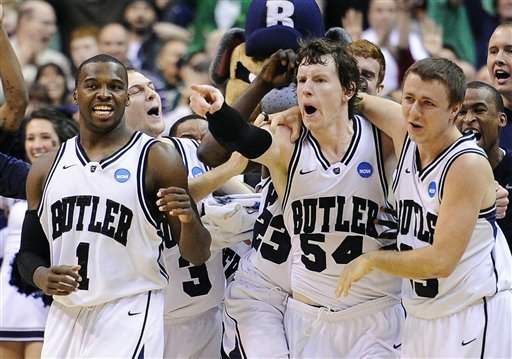
While that madness was playing out, I was concentrating on the truly astounding, the playoffs of the NCAA men's tourney.
Arguably, the best of the game is fought on courts in the middle. The same kids who astonish us every year with their talent are born, raised, and schooled in those reaches of our landscape that are the breeding ground for the radical right speak that dominated the Iowa gathering. As you watch the final four take note of the fans, the bands, and the cutaways to their home schools. They are not ignorant. They don't drool. And it is yet to be seen whether they can be scared into responding to the hysteria of the persons who would lead them.
The disconnect is mind boggling. Those stands are filled with thoughtful, concerned, people who are hurting. Why do "progressives" cede them to the right? The fact is there was no response to the hysterics of the Tea Baggers from professionals on the left. As for the so-called liberal media, it does a great job of not pressing any of these potential candidates on any of their outrageous claims or staked out positions. Radical is the name now given by the right to any press that reports or asks any question regarding their remarks or behavior.

What of the responsibility of the so called progressives to push back? There are signs of an awakening in Wisconsin. I don't trust it. It is too rifle shot an issue and one has to wonder if the rage will extend to support of grievances from the broader cultural agenda now under attack.
The middle comes up quick as you move off the coasts. During a recent election in which a gay rights bill was on a ballot, if you noted lawn signs in Portland, the city on the edge, you would have thought that passage of gay rights was a slam dunk. On a drive not two miles out of the town limits the yard signs changed and in fact the referendum went down. I don't think the so-called left really want to spend any quality time inn the middle. In the game of politics as social identity there is not much fun imagined by the cadres that would be required to actually sit down and speak to our neighbors in the middle. We don't gain their respect marching through their Precincts wearing bias on tee shirts or parachuting in to pass out leaflets and then hurrying out.


We have a President who holds political action hostage by claiming his is the voice of progress and we should accept his politics as our own, as the old saw suggests, "what's our option". I for one believe we have to create an option. I am not going to accept as a given the policies of war, and empire, and America for the rich. I don't believe there has ever been a better time to create a true progressive movement. It will require time in the middle.

We've spent most of our lives in the middle. When we moved to the Shenandoah Valley the first question the first person we met was, "Is Max going out for band or the orchestra"? The second question was what the J meant on Max's school application. When Charlie came to pull some wire we spent as much time bullshitting about our respective lives as we did getting the work done. We had kids in common, tough times, changing landscapes, and ironically the influx of people from the city, of which I was one, was a big topic. What locals wanted me to understand was that the familiarity and solidarity of their community was what they feared they were going to lose. They knew where everyone lived, and when someone might be snowed in, or in need of checking up on, they responded. They feared they would lose that intimacy. They wanted me to commit to them. I volunteered to coach midget basketball. Carrie taught pottery.
They did not fear my politics, my religious orientation, my big city ways. It was a constant source of amusement. There is a reason that most of the comics come from the middle. They would rather tell a joke than the truth, and they are good at it.
When my car needed repair, it was done. When the dogs needed shots it was done. When we had a serious medical need, it was satisfied. The details of such a life are for others to write. What I want to share is how much we had in common. The predicate was we weren't there to change them, nor they us. We grew together. I became a leader in the dem party. We got candidates elected. We were on the ground.

I find the theory of spatial harmony, the idea that when people sit next to each other they tend to harmonize their thinking, most exciting. Here is an excerpt from a book wherein corporations are picking up the data and incorporating it in their design of office space.

To be in a position to harmonize requires proximity. Everyone believed Virginia was going to go red in the last presidential election, and they cited race as the key issue. Obama won Va. The fact is that the next gen has taken race off the table. They have eaten at the same table with others and while not integrated are past the simplistic race based politics of their parents.
Now as the political season heats up again, we have an opportunity to harmonize with the people in the middle on an array of issues. If the only voices they hear, and the only people who will sit with them for any reasonable period of time come screaming from the right, then the future is a foregone conclusion. There is an alternative. Those who have roots in the middle have to go home again, sit around those family tables and discuss their collective futures. Young persons looking for opportunity would do themselves a great service by seeking out prospects to thrive where there is a vacancy they can fill. Seniors might consider affordable options for retirement where places are begging them to migrate. And, political organizers who mean it, who want change enough to live for it, might consider relocating. They would get a chance to see some great basketball.

Thursday, December 9, 2010

The Gift


The grand guy is 5 today. The event occasions a lot of thought. C and I are starting to contemplate the final gift, the legacy we can leave the family.

We take all too seriously the probability that whatever cash we might have will be inflated away. That belief results in the avoidance of toys, and diversions as gifts. Coming off the Chanukah round and heading into the Christmas season it is hard to maintain some kind of reason in the face of the buying tide that engulfs us all. An idea becomes obvious; we can't fritter away what we have on junk.
We want to set a serious tone about values. We are trying to define wealth, imagine what it might consist of going forward, and endow the family with the ways and means to help secure their future.
The best gifts I received as a child (excluding the Rawlings PM7 baseball mitt) were those certificates, shares of stock, (1000 shares of USAir grandpa bought at $3, for my Bar Mitzvah) that sat undisturbed in the desk drawer and quietly accrued value until we sold them, at $33, to pay off college loans. We were lucky. The market has been a storehouse of wealth. I have no such confidence going forward. No shares for Westley.

The gold bugs have replaced paper for a hard currency. All well and good. But the fact is that for gold to be of value it must be exchanged for a consumable at the end of the day or it remains no more than a symbol. No bars for Westley. We could contribute to a college fund which of itself reinforces the horrible and disproportionate inflation that is tuition. No 529 for the boy.

We recently returned from a visit to the children during which time the family were guests at a friend's birthday party. We talked about it on the long drive home. We sense the pressure to engage the kids in a memorable experience. In this case it was a bowling party. They had a ball. Conversations with the parents during the party, getting to know them a bit, revealed that most of the 15 moms at the party are members of a reading group. The men were heard roaring and lying the way their dads did before them. They have figured out how to be together at times of no import. There is no evidence that they congregate to contemplate the big issues of the day. They appear to pursue their hopes and dreams within the privacy of their separate homes. Their fates are going to be determined independent of one another.

I have spent my entire life in pursuit of the promise of community. I have failed to find it. From the early shock of my high school fraternity deciding to black-ball my friend and my resignation because of it, to the ultimate, and finally acceptance of the truth that self interest trumps community every time. I wonder if this "truth" is one that is a by-product of wealth. As one acquires more money it seems the most obvious way to express it is to buy the house on the hill,"top out of sight", the furthest one can get away from ones neighbors. Clearly the owner doesn't believe that he will ever need them. One wonders how this will play if and when times get tough.

I think the family needs a fall back position. If this were a suggestion that they ought to form some kind of commune, get in front of the curve, I would be tolerated and dismissed as the unreconstructed 60's refuge that I am. But, what if the project was something more immediately practical, useful, and without the stigma of group grope?

My children contemplate vacation destinations. My son hunts with friends. My grandson attends day camp all during the summer. How would they respond to the idea that they build a camp for themselves. Not a second home, or a getaway but a camp in the woods shared by any and all of their friends who want a piece. Hopefully the place will never have to be more than a retreat. But if/then they have it. They will have learned to work together. They will have shared basic skills. Here's the deal.


Our gift to Westley, his parents, and their friends, is to match any amount that other friends and/or their parents are willing to put up to buy such a place. A hypothetical might be that Max/Rachel share this idea with 20 friends. 10 friends want to pursue it. They identify a 20 acre parcel in the near woods that is private and affordable. They split the price ten ways. Our check is in the mail

Happy Birthday

Tuesday, November 9, 2010

Election Day Lessons

Moms can't catch a break. The following is an excerpt: From Erica Jong, WSJ Saturday Essay
"Our obsession with parenting is an avoidance strategy. It allows us to substitute our own small world for the world as a whole. But the entire planet is a child's home, and other adults are also mothers and fathers. We cannot separate our children from the ills that affect everyone, however hard we try. Aspiring to be perfect parents seems like a pathetic attempt to control what we can while ignoring problems that seem beyond our reach.

As we give up on ideals of community, we focus more and more on our individual children, perhaps not realizing that the community and the child cannot be separated."

The NYT blog response, if read by moms will drive them to distraction. Time better spent focusing on the job at hand. The facts, as witnessed in one tiny village on the Hudson, belie all of the summary statements made by those who write about parenting.

It happened that our kids' schedule conflict allowed us the privilege of child caring. It was election day. The prospect of a long day in a small hurricane was eased when Evelyn invited us to her home where moms were going to gather to staff the phones in a get out the vote pitch. Their children would play together as another coincidence had it that the schools were closed for a work day. No "avoidance" here.


Carrie and I are no strangers to phone banks and so we did our share. The attic was commandeered by the kids and one of us would drift up to check out the scene from time to time. The kids got on well. As moms came and went the conversation ebbed and flowed around the political issues of the day. I shared the perspective that it seemed moms were comfortable in their roles as moms. We had noted that all of the moms in this house had been seen picking up their children from school the day before, and that there was a great turnout and crazy fun had in the previous weekend halloween activities. (Cold Spring, NY is a mecca for over the top halloween celebration). Years earlier a new mom friend of ours howled with frustration; "I am tired of being the only mom in the tot lot!"

These moms are in the process. I heard all manner of civic, and social engagement. No "ignoring problems beyond their reach." They are bonding as a community. This scene was repeated around the country as new energy electrified the electorate. Moms are widely disparate and being manipulated in opposition to each other but that cynical strategy is not going to work. When the pols and the pundits fail to deliver a safe and secure future for their children, the moms are going to unite and create their own. They are going to clear the decks of people who presume to tell them there is A way. The truth is that nothing dramatic happened that day, And that is as it should be.

Thursday, September 9, 2010

Freedom


Freedom, Rights, Privilege

Phyllis Schlafly continues to head the Eagle Forum, a radical conservative "think tank" , that is part of the chorus of hard right reactionaries. One paragraph from their home page sets the tone:
"We oppose all encroachments against American sovereignty through United Nations treaties or conferences that try to impose global taxes, gun registration, energy restrictions, feminist goals, or regulation on our use of oceans."

At the 2010 Eagle Forum Collegians Summit, Chris Horner, was featured reading from his latest book,"Power Grab: How Obama's Green Policies Will Steal Your Freedom and Bankrupt America". He throws a lot of language against the wall and waits to see what will stick. The freedom concept, and loss thereof, seems to get a lot of traction if the q/a part of the program is any indicator. It was in this forum that Ms Schlafly interrupted the proceedings to make the following point: "I use a 200 watt light bulb on my desk. I don't want to use those squiggly things that have no light. I can't hardly find a 200 watt light bulb in the stores anymore. I want the freedom to use the lightbulb I chose. I am losing my freedom".

It boils down to that. Of course within that silly example is the demand that she be allowed to burn whatever energy she wants and no socialist government agency is going to tell her she can't.

Carrie and I had a two hour drive the other day and we talked about this issue. This loss of freedom thing. We then proceeded to list freedoms we had lost.
I can't raise a pig in my backyard.
I can't drive 100 mph.
I can't water my lawn during a drought.
I can't walk my dog without a leash and I must pick up his poop.
I can't park a trailer, boat, or RV, in my driveway.
I can't buy a bottle of booze till I am 21.
I can't quit school till I am 16.
I can't dump my sewage in the gutter.
I can't run a business out of my garage.
I can't leave my children unsupervised.
I can't spray DDT in my garden.
I can't ride my bike on the sidewalk.
I can't grow marijuana.

I no longer can play music as loud as I want.
I can't let my lawn go to weed.
I am not allowed out of the ward if I have typhoid.
I can't wear cut offs to school.
I am not allowed to walk bottomless in public.
I can't cut down a tree in the park.
I can't dam the spring, or poison the well.

All of the above are freedoms I once had and were sacrificed for the common good. To those on the right, who give voice to a new "contract with America" the idea of common good does not extend to any limitations on their freedom. They are shredding the social contract that limits the rights of say a farmer to poison my food source, or exploit stoop labor, or butcher a "mad cow". They would drill for gas without consideration of the impact on ground water. They would manufacture a defective product and bear no responsibility for the consequences. They retain the right to exploit any and all resources regardless of the impact on the rest of us.

The most maddening element of this practice is that the exploiters are able to rally the very people they are going to singe in the name of protecting their freedoms.

I think the key to forming an opinion on all of this is to ask yourself not what freedoms you fear losing, but which freedoms you want your neighbor to have.

Monday, July 12, 2010

World of Work

You know a problem is getting "serious" when the NYT does a feature on its front page, American Dream Is Elusive for New Generation. The story is a profile of the agonies of 2008 Colgate grad Scott Nicholson, the unemployed millennium gen, solid son of the solidly middle class. The latest example of an economy gone bad. Comments attached to the piece
and the letters to the editor that followed, give him and his family a pretty swift ass kickin. He appears self indulgent and his family enable him.

No one in this story, or the related comments, challenges any of the basic premises underlying Scott's predicament. He must be thankful for any job offer. He must get out of the house. He might move to Europe where the job possibilities might be better. Scott must get better at becoming a wage slave to a system that doesn't need or want him.

During the same week Alternet picked up a story from Psychotherapy Networker / By Mary Sykes Wylie, appropriately titled: Has the American Dream Become our Nightmare?

That title could be thought to be the first of a set of fundamental questions that needs to be asked and answered. Other questions that we all have to ask include: How might Scott spend his days in ways that don't make the rest of our lives materially worse? What is it that we need, if anything, that Scott might help us acquire? How might Scott evaluate what he really needs? What are Scott's lifetime ambitions; where does he want to be, with whom, and how many of his ambitions involve money? Obviously none of the answers to these questions or even how to pose them were part of Scott's education.

Colgate senses the angst in their graduates. Their response in justifying $54.000 in annual costs to attend include assisting the host community by buying up buildings and placing University offices within them, publishing studies that demonstrate the Colgate grads do better salary-wise then many peers, and bringing back Alumna with a job to share their experiences as a demonstration of "you too can do it." In this case the alum is a vp at MTV.

What Colgate might do: They could rethink their curriculum in terms of 21st century reality. They could sponsor teach-ins on the most critical issues of the day. They could assist their students in conceiving of and moving into a world that was sustainable, ethical, and elegant. They could strengthen their career counseling department. To be effective they have to anticipate the world their graduates are going to enter. The university could provide transitional housing for grads while they determined their next moves. They could incubate entrepreneurial alternatives to traditional job searches. The university might provide goods and services: health care, senior activities, child care, food service, art activities, to their neighbors, enriching the entire community. Any number of grads might be part of the delivery mechanism. Most importantly the university is going to have to become the well spring of alternatives to a system that is so fundamentally broken.

The best example of what is required is exemplified by the award winning documentary film, TEE Shirt Travels, embedded here.

Filmed in Zambia, this film explores the unintended consequences of western do-gooders shipping second hand clothing to a nation in "need". In the process we wiped out their indigenous textile industry and created a nation of re-sellers. It is heartbreaking. And just when you think you can't stand it any more you have the testimony of the stated dream of an unbelievably hard working Zambian young man. His ambition is to have a car. We have shortened the distance between the continents. We have shortened the timeline of civilization.

Monday, March 1, 2010

Social Studies


I wasn't prepared for my visit to Taos Pueblo. I had been schooled in all the proper cliches; cowboys and indians as a child, giving way to the tougher reality of Russell Means and the American Indian Movement as a radical younger man. I have experienced first hand the relative poverty of the Seminole in the swamps of the Everglades, and witnessed the growth of the casino culture that now permeates the tribes. I had my Native American education. While traveling in the Southwest I resisted the traditional expressions of Native culture, the "craft stores", the fry bread stands. It seemed all too scripted. I was more impressed with an installation in Santa Fe, "Art Without Reservation".


Here were new artists, drawing on their traditions but now clearly "modern" and integrated into mainstream culture.

I was talking to locals in Santa Fe, old friends, about this experience and they advised the trip to Taos. http://www.taospueblo.com/ I feared a Disney ride. "Stay away from the casino," they warned, the rest is the real deal. It's been occupied for 1000 years" For me the real deal was our guide, a 20 something college student on summer break and very secure in who he was. What he understood about the artists on display in Santa Fe was that their art was for us, the white guys with the money. They were about breaking through, crossing over, being respected on our terms. What he wanted Carrie and me to see, and touch, and taste was the core of his tradition. He wanted us to dip into Red Willow Creek, the stream that provides all the water for the Pueblo. He took us inside the jewelry studio of a wizened old craftsman, crafting the silver that the tribespeople wore. He feed us a "pickle" and sweet drink sold from a jug on a board spanned across two plaster buckets. "You are going to hear a ton of BS." he assured us "No one lives here anymore, everyone left for the creature comforts, that kind of thing." "Truth is people come and go. But they never leave the tribe." He showed how they powered everything they needed with propane. Told us they had been given exclusive rights to graze and harvest buffalo for a commercial meat market. He made sure we walked through the adobe buildings, "America's first condo", he joked, and then sped off in his pick-up at the end of his shift. It was complicated.

This from the wiki:
"The deep feeling of belonging to a community, summed up in their phrase, “we are in one nest,” has held the Taos people together. Both men and women are expected to offer their services or “community duties,” when needed. One should be cooperative and never allow their own desires to be destructive of the community’s interest. One of Taos’s strongest institutions is the family. Descent on both the father and the mother’s side of the family is equally recognized. Each primary family lives in a separate dwelling so when a couple gets married, they move to their own home. With relatives so near by, everyone is available to help care for the children. The elderly teach the young the values and traditions that have been handed down, which protects the integrity of the Taos culture."


It got more complicated when our friends suggested that we attend the annual corn dance in the Santo Domingo Pueblo. We were cautioned to appreciate the fact that what we were about to experience was not for our benefit. This was a centuries old tradition, not a pow-wow for consumption by gringos.

Hundreds of visitors sat on a berm on the edge of the plaza fronting the pueblo. Two elders walked carefully over the ground, I'm going to guess 4 acres, picking up small stones, anything that might impede the dancers. Then the sound, the roar of drums is heard. The drummers from one tribe enter the space. Then the babies appear. The children led by their elders, are adorned in tribal dress, some of their bodies are painted in adobe mud, and they are moving in the dance step they have mastered as young as three. Soon the plaza is filled with dancers, hundreds of family members, ranks and files, adorned with crowns, and bells, and rattles, and skins, all cued by the drums to move in an elaborate choreography, a thousand years in the making. Tribe yields the space to tribe (they have come from other pueblos) and the succession of dancers proceeds throughout the day. Suddenly it ends. We are not 4 feet from a row of dancers. A young man shape shifts before our eyes. He is back from the trance he has been in for the last hour and asks his buddy, "So I have to change and then we'll meet up, cool with you?"

The above is so not any piece of any curriculum I have been exposed to. This trip into the American reality is a must do for any and all of us and would be a critical "field trip" for me and my fellow students of any age. What is happening with Native American Studies to a great degree is concerned with the integration of the
Indian kids into the mainstream, or protecting their culture. Reforming the teaching of Thanksgiving seems to be a big issue.

What is not happening is the wider exposure to the life lessons to be learned by example, of the multigenerational "dance" and the meaning for the rest of us.

When a Native American professor out of Yale develops a revised curriculum unit in American History for implementation in a New Haven magnet school. I get interested.
It is troubling to say the least when you scan the curriculum at the school for which the course was prepared and find no evidence that it is present.

C.A. Bower, a professor of great influence for those of us concerned with environmental studies, has bemoaned the loss of tradition, in the name of neo-liberal transformative education.

The following is an excerpt from an article posted on his web site:

Title: Is Transformative Learning the Trojan Horse of Western Globalization?
Author: C. A. Bowers, Adjunct Professor of Environmental Studies, University of Oregon


It is important to acknowledge that the rise of liberal/Enlightenment ideas in the late
18th and 19th century led to basic improvements in the lives of the people of Western Europe who had been oppressed by feudal ideas and institutions—and by the authoritarian political systems that were equally resistant to change. The emphasis on the authority and power of critical reflection to overturn unjust traditions, the idea that change can lead to social progress, the view of the individual as having the power of self-determination, and the idea that new forms of knowledge will mitigate the ravages of the illness and the stultifying nature of work, led to important advances. But it also needs to be kept in mind that the widespread acceptance in the West of these ideas also coincided with the rise of the Industrial Revolution. And more importantly, these liberal ideas had no self-limiting principle. That is,the dominant motivation has been to achieve more and faster progress, more reliance on critical reflection (increasingly by experts promoting the development of new technologies and markets), more labor saving technologies (and now the elimination of the need for workers), newer drugs (and the control of the American Congress to ensure the growing dominance of the drug industry), and more self-determination—including self-determination in the construction of knowledge and values. The lack of any self-limiting principles, which made these liberal ideas even more problematic when they were merged with the market liberalism of John Locke, Adam Smith, and, later, Herbert Spencer, becomes especially evident when we consider the current drive to turn every aspect of the environmental and cultural commons into market opportunities—and to convert the entire world to a survival of the fittest business mentality.

What from the beginning of human history has been understood as the commons, and
which exists today in various state of viability in the diverse cultures of the world, is the only alternative to the way in which the West’s industrial culture is creating greater dependence upon Western style consumerism and technologies. The nature of the commons varies from culture to culture, and from bioregion to bioregion. What they have in common is that much of the culture’s symbolic patterns as well as the natural systems of the bioregion are available to the members of the community on a non-monetary basis. That is, they have not been enclosed—that is, privatized, commodified, monetized, incorporated into an industrial process, and so forth. This general account of the commons does not mean that all of the culturally diverse commons where entirely free of political systems that gave certain groups
special advantages—including the right to restrict the commons to the bare essentials for sustaining life, such as access to water, soil for growing small crops, animals, traditions of ceremonies, patterns of reciprocity, intergenerational knowledge of how to use medical plants, preparing food, and so forth. To make the point more directly, the commons should not be understood as always free of status systems and the unequal use of power. On the other hand, many of the cultural commons have been and still are characterized by local decision-making—an important phenomena that is now being undermined by the World Trade Organization and capitalistic forms of enclosure where decision about the use of the commons is now made by corporations and private owners who are unaffected by their decisions. The enclosure (privatization) of municipal water systems, as well as the corporate ownership and sale of supposedly “pure” bottled water, are examples of how the process of enclosing the commons also undermines local democracy.

What we experienced in Taos is a living example of an authentic commons in action. There are lessons to be learned there.

Thursday, June 25, 2009

Double Bind

"Damned if I do, Damned if I don't." The perfect example of the "double bind". Only in this case the action isn't specified. You can get more specific examples and definitions but for our purposes this example of contradictory language will do. Now what are the actions I want to consider? Lets start with: "We don't save enough." vs "The economy hinges on the consumer returning to the marketplace." How about: "We must stop dependence on foreign oil." vs "The American auto industry failed because the public stopped buying cars." The policy response is "cash for clunkers" a program that hopes to encourage the sale of yet more cars albeit with slightly higher fuel efficiency.

"We are in the middle of the greatest debt destruction in history" vs "We must stimulate the economy by generating trillions of dollars of new debt."

"We are burning too much carbon." vs "Your electric bill rose because the utility argued they couldn't maintain their profit margin on reduced sales."
"There are limits to growth determined by the fixed amount of resources available on earth." vs "If we don't continue to grow we will fail."

What's a body to do? Bateson's theory of the double bind in communication implied that its persistence in language would result in schizophrenia.


I believe there is a sane alternative. The institutions that construct the language in the above examples of the double bind are vast competing forces, struggling for survival in what is clearly an end game for one or more of the opposing points of view. We however are but individuals, who, if we were to become selfish, could abstain from the limits of the duality, and construct a third way.

The objective of our collective school curriculum, from the moment we enter the system, is stated as the development of individuals with the ability to think critically, make decisions based on sound reason, and realize our unique potential. Nothing could be further from the truth. We are tested, shaped, and driven on a path of group think that allows us to be marketed to as a herd. All the while decrying behavior that might allow us to realize our individuality as selfish.

Its time to get selfish, to screen all conflicting points of view from the perspective of "does it work for me". The NYT in a story in april referred to the double bind of college loans. We were all told they were a good investment. It may not work out. When choosing a course of study we have been counseled to specialize, develop a set of marketable skills. It turns out that many "secure" positions are now dead or dying and the ability to be flexible, adaptable, and a generalist is becoming a smart survival skill. When it comes to trusting others with your money maybe investment firms don't have your best interest at heart. The failure of responsible institutions to deliver on their promises of health, wealth, and the pursuit of happiness, is obvious to all.

It would be wonderful if such a screen included an appreciation that what works for you is not achieved at the expense of others. That in itself could be understood as a selfish interest. Stability of the population, the planet, and community you live in, is life affirming.

It is time to construct a personal reality. Now the irony of such a general statement is that if we have learned anything it is that we can't "go it alone". So now we have constructed the ultimate double bind statement, to survive "I" must find my way, within a "COMMUNITY" of fellow travelers. These terms seem to be mutually exclusive. If we accept the possibility of community to be diverse, it can become inclusive.