Showing posts with label affordability. Show all posts

Friday, June 22, 2012

Prosperous


I am reproducing the following letter to the editor printed in the current issue of The New Yorker in which the author hits a new note in the on-going discussion regarding the "value" of college education. More to my purposes is to point out his concern regarding the vast numbers who won't live as "prosperous" as their parents. This has become such an accepted proposition that it needs to be examined.
RE: THE COST OF COLLEGE
A letter in response to Nicholas Lemann’s article (May 28, 2012)
JUNE 25, 2012
Nicholas Lemann concludes his piece on student debt with a few words extolling the societal benefits of higher education (Comment, May 28th). Perhaps, but the dollar value of a college degree for many students is not clear. While there is considerable debate over the numbers, it seems that about half of all jobs in the foreseeable future will require a four-year college degree. If our society needs half our workers to do skilled work that doesn’t require four-year degrees, our obsession with making college available to all seems destined to disappoint. There’s a flip side to the studies that promote the benefits of college: if college-educated workers are now making eighty-four per cent more than high-school graduates, up from forty per cent more in 1983, it means that those who can’t afford a college degree have fallen radically behind. We need to respect the fifty per cent of workers who do so many essential jobs, and we need to pay them a living wage. Part of the desperation for a college education is that the gap between the rich and the rest of society has grown so large that everyone except the very few winners in our brave new economy will lead lives that are much less prosperous than those of their parents.
Tim Butterworth,Associate Fellow.Institute for Policy Studies,Chesterfield, N.H.


My father owned a succession of Jew Canoes. His last was that 1972 Eldorado which he kept in its own house in Florida. When I met Carrie her daddy drove a 1956 Coupe-deville. Her grandfather drove a Chrysler 300. They all consumed an average of 7 mpg. Our first vehicle was a Lambretta motor scooter. Our first car, a Fiat 500. 


My father was a home builder. His house was a 2400 square foot rambler. He built much larger houses. Today they would be called McMansions. He referred to them as "Big-Mothas". Carrie's parents built a three level split with a two car garage.

My father would answer when asked, "how was the restaurant?" "It was fantastic, the steaks fell off the sides of the plate." My parents favorite restaurant was Momma Leones in NYC where you could order an antipasto that just kept coming, "and the shrimp. they never stopped bringing those shrimp". They lived large. It was the motif of their generations' lives."Do you want to be Queen for a Day?"

We met in college. Carrie stopped after her second year to earn the bread to keep us going. We studied liberal arts. I majored in American Thought. We were the first people in our families to go to college. We borrowed the money and paid our own way. 

Our first apartment was advertised in the Washington Post as a studio at a very uptown address for $75 a month. It was on the ground floor, past the laundry. A dentist had offices on this floor and controlled more space then he needed. He sub-leased a triangular space to us. The walls were 17 ft long leading to a bathroom at the apex. No kitchen. We put a "bar" piece in as a room divider and stored a hot plate, rotisserie (which blew fuses on the entire floor), and pots and pans on the one shelf. We did dishes in the shower. We had a cat. When we invited our parents over the first time, we cued the doorman to help with the joke. This building had a turnaround drive. It is still a prestigious address. Neither set of parents could believe we lived here. The doorman showed them in. They entered the apartment, "living room" and when they asked to see the rest, were led into the tiny bathroom. I remember my father's reaction, "people can't live like this."  We did until the city insisted that it was a non-conforming space and we had to leave to move into our next one room studio. 

When we bought a house it was 768 sq ft.We had a dog, a cat, and a child.   We expanded it to 1100 sq ft. over the thirty years we owned it. 
We ate ramen, mac and cheese, and a lot of iceberg. We never, here comes the cliche', ever, felt poor. Our fortunes rose and fell, we moved. We ate better. I don't know how to measure our "prosperity". Clearly we didn't share our parents life style. Today you would measure our btu footprint as a fraction of our parents and it would be celebrated in some quarters as ecologically correct.

It is critical that we challenge the generally accepted definitions of "prosperity". The facts are that all over the world, the desire to live large as individuals, and to grow as nations looks all too similar to how our parents, and most of my gen live. We can't sustain that life-style. We have to change the paradigm. It begins by challenging the terms that set the tone, for what constitutes a prosperous life. 


Thursday, June 14, 2012

Latkes by any other name


Potato pancakes are commonly associated with traditional cuisines of Luxembourg (gromperekichelcher), Latvia(as kartupeļu pankūkas), Lithuania (as bulviniai blynai), Austria, Belarus (as draniki), Germany (e. g. as Kartoffelpuffer), Poland (as placki ziemniaczane), Ukraine (as deruny), Ashkenazi Jewry (as latkes or latkas (Yiddish: לאַטקעס, Hebrew: לביבה levivah, plural לביבות levivot)), Hungary, Slovakia, Persia and the Czech Rep. (as bramborák or cmunda), although other cuisines (including those of India and Korea) have similar dishes, such as Gamjajeon. It is also the national dish of Belarus. In Ukrainian, Belarusian and Russian cuisines, potato pancakes are commonly known as deruny (Ukrainian: деруни) or draniki (Russian: драники, Belarusian: дранікі). Throughout Germany, potato pancakes are also very common under the names Reibekuchen or Kartoffelpuffer, and they are eaten either salty (as a side dish) or sweet with apple sauce, blueberries, sugar and cinnamon; they are a very common menu item during outdoor markets and festivals in colder seasons; a traditional favorite in southern Indiana during holiday festivities.

The Rösti from Swiss cuisine differs insofar as it never contains egg or flour.

In the North-East of England (particularly County Durham), there is a popular dish known as tattie fish- "tattie" being the local slang for potato, and "fish" because the pancake resembles a deep fried piece of fish. The pancake consists of flour, eggs, shredded potatoes and onions. Some people add tomato or cheese to the mix, depending on taste.

A form of potato pancake known as boxty is a popular traditional dish in most of Ireland. It is made in a similar way but using more starch.

The Swedish version of unbound potato pancakes is called rårakor. When prepared with a batter of wheat flour, milk, egg, and shredded potatoes and fried like thin pancakes, they are called raggmunk, the word "ragg" means crispy and "munk" derives from the Swedish "munkpanna", which is literally translated as donutpan. Both kinds are enjoyed with fried pork and lingonberry jam.

As I was perusing an otherwise great food book, "From Harvest to Heat", I came  upon a recipe for "hash browns" that resembled latkes. I know hash browns and as you read in the above there are many variants of latkes but hash browns ain't one of them. To further the insult the recipe has you grate the potatoes. I found that many recipes for potato pancakes begin with; grate some potatoes. Think of the difference between a shredded carrot and grated parmesan and you get my point. You want to shred your potatoes. There is a shredding disk in most food processors. The manual square steel combo kitchen tool has a shredding side, a slicer, and a grater. Use the shredder for long, an inch or so, crispy threads. 

I make latkes from any potato but russets which are just too starchy. Gather a pound, three or four medium or two large potatoes. Shred them and cover the shreds in a bowl of water. Swirl with your hands for a few seconds and drain into a sieve. Dump the shreds into a large clean tea towel. Gather up the corners and form a tight ball. Over the sink, squeeze the towel until most of the water is expelled from the potatoes. 

In a large mixing bowl crack and stir an egg. Add a tablespoon of flour. Now things get interesting. I add a couple tablespoons of my favorite dried thai shallots, you can add shredded onion raw or fried, scallions, a shredded carrot, some shredded celeriac or zucchini,  crumbled cheese, s/p. paprika, garlic, herb, you get the idea. Add the potatoes to your bowl and stir throughly. We use two non stick pans so we can do many at once. Crank to medium high heat and add lipid of choice. We use duck fat but any fat will do. Gather a large spoonful or ice-cream scoop of mix and gently plop into pan, press with spatula. Repeat leaving space between to make flipping easier.


 When edges start to turn brown (the crispy bits are critical) flip and let finish, browned. Drain on a paper towel, place in warm oven while you finish the rest.
 I double this recipe and have leftovers refried with a poached egg for breakfast. As many variants as there are for flavoring you can have just as much fun with toppings. Sour cream and applesauce are standard. Consider minced corned beef, or bacon, smoked salmon, caviar & creme fraiche,  melted cheese topping, or a burger (an open faced sandwich). And for a real open ended option consider using any shreddable veg; beets, parsnips, sweet potatoes, for the pancake. Or, and I do this, make some spaghetti, drain it, season it and cook as above. 
Recession, what recession?


Thursday, March 10, 2011

Fat Tuesday

In the run up to Mardi Gras the urge for cajun cooking gets extreme. I was craving red beans and rice. You don't make small quantities of red beans at home. Good beans require you add at least one smoked ham hock to the pot. That means you gonna cook up a mess. This is a good example of deferring to an institution to do the cooking unless you intend to feed a mob or eat red beans for a week. nola.com ran a column on the places to get the best red beans and rice in New Orleans. Popeyes made the top 5. It wasn't the first time someone had recommended them. So Monday, red bean day, we drove the 25 miles to the only Popeyes in the state of Maine. What was I thinking? What are the so-called experts thinking? For those who don't know, one is handed a covered foam cup in which two tablespoons of rice are placed over a red paste of something. I'll stop there.

By the time any chain opens the third store, I don't care what the product, it is not going to warrant the drive. Subway proudly announces it has more units than MickyD. That doesn't say a thing about the quality of the sandwich. And none can compare with the hands on, one off, of say this piece of work at the Num Pang Sandwich Shop.
To say that bigger is not better is to state the obvious. Why then the insatiable urge to grow? In business terms the enterprise trades off quality for profit. In the public sphere the world is far more complex. You will concur, after you read this, that it is obvious to say that the entrepreneurial spirit invades the bureaucracy. Unless you experience it however, you can't appreciate the scale of the behavior. Government agency heads read their budget projections with sweating palms. They fear a cut-back, celebrate an increase, and these numbers have little to do with the delivery of the service they are charged to perform. Bigger is just better. They sit at the cabinet table in ranked order of whose agency is bigger, how large the budget, how huge the staff. They often fund projects with an eye to "continuation of effort", the opportunity to continue the project, not with successful completion. It is how we got where we are.

The behavior of bureaucrats at the local level is no less insidious. Given that the school allocation is always the largest item in any municipal budget it is no wonder that here is where the heat is rising as we contemplate cutbacks. Teachers are front and center of this discussion; fire them, cut their pensions, curtail their ability to bargain. Very little attention is paid to a real budget buster, the building program. School buildings are mortgaged and thus amortized over the life of the instrument. A thirty year building bond appears on the budget in increments. It doesn't feel, or look so bad. Fact is, it is an enormous contributor to your total tax bill. And that bill is brought to you by the same gangsters that brought you the end of the world as you know it.

When we were in Virginia we lived through this way up close and personal. The arguments for shutting down the neighborhood school that had worked well for the previous 70 some years came down to consolidation is a good thing, it will improve the delivery of services because the new bigger school can deliver more, fill in the blanks. There was no empirical evidence to support those claims. It was accepted, not without a fight. The protesters lost. Ground was acquired from a friend of the board at a price that set a record for a land sale at that time. Architects and builders went at it and a shiny new school rose in a farm field and the old time school was abandoned.
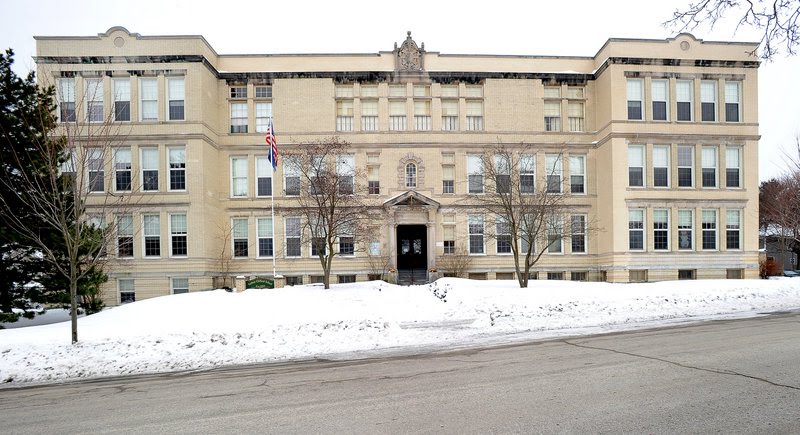
Closer to home the same process has just repeated itself. This is what we lost:


After the memorial for the old school, the weeping grads that came back to praise it, and testify as to how they will miss it, blithely accepted the new reality.
This is what we got. Plus a bill for 14+ million dollars.


NEW SCHOOL’S FEATURES
• A prominent principal’s office with large windows overlooking the front entrance, which will be the only public entrance. It will have a closed vestibule with a key-card system for staff members and a two-way communication window to screen visitors.
• Classrooms clustered around four open, carpeted areas with skylights, where teachers can work with students one-on-one or in small groups. Classrooms are in two, two-story wings, with lower grades at ground level.
• Several single-user bathrooms in each classroom wing, meant to increase privacy, decrease the distance from classrooms and reduce the potential for students to misbehave in “gang” bathrooms.
• Various energy-saving and environmentally friendly features, including a roof drainage system planted with greenery, solar-powered hot water and a dual-fired heating system that will allow the school to burn oil or gas, whichever is cheaper.
• A teachers’ lounge and workroom – something Clifford lacks – and a health clinic with a bathroom that’s larger than the nurse’s room at Clifford.

The following is excerpted from an article In The Portland Press Herald:

A tour of the school reveals more features.Each hallway is lined with an occasional grooved tile that reflects the theme of the wing. For instance, the ocean wing has tiles with embedded fish scale patterns.Jenifer Richard, an interior designer from WBRC Architects, said children enjoy running their hands along walls, which is why each wing has special hand tiles.Richard said the other wings' themes are agriculture, forest and mountains.The floors also reflect wing themes. The Ocean Wing floor tiles resemble rippling water. Forest wing floors look like bark with spots of leaves on them.
Another article re the school budget process in rural Maine, contained the following:

If the transition goes smoothly, it will bode well for future building projects, school officials said. They're working on plans to replace or renovate several of Portland's 10 elementary schools, depending on availability of state funding.
They're also preparing to tackle the controversial subject of redistricting within the next few years, which could force residents to reconsider their definition of neighborhood schools.
"We need to communicate with parents and students to make sure this transition goes well," said Jaimey Caron, chairman of the School Committee's facilities subcommittee.
The article provoked the "humble farmer" to write the following letter to the editor:

Robert Karl Skoglund 02/28/2011 06:24 AM
Fifty or so years ago the people in St. George, Maine voted to go into a school administrative district with Thomaston. This is like sending a weekly check to a man who lives with your wife and raises your children.
You might well ask how intelligent Maine people could be suckered into such a con game.
The basic premise is something for nothing. It is absolutely impossible to fleece people unless they are convinced that they can get something for nothing.
Here’s how the school con works.
You, the taxpayer in Maine, give the State and Federal Government your tax dollars. Then, if you do exactly what the government tells you to do, they will give back to your school some of your money.
You smile and feel pretty good that you got all that free money from the government.
Here’s how the school con started.
Building contractors convince top officials in the education business that it’s cheaper to educate children in large central schools. For years Maine people have raised chickens in large, centrally located henhouses. The more chickens you can jam into your henhouse, the more money you can make. The grain bin is right by the door. It’s efficient. So folks very quickly bought the argument that it would be cheaper to educate kids in consolidated schools.
It was a good argument, but there was one hitch. No chicken farmer in his right mind would vote to spend the amount of money it was going to take to build those expensive gyms and playing fields. Because most anyone would ask, “What’s gymnasiums and football fields got to do with education?”
But the wonderful part about the whole deal was that the towns wouldn’t have to pay. The state was going to pick up the tab. So even the most frugal chicken farmer jumped right in. He was suckered, you see, with the promise of something for nothing.
His town sent his tax dollars to Augusta to pay for all the schools in Maine. But there wasn’t enough money to build and run schools in all the towns. Who would believe it?

Maine people who were very frugal, Maine people who would never in their right minds vote to replace their present excellent local school, voted to go into school administrative districts. They might attend church in a building that was built in 1850, but thought that their children couldn’t be properly educated unless it they were housed in a shiny new building. And they wanted to get their share of that money out of that big money barrel in Augusta before their sticky fingered neighbors in the next county got it.
It was cleverly done, wasn’t it? But like any con game, it had to work because most taxpayers can be convinced that you can get something for nothing. Forty years ago we had communities in Maine. When you lose your school, you lose your community. And when you farm out your child’s education by getting into a school administrative district that will “save you money” don’t be surprised to discover that you might be paying for that education twice.

The humble Farmer

Wednesday, June 9, 2010

The Class of 2010


This blog space has intended to infill the gaps in the formal curriculum that you have just completed.
Prior posts have dealt with ancillary housing options, yet more shelter strategies, dorms as models of "real world" possibilities , economic survival options, and the ultimate in "sharing" programs.
I posted a short list of supplemental courses that I called "the art of crap detection" within this post.

All of the above pointed out that the most important lessons you were learning were informal; living in groups, being carless, the economies of scale, and that having access is more important than owning.
If you insist on leaving the "ideal world" you just inhabited, where you literally had it all, then consider the following my commencement address.

The decision you are going to make re. where to live is more important than your career choice. Typically, media stories will list cities that are attractive to recent grads and list the criteria supporting their choices. This story by Richard Florida goes so far as to cite that which is "important" to 20 somethings; bars, restaurants, and entertainment. (You are worth no more than your ability to consume). What everyone of the chosen cities have in common is that they are already what they are going to be. As a migrant to any one of them you are chasing a dream already realized by those who preceded you. You hope to become part of that which already exists. "I am moving to NYC cuz that's where the hipsters live". What you can't know, because your teachers like Richard Florida haven't a clue, is that you are about to participate in the "next biggest sucker syndrome". The person who is about to leave for someplace where she has a chance of actually carving out a living for herself, needs someone to whom she can sub-lease her too expensive 350 sq ft apartment. Don't be that person.

Its is going to take some backbone to resist the kind of marketing crap proffered by the merchants of cool so lets use some common sense.

The criteria that I would suggest you apply when considering where to live include: What is the total tax burden of the place you might live? What is the cost of auto; insurance, registration, and taxation? What are the rules regarding house sharing? What is the speed of the local ISP provider? What are the average utility costs? What is the fiscal status of the town, state in which you might reside? What is the cost to have a dental filling? What is the ratio of others to whom you might be attracted? Are there viable and independent media outlets? What are police practices regarding victimless crimes? Applying the above criteria would automatically rule out California.

The places that do qualify are invariably going to be the subject of bad news. You are going to hear about the abandoned, the broke and broken places that are the casualties of the economic collapse. This is exactly where I suggest you begin your quest. Only when a place is degraded enough does it become possible to have an opportunity for real growth. Consider that Georgetown, D.C., Harlem, NYC, The Mission, S.F., SoBe, and now the Design District in Miami, are examples of what were once neglected slums. Their reconstruction afforded their pioneers the opportunity for employment, new think, and identity. Now those very people couldn't afford to live in any one of these neighborhoods should they chose to move there today.

In a world where one can literally buy anything from anywhere and have it delivered, where the newest ideas are instantly available on the web, where affinity networks thrive, the pressure to be within the hip cores is unimportant.

The myth that there are "creative communities" belies the fact that the most significant wellsprings of art are often at a remove, giving the artist the space they need to create their own identities. Think Morgan Freeman, Clarksburg Ms., Dennis Hopper, Wilmington N.C., the crowd at Black Mountain, N.C. or Georgia O'Keeffe in Abiquiu, N.M.

More important than any of the shibboleths that are so indicative of mob think, absorb the most important principle you weren't taught during your college days, buy low! This is just as true in real estate as it is an adage in the stock market.

When a place has become cheap enough that you, or more importantly a group, can pool resources and actually gain a foothold, then you have a real opportunity. Exploit the social network you have developed, form a gang, and move somewhere. The wants and needs of that place and the opportunities will sort themselves out. This is exactly what happened in Hardwick Vt.

What a fabulous example of the success of people who went their own way. Other food oriented activities are located through Balle.

Get busy. There has rarely been more opportunity.

Wednesday, November 18, 2009

Maximizing the built environment

A scenario:
Barbara is a single mom who got herself behind the eight ball. Her husband died from a sudden heart attack while jogging. They had no life insurance. To help her with cash flow she refinanced her modest three bedroom, two car garage home in middle America using an adjustable rate mortgage. The way it was explained to her, "when the affordable rate is about to adjust, we will refinance again, and the monthly payments will remain the same". The problem is that when the adjustable rate reset, there was no bank ready to refi her loan and now she was saddled with a mortgage that was breaking her.

Barbara works in human resources at a mid-sized utility company. After her debt service she barely has money left to feed her two kids, 3 and 5 years old.. She was very close to foreclosure when a group of three approached her office with a concept for a new small business (house retrofitting for conservation) that they imagined was allied with the utility, and that the utility might want to fund. This was beyond her pay grade and she pushed the proposal up the chain but kept the cover sheet of the proposal in her desk. Weeks later she called one of the principals out of curiosity. No the utility hadn't funded the venture but the group had secured some start up money and was plunging ahead. They were looking for space.

No one can ever trace the sparks that trigger creative energy. What Barbara blurted out was, "would you consider renting my house from me during the working day?" Meetings were had, problems discussed, and the resolution worked as follows: They split the debt service and utilities. For the start-up this was far cheaper than the office options they had explored and far more comfortable. The living room, dining room, kitchen, and one bedroom would be shared by the business while Barbara was at work. Barbara and the kids each maintained a private bedroom. The key to the success of the concept was the separation of stuff in the shared space. Barbara contacted the head of the architecture dept. of a nearby university and posted a want-ad for a design project. A short description was included and of course a student responded within days. In addition to a little money beyond materials what the student needed was a practicum for credit. For that the student required they document the process. No problem.

Barbara suggested the student set up shop in the garage. He did. And what he fabricated was a set of three modular storage cubes on wheels. During the work day they opened to include the work surfaces, and communication storage areas that were needed, and at the end of the day, were secured and rolled against a wall, out of Barbara and the kids' way.

The kicker was that when the project was finished, the student suggested that he could retrofit the garage and create an apartment for himself in the space. He did. You will be pleased to know that Barbara is secure in the house, the start-up has positive cash flow, and the city certified the garage as a legal ancillary space.

Tuesday, October 13, 2009

Built-Ins are Bankable


Built-ins are Bankable:

You enter the dwelling space and you immediately sense that the owners have overreached. It isn't a matter of the size or the cost of the housing. The sparse furnishings suggest that the owners simply haven't the money to fit out their new digs.
The fact is that the cost of furnishing a new home is rarely factored into the total cost of housing. Typically new starts begin with a hand me down or two, play out a shabby chic style, or worse, go into more debt, at outrageous interest costs, to furnish a space. "Rent to own", credit cards, or furniture store credit is usually exorbitant.
If we are to develop affordable housing options we have to be mindful of the total livability cost of any space. So here are a couple of thoughts and strategies we might employ.

When I say that "built-ins are bankable" what I mean is that if the builder has included the banquette pictured at the top for example, it is included in the cost of the house and is wrapped into the mortgage. It is financed at the same time as the home and at the same interest rate as the structure. It is part of the structure and therefore considered "real estate". In today's market that means the cost of the money for the kitchen seating group was 5%. As long as we continue to provide tax reductions for interest payments on real estate, the interest is deductible.
Strategy number one has us influencing builders to include as many built-ins as we can imagine.. The pic above is from a book currently on Google Books. The cover itself is filled with possibilities.

Strategy number two involves people about to buy a new space and before they agree to purchase they develop plans for additional built-ins that they want included in their new home. If the builder is still on site it is probable he will welcome the opportunity to increase his return on the structure. If the original builder is not available then the buyer can contact an aftermarket retro-fitter and work out a building plan that is formalized and thus can be brought to the table with their lender. This movie shows a typical retrofit.

A third strategy has a person in their space and considering a refinance, or executing a part of a home equity loan. In both cases a set of plans and contracts for built-ins will be accepted as a bankable home improvement. At times like these, "cheap money" suggests the time is right to increase your "relatively cheap" home line of credit rather than getting killed by your credit card rates. So consider beds, closets, book cases, entertainment centers, cupboards, storage chests, shop benches, the list goes on. Built-ins are also the key to maximizing small spaces and making them functional. THINK BOAT.

Wednesday, October 7, 2009

Antiques, the new Green


Ikea has become synonymous with new house formations. Students in large numbers and "starters" finding themselves in need of furnishing and pinched for cash opt for the affordable, stylish solution. In the process IKEA has become the world's third largest consumer of wood and though IKEA suggests they are responsible, their consumption patterns are hard to discern. In Ellen Ruppel Shell's new book "Cheap: The High Cost Of Discount Culture" Ikea is taken on as the new WAL-MART.

There is an alternative that may be a little hard to get your mind around at first. A Brit with the fabulous name Nigel Worboy has formed an organization, "Antiques are Green". In the following interview he makes his case for collecting antiques being the oldest form of recycling.


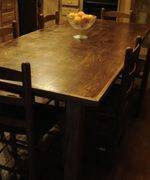
There is a great variance in what constitutes an antique. I don't think one has to learn the trade to begin the process of furnishing your life with sturdy pieces that you can use for a lifetime, pass on, or sell for a profit when you no longer need them. Parents wanting to do their kids a favor might consider off loading to them a piece or two when they need it most. The three pictured items might be good places to begin. The cupboard is named a Hoosier for the company that made them and serves as a kitchen utility area for those short on cabinets. An armoire is a closet that can be moved and comes in many configurations. The farm table could become the multipurpose center of your space. Each of these pieces is guaranteed to appreciate in value and afford you the most bang for the buck in the long run.