Showing posts with label Recipes. Show all posts

Tuesday, May 10, 2011

The Truth will save you bucks

Harold McGee was inducted into the James Beard hall of fame last night. For thirty years his book "On Food and Cooking" has been my go to guide when I wanted to know what was happening on the stove or in the oven. In addition to applying basic scientific understanding to the cooking process he is a great myth buster, and can save you a great deal of money if you heed his advice.

You will notice that I added his blog site to the roll on the right column of this page. I go there constantly.

One of his entries that I particularly appreciated was his discussion of the testing he did on cooking oils. When I could still watch the food channel I would cringe every time Mario would insist that you had to fry or saute in EVOO. It was clear what brand he was using and though I don't know that this was a product placement, it smelled of it. In any case the effect must have been to convince viewers that he knew what he was talking about, he was Mario. So McGee subjects a variety of cooking oils to the taster, smell, test as they are heated and concludes that his testers could not discern a difference between the oils he used. Something changes when you heat them and in fact olive oil scored poorly for taste when heated. Use olive oil for dressing and finishing food, not for cooking. There is more bad news re. olive oil. Most of the so-called EVOO isn't. This confirms an earlier test. In the course of the initial study Berio was consistently identified as an honest brand. Why pay more?

While on the subject of oil consider the idea that frying chicken at lower temps, 300 instead of 350 and up, is a preferred temp as it allows the interior moisture more time to dispel without burning the surface.
Here are some counter intuitive tips for deep frying.

The following article points up another frying practice that makes for better cooking:
"While European and Western cooks deep-fry with a single frying, the Chinese deep-fry in stages. After being marinated, foods are then deep-fried at a low temperature, maybe 290°F, and later finish-fried at a high temperature, 365°F to 385°F. This staged cooking increases crispness and color. Batters reduce surface moisture, and a dryer surface reduces initial boiling. In addition, batters add color, flavor, and texture to many deep-fat fried foods, with green tomatoes, eggplant, okra, and even ice cream being examples of foods that are battered before they are fried. A meunière is a thin, light breading, or flour dusting, often used on fish and popular in traditional French kitchens. But batters can also be thick, as in the case of double, triple, or breaded coatings used for fried fish and chicken." Mark F. Sohn enotes

David Chang changed many cooking practices for me. I had treated brining as a gimmick that never seemed to change the moisture content of turkey and so the concept was dismissed as ineffectual. Then Mr Chang suggested I brine my chicken wings in salt/sugar water for a few hours before I dried and deep fried them. You will taste the difference. The science is explained on this page from the Exploratorium in SF.
The contents of this page dispel another myth; searing meat retains its moisture. What happens when we heat meat in a pan is called the Maillard reaction. It is explained as the browning phenom that gives meat flavor as the heat caramelizes sugars on the meat's surface. You want this to happen but not because it retains moisture, it doesn't.

While we are on the subject of surface temperature lets dispel yet another myth; gas is a better heat source than electric. It might look cooler and the grates suggest real cooking is going on here but the fact is that gas is wasteful and in some cases unhealthy. Gas does not burn at 100 percent efficiency meaning that some noxious gases are released into the environment. It is no more accurate or controllable then an electric dial and the idea that it burns hotter is foolish as you don't want to use extreme high heat. High heat kills pans. I have praised the virtues of induction cooking and hope the price point drops as the stove tops and portables become more available.

Here is a truth that is so simple one wonders why anyone buys ersatz mayonnaise. Some will argue they can taste the difference between blender and hand whisked mayo. Harold, are you listening?

Tuesday, February 1, 2011

Side Dish

The rule in our house has been; Don't eat in restaurants food that you can prepare better at home. This rule used to be limited to steak joints, spaghetti mills, and salad bars. Who could have imagined that the rule could be extended to restaurants that serve dry cereal, PB and J, and now the latest in the single dish restaurants, soon to be on a corner near you. They come with names that are a variation of "Mac something", the name for any one of hundreds of new mac and cheese outlets. It would be too easy to ID the latest hot spot in NYC, so for some scope consider CHEESE-OLOGY in St.Lo. This store has franchise potential written all over it. I am sure they serve great mac and cheese, and the variations sound wonderful, but when I'm in St Louis, I'm going to be suckin ribs.

When Carrie and I found that we could read in bed from the light transmitted from our young bodies, alit with the afterglow of Kraft's original mac and cheese (in those days 4 boxes for a buck) we hauled out the Fannie Farmer and have been making variations ever since.


Our mac and cheese is baked, topped with bread crumbs, does not contain an egg, uses up cheese ends, employs meaty sized short cuts of pasta, and the preferred cheese is a yellow cheddar. Within this simple recipe there are some fabulous lessons that can be widely applied. First of all we build our dish on a béchamel, froggy for white sauce. The keys to white sauce are universal principles that can be widely applied: One tablespoon of flour will thicken one cup of liquid. A roux(roo) the combination of fat and flour that is the first step in the creation of the sauce, does not have to be brown to be flavorful. The way to avoid burning a roux is to saute some veggie bits in a pan, say onion, and sprinkle the flour on top, stir for a minute, and then add liquid, The liquid need not be hot, but you do want to whisk until creamy (if using a non-stick pot, use a plastic whisk). Simmer for 5 minutes or so to "cook" the flour. Add a handful of grated cheese, stir again. Add slightly undercooked macaroni, stir and pour out into greased casserole. Sprinkle with breadcrumbs, Bake at 400 for 15 minutes or until a peek reveals a bubbly dish you can't wait to eat. The above is devoid of specifics because they are so variable. I start with two TBLs of butter and two TBLs of flour over a 1/4 cup minced onion. You can use olive oil, bacon fat, schmaltz, your lipid of choice. Given I have two TBLs of flour I add two cups of milk. I could use stock, cream, half and half, or heavy cream, or any combination. Keep the proportions constant. Cook at a simmer, stir until thickened. Add 1/2 pound cooked pasta. There are as many variations for toppings or stir throughs as you can imagine. The menus of the restaurants are inspirational and nothing you can't do yourself. Ben's Chili Bowl in DC (Obama's fav) used to have a chili mac/cheese that you could order with extra grease. It is a miracle we are still alive.


There has been a game changer in this house. Thailand companies make fried and dried garlic, shallot, or red onion flakes. They come in 4 oz to 2 pound containers in Asian markets. I buy 8 oz jars for 3 bucks at my local supermarket. This is not garlic powder, nor is it a substitute for fresh . These products have a distinctive flavor that adds depth to many recipes. I sprinkle it on veg, stir it in scrambled eggs, use in salad, each variety has hundreds of uses, and I add it to my mac and cheese.

While we are on the subject of comfort food. The other morning, stirring in bed, anticipating Carrie's awakening, I knew I was in for another bowl of oatmeal. Her instincts were confirmed. Oatmeal has just been voted the healthiest breakfast one could eat. If I smother it in enough syrup, and raisins, and cinnamon, I can manage to get over the gluish feeling I have in my mouth. I was not looking forward to breakfast. And then the epiphany; why not savory?
We have settled on old fashioned rolled oats which we buy in the bulk bins in our local market. Two cups of salted water set to boil. Pour in one cup oats. Reduce heat. Cook for no more then ten minutes. Now Carrie adds milk to get the consistency she wants. It was then I jumped in with a handful of crumbled bacon, a heap of fried/dried shallots, a slather of olive oil, a crack of pepper, and topped it with a soft cooked egg. I look forward to my next bowl and another variation. Mark Bittman likes soy and scallions in his oatmeal.

Side dish:
What the hell does it mean to "win the future". We are so caught up in this competitive madness that we have lost the ability to distinguish between a football game, a foot race, and a national, what? We win the war? Is that what the masters of the universe are prepping us for. US v China in the race to what exactly? What does losing look like, smoldering embers? We breed that mentality in the schools. We grade students. We fail students. We grade them on curves. They are taught to compete. If we truly wanted them to learn we would inculcate them with curriculum until they got it. They would all win. We would have to figure out another way to determine who got into Harvard, and who went to jail. That would piss off aspiring parents who want their kids to win. And what does losing look like? What does it mean to be deemed a failure at 13? No one believes grading is a benign method to determine how they are progressing and not meant to be competitive. Save us all a lot of trouble and just kill the losers off. Or, teachers, and I know you are out there, refuse to grade them. Not by yourself, though that would be wonderful. In the faculty lounge today, agree among yourselves to just stop. That's something you can do. Stop grading kids!

Thursday, August 12, 2010

Roll Your Own

A cruise through my local supermarket this morning revealed the following facts: Boneless beef sirloin steak, America's favorite, was on sale for 2.99 a pound, pork sirloin roast was 1.49, and split chicken breasts were .99 cents. For reference know that in the trade these are referred to as "prime cuts".

Across the aisle, in the ever growing sausage section, a survey revealed the following prices: Store brand Italian sausage was 3.19, "Gourmet" whatever that means, was 3.39, Jimmy Dean's Breakfast was 3.39, so called "all natural" was 5.99, and D'Artagnan's was 9.18 a pound. Different brands of sausage made from chicken all hovered around the 6 dollar price point. Specialty sausage, chorizo for example was 4.99 a pound.

Hebrew Nats were 5.80 a pound and franks you shouldn't even consider eating fell to as low as $1.29. A new item, uncured franks (no nitrites), sell for 6-7 dollars a pound.

Bottom line: The prime cuts are half the cost of whatever finally makes it into the sausage of your choice. You can be assured your commercial sausage contains no prime cuts.

The old joke re. the making of laws and sausage, you don't want to see it, still holds. The following was the most info I would share with you without totally grossing you out:
ABSTRACT:
"Spent layer chickens, an underutilized, inexpensive source of animal protein in the United States, were used to produce an acceptable all chicken frank following mechanical deboning of the chicken parts without pregrinding. The franks were subjected to shear tests and compared to two well-known commercial brands of chicken franks for overall acceptability by an untrained 59 member panel. The franks produced from mechanically deboned spent layer chickens (Lab franks) had greater resistance to shear than the two commercial brands and the panelists showed significantly greater preference for one of the commercial brands. Comments of the panelists indicated the texture of the lab-prepared franks was tougher than the two commercial brands. However, 12 members of the panel stated the lab-frank texture was tender. Collagen content of the spent layer franks was no higher than for the commercial brands. It is therefore concluded that the toughness could have been due to the nature of the myofibrillar proteins. Such toughness could be modified by tenderizing enzyme treatment of the raw material to produce varying degrees of frank softness or firmness depending on consumer preference".


Beef producers live with the daily fear that an incident of mad-cow entering the food chain is coming and the smart money is betting that it will be the result of bone material in beef that was "chipped off" and used for franks. That should be enough reason for you to consider making your own sausage.

You can go whole hog and buy sausage stuffing machines, casing, and learn to form sausage links while keeping the air out, or you can prepare your own recipe from prime cuts, control the additives by adding herbs and spices of your choice, add pure fat for flavor and mouth feel, and simply form a patty and fry or leave crumbled for pizza or pasta. The following is a site filled with recipes that you can adopt.

Here are my provisos. Use a food processor and make small batches that can be ground and mixed to a smooth paste. Always test a tiny bit in a hot pan to taste for seasoning.

For the truly food obsessed do the following. If you have a custom butcher shop, independent market, or slaughterhouse near by visit them and ask for caul fat. Here in Maine the way I obtained mine was to note a recipe on a restaurant menu that called for rabbit wrapped in caul. I called the chef and asked her to order an extra ten pounds for me. She did. I picked it up at the next lunch.


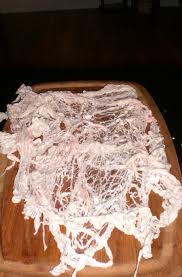
Caul fat is an inner organ lining the best of which comes from a pig. It is not greasy or smelly. In a ten pound box for example it will be squished together in a mass. Soak in a pan of water and start to separate the sheets. Lift a large sheet to a cutting board, and using a paring knife or scissors, cut 6 inch squares. (I pack what I don't use in small freezer bags). It won't be neat. It doesn't have to be. You can place a couple ounces of stuffing in the center, press to from a disk and fold the caul over. You can spread filling, tube like, across the caul and roll it like a frank. Fry over medium heat. The caul will melt away or leave just a trace of gorgeous netting. Once you have caul in your system you will discover a variety of uses. Here are pics of the ultimate chicken loaf.

Monday, August 2, 2010

Tomatoes

Tis the season.

Tomatoes are in and I want to help to keep things simple. A good first principle is that canned tomatoes are for cooking and fresh tomatoes are to be eaten fresh. Most of us will simply cut or slice a fresh tomato and add it to a salad or sandwich. Here is a preparation that takes longer to write about then perform and will significantly improve your summer tomato pleasure.


Filleting a tomato. The pics are self explanatory. Here are some essentials. Just barely score the flesh. Immerse in boiling water for no more than a minute (you will notice the skin start to curl).


The point is not to cook the tomato. Plunge in a bowl of icy water. Remove center core. Peel.


Cut from the top to the bottom of the tomato at the point where the flesh is thickest. Err on the side of thicker. You can always remove excess with your fingers. Sometimes you will create a quarter piece or often the whole will remain intact.


These fillets are obviously dryer and thus better on bread, lack uggies which freak most kids and some adults, and can also be sliced and or diced for a variety of uses. Your salsa will improve at once.


Collect the uggies in a sieve and press and strain them for juice.

Here is a fabulous recipe: Under cook 1/2 pound of pasta by a minute. Save a half cup of cooking water. Heat retained 1/2 cup juice in saute pan, add pasta, swirl in hot water as needed to moisten, stir till absorbed (about a minute), turn out. Top with sliced fillets of tomato, oil, some shredded basil, a crack of black pepper or red flakes, a sprinkle of salt, serve 4.

A side dish: Roma style tomatoes are grown because they have thick flesh, a high meat to juice ratio and thus are perfect for cooking. There is no reason to grow your own given the producers do a great job of the whole process, including canning.
San Marzano "style" tomatoes are Roma type and unless labeled DOP are grown here. A lot of time and energy has been spent tasting different canned tomatoes and conclusions are reached that might have you going out and spending 5 bucks a can in the belief that an Italian San Marzano is a better tomato. If we were eating them from the can (we don't) the expense might be warranted. Given that, at least, we will smash a garlic clove, add a pepper flake, and cook our tomatoes in olive oil for at least 20 minutes I defy anyone to distinguish the difference in the source of the tomato once cooked. More important is to notice the amount of sodium added to the can. It varies widely and you don't need the extra salt. You can always add your own.
Consider how you want your canned tomatoes to perform and purchase the appropriate style. Crushed, sometimes labeled "kitchen ready" are the simplest for a basic sauce. Italians buy jars of "passata" for their sauce which are essentially crushed tomatoes passed through a sieve. You might want diced to hold up a little texture for a cooked TEX/MEX salsa, and whole tomatoes can stew with a chicken and hold up.
Many eschew tomato paste as something less then authentic. Big mistake. For years I couldn't discern what it was that smelled so rich emanating from the back of checkered tablecloth "Ity" restaurants. I couldn't duplicate that aroma and I knew it was key to a successful sauce. Roberto Donna of Galileo in D.C. finally clued me in. Caramelize a couple of tablespoons of paste in oil with garlic till just lightly brown and then proceed to add tomatoes etc. Ah the love.

Monday, December 28, 2009

The Stock Market


There is a new way to separate you from your money and lessen the quality of your life, and that is the new stock in a box appearing in your food market. Better than the instant bouillon cube which is no more than salt in foil, the new box is an apparent step up from Swanson's broth in a can. These products allow you to fool yourself into believing they are as good as homemade. They aren't.
I am old school and still believe that the simpler my food the better. For me nothing beats a golden broth consommé with maybe a tiny bit of veg floating on the surface. Nobody made it better than Jean Louis Palladin and when I asked him how it was that his was so much better than the competition he produced a tiny brown bottle. "My mother sends me this essence of burnt onion juice." he told me. "A few drops will flavor a quart of stock."

You can do this; make your own stock, and it is virtually free. Every time you peel and trim an onion, toss those peels and ends in the plastic bag you have ready in the freezer. So too the carrot peels, the lettuce trim, the fennel bottoms, the parsley stems, and the wing tips and back bones or whole carcass from your chicken. It is also a great idea to crush egg shells and save them in the bag. When making the stock the shells will form what is called a raft which will capture the scum on the surface.

(a parsley trick: trim off the stems, rinse the leafy bunch in water, place one or more bunches in your blender, pour in a cup or two of water, pulse. Strain the now green water (add to stock), place the now finely chopped parsley in a freezer bag, flatten, freeze, break off what you need when you need it.)

Brown the onion and chicken parts in the bottom of a stock pot, add quarts of water, a bay leaf or two, other herb, a clove, some pepper. Don't add salt yet. When you make your final soup you will be able to judge how much salt to add to taste. Bring to slow boil, reduce heat to simmer, forget it for an hour or more. Remove raft with a slotted spoon or simply pour stock through a strainer and save. Purists will want to remove the fat from the surface once it chills and sets. You can refine the stock more by straining again through a paper towel or simply leave the last inch of stock on the bottom of the pot where the unstrained solids will have collected. Store stock in pint or quart containers and freeze till needed.

To get the chicken parts for the stock will require a very sharp knife. I hope you got a sharpener for Christmas. If not get one. You can spend more money but this one does a great job.


Start with a good knife, you will need three in your life, a boning, a paring, an 8inch chef's.


This video will show you the basics of how to bone a chicken.


You could stop short of the whole boning process by just removing the wing tips, cutting out the back on two sides, and using these bones for stock. Or by making a small incision at the wish bone, inserting your fingers and pulling the breast away, you can bone the breast out of the chicken without a knife. The thighs will break off with a twist and tear. Another trick is to turn the separated leg over, skin side down and notice there is a whitish line where the thigh and drum might meet. It is exactly where they meet and if you slice atop that line you will separate them perfectly. Most of the time you will want to keep the bones within the legs and thighs for your recipes.
A starter soup might have you poach (20 minutes will do) the large pieces of chicken as you make the stock, and remove them to cool. Cook off some rice or noodles, dice a carrot, get a cup of frozen peas, shred some chicken. Place all in a pot, add stock, a bit of white wine, simmer, add a pinch of nutmeg, sprinkle with grated parmesan. Ahhhhh.

Monday, October 19, 2009

Ribs and Wings


When the market place goes topsy that doesn't mean you have to. Take spare ribs.
Spare ribs are what is left over when the butcher is finished taking off the prime cuts of the pork carcass. Prime cuts include chops, and roasts, You can recognize a prime cut, they have meat on them. In the day, when true value was not market driven, spare ribs were the cheapest cut in the meat case. Now that demand has outstripped supply you have a situation where baby back ribs (from the loin area) cost two to three times what the boneless loin costs. And on a yield basis, how much meat you get, the factor may be ten fold.

Lets be honest. The rib is really just a sauce delivery vehicle. (For some bone suckin, crunchin, freaks of which I am one, the bone is an important part of the experience. To you I say, save the bones from the next order of ribs you eat, clean and store them, and have them on the plate for dipping the next time you BBQ some loin.)

Buy a loin roast. Halve it longways. Rub in your favorite rub. Sloooow roast at 250 for 4 hours or till internal temp reads 140, check every hour or so, bathe in sauce for last 20 minutes. Let rest. Slice in half inch strips, dip in yet more sauce. Forget about ribs.


Chicken wings now cost more then breast meat for the same reason. Supply has outstripped demand. Buy a good heavy chefs knife. Learn to use it.


Buy chicken thighs (which are inherently juicier than wings). Chop them in half. Cook as for wings but a bit longer to compensate for the added meat on the bone.

And when all of the cuts are boned out of the respective animal, the scrapes, the leftovers are turned into sausage. Some sausage is now more expensive then any cut of the animal, particularly chicken. Making your own is so simple and so healthy by comparison there is no reason not to do it. You do not have to stuff sausage into intestines. Make patties formed from fresh meat and spices or crumble and use in your favorite recipe.

Thursday, August 13, 2009

The Real World, Part One


A student returning to college asked the readers of the Blog 101 Cookbooks to suggest ways he might overcome the horrors of dorm food and required meal plans. After 392 comments the host interrupted the process.

It is difficult to make generalizations about the state of food on campus. For every food service that is diversifying and including more healthy options, there is a campus that has been optioned by fast food chains.

I believe that every college ought to offer classes in food; nutrition, shopping, preparation, and presentation. Refined Home Ec ought to be a required part of every gen ed curriculum and should begin with food. I'll begin with the following:
The cruise through the supermarket.
As has been mentioned in this space the number of MREs for civilians now being offered in every major supermarket grows and grows. They are intended for working persons who simply don't have the time or inclination to cook. Salad bars, rotisserie spits, precooked entrees and sides abound. One pays for that convenience. Students can learn to roll their own. The lettuce that is 6 bucks a pound in the salad bar, is 1.50 in the produce case. Even here the price for convenience has one paying a premium for the bagged "salad". Anyone can shred a head of lettuce, slice a cuke, peel a carrot, top a radish. The temptation is to select one of the hundreds of dressing that line an entire aisle of most stores. The reason there are so many is that they are cheap to produce and yield high profit. Good for them Bad for us. Note the presence of things you either can't pronounce or know by now aren't good for you. The number of offerings suggest that something as simple as the most basic dressing is as foreign to most of us as its name, vinaigrette. One part vinegar, three parts oil, salt, pepper, whisk with fork, pour. Add herbs, flavored vinegars, mustard, go nuts, have fun.

Fruits aren't as easy as you might suspect. A tasty apple is a slam dunk but unless you live near where they grow them you aren't going to taste a ripe peach. Ripening fruit is a problem. Some solutions are easy. A pear needs time to develop and placing them in paper bags and waiting a day or two will work. Off gases from bananas will ripen pears, papayas, and mangos so placing them together in a paper bag will ripen all of the fruit. Here's a fundamental truth: Fruit goes on sale when it is in season, ripe, and abundant. Knowing the cycle of ripening is a help. Here is an example from Michigan You will need a local resource.

So we will cruise through the store and note fresh and available options; nuts flood the market around the winter holidays, Florida citrus comes in after the new year, potatoes and all manner of the onion group are harvested in the fall.

We have mentioned cans of salmon and beans. Canned tomatoes are their own special treat. Watch for the sodium content when choosing a brand. You don't need the extra jolt of salt. In most cases I prefer food packed in jars to cans. There are fewer negative surprises. Roasted peppers and new lines of vegetable (eggplant, olive, artichoke, chickpea) spreads are becoming common.

This naturally leads one to bread. Most supermarkets are buying in bread from local artisan bakers and if you don't have access to a decent loaf, move.

What's your criteria for a good life? That loaf, torn, dipped in olive oil, rubbed with a clove of garlic, topped with a slice of a hundred options in the cheese or deli cases, a tomato crushed in the hand, smeared with hummus, tapenade, or creamed cheese. And we haven't cooked anything yet.

The revolution is upon us, the kinks are still being worked out, but induction cooking is a fact of life. I would guess that food is being kept warm in your cafeteria on an induction hot-plate. They are not of uniform quality and reviews vary. I bought one from overprice.com.

It has never failed me. The investment is well worth it. It does not spread noxious fumes, is cool to the touch, and is portable. It requires cookware that responds to a magnet. Luckily, the one pot you need, a spun steel wok with a flat bottom, works. Don't get caught up in the asian names and uses for a wok. It is the most versatile pan in the kitchen. You can scramble an egg, cook soup, make spaghetti, and of course you can stir fry veggies. It will also serve as a mixing bowl. The key is never to use soap once it has been seasoned, (heated with a film of oil to smoking and allowed to cool).

People need to learn about tools, and their care and maintenance. None more-so than a knife. There are really only two knives any cook ever needs, but I will forego the 8 inch chef's knife for our purposes and stick with the knife that can do it all. My choice is a "trout knife" from LLBean.

You can peel. core, filet, scrape, bone, chop, and then use it to eat with. It fits neatly in all hands, takes a great edge, and comes with a sheath. Buy a fork, tea and soup and ladle spoons, a high temperature tolerant spatula, a soup bowl with a flared edge so that you can grip it when you use it as a mixing bowl, a flexible cutting board that can be rolled up, a set of rigid plastic plates that can be wiped clean and a can opener.

Applying all of the above thoughts let's make our first dish. Gather an eggplant (firm, small button on end) a smallish onion, a head of garlic, a green pepper, a zucchini if they are in season, a 14-oz can of diced tomatoes, a handful of pitted olives, a bottle of good vinegar (apple cider works fine), a 16-oz bottle of good olive oil, a fresh herb (basil, parsley) if available, and a packet of dried oregano, salt and pepper (they now pack pepper in grinders ready to go).

Peel and chop, onion in dice, chop pepper (take off top, break with your hands, press skin side down so your knife won't slip, slice lengthwise , and then chop) peel and cube eggplant, break out a couple of cloves of garlic (trim skin off), wash and trim ends off zuke and then slice in thick chunks. Open tomatoes.

Pour several tablespoons of oil in wok, heat to full blast and saute onion, pepper and eggplant together, stirring and turning often with wok tool. Five minutes will do. The eggplant will absorb the oil like a sponge so add sparingly as needed. Add chopped garlic and turn just to brown lightly and then add tomatoes and the liquid from the can. It will bubble, add a bit of water if it appears dry, it should be wet on the edges. A teaspoon of salt, grindings of pepper, a palmful of oregano, a quarter cup of vinegar (count to two when pouring), a handful of olives and a packet of sugar stirred in complete the ingredients. Turn the heat down to simmer, and cover. Five minutes later turn the contents over to avoid sticking or scorching. Repeat once or twice. You don't want a mush. The eggplant should appear to have some shape. Let cool to room temp. Rip bread, top with 'caponata", chase with "a simple chianti".

I will suggest recipes from time to time.