Monday, October 4, 2010

Waiting for Supermen


Screeners of the new film documentary, "Waiting for Superman" have been told to bring towels. As if the audience had no idea of the state of public education in America. It is true that there are those who live at such a remove from troubled school districts that they may have never actually been in a central city school, those living in rural Montana for example, but the rest of us have either fled them for cause (Obama fesses up) or their cable has been cut for the last 50 years. I spoke on this blog in February to some of the issues.

Let's allow the possibility that what these kids haven't been getting is absolutely known to all of us and we have chosen to do nothing about it. People within the Washington D.C. metro area who are old enough will remember "massive resistance" and those that don't ought to read this link. It is a perfect example of a very public expression of an area of the country saying no to integration because they knew that children of color were under educated in sub par schools and whites were not going to be forced into those schools. They didn't pretend they didn't know what was going on. They had supported keeping those kids in their place. And white kids were not going to that place.

But let's get some perspective here. To make the leap from; we are keeping the black and brown folk down, to, we have a broken system. is the height of public manipulation. Let's get some facts on the table before we get caught up in the great public diversion away from our other problems:
There is not one vacant seat in any of the colleges and universities in America. Evidence includes a discussion group that identifies the acceptance rate at leading universities and includes a discussion of Cal Tech. Cal Tech applicants come from California public schools.
There are millions of highly qualified, educated persons, standing in unemployment lines.
The economic success of the BRICs is not because their schools are better than ours. They have a work force that will work for less.
We are not losing our ability to compete in the world because some inner city kid is being trampled.

Another set of behaviors, educational outcomes, is more interesting to me:
The people who implement all the current forms of "massive or passive resistance" are highly educated.
The persons who designed and built the killer drone unmanned aircraft are all Ph.D. engineers.
The persons who designed and implemented the ad campaign for "Sugar Smacks" were all college grads.
Supreme Court Justices Roberts and Kennedy to name but two, are law school grads who voted to extend to corporations the rights of individuals.
All of the bankers and insurance company executives that have brought the world as we knew it to an end are business school graduates.
The Unabomber is a Harvard Graduate.
The geniuses that destroyed the American auto industry were all graduate engineers.
The persons who are asking for your tax dollars to support a manned mission to Mars, to sustain the thread of life that will expire on Earth, are all graduates of schools of higher education.
The generals that brought you Vietnam, Somalia, Iraq, and Afghanistan are all graduates of West Point.
The software engineers that gave you the ability to reduce human existence to the banality of tweets are all highly educated.

After the current round of the education debate is over, refueled by the guilt instilled by the latest film documentary on the subject, I am going to be asked to divert my money away from some form of self indulgence to support the improvement of the educational circumstances of under-privileged kids in city school systems. I will "resist". What I am more than ready to do is give up meat to challenge the efficacy of American higher education. I want my money to be used to create a set of objectives for our graduates that includes ethics, morals, and a sense of responsibility to our fellow human beings on this planet. Moral college graduates will not tolerate the destruction of others. They will improve education.

Friday, September 24, 2010

A Pox on Both Your Houses


The war against the poor is at once brutal, subtle, and rife with contradictions.


The life lessons that had the most effect on me came while I was in the field. None more profound than while on a recruitment tour for a new college my firm had bought and hoped to reform. The argument offered in our catalog was that essentially the administration of this new college has accepted the premises laid out in Donella Meadows publication, Limits To Growth.

If our new reality was that we were going to have to learn to do "more with less", then our curriculum was going to reflect a new set of studies, teaching methods, and evaluations. We imagined these reforms would afford our students a skill set that would serve them well in a world about to radically change.


For example we integrated studies, proposed team work as of the highest value, moved teaching staff from the front of the class to within the body of the learning community, and created courses that included problem solving, design and planning, even within the traditional humanities.


I brought my program to guidance counselors in high schools in MD, NY, and was satisfied with responses from students indicating they would apply. I had yet to meet with parents. I had family in Hartford, Ct and they agreed to host a gathering of prospective students in their home. On the given evening I greeted more than 50 parents and students in this suburban setting. The students were animated, asking tough questions, most of which centered on accreditation. (because of the changes we proposed, our accreditation was under review). There were a disproportionate number of lawyers in the group and this became apparent when the parents, having heard enough, rose up in revolt. Let me reduce it to one parent's statement that summarized the spirit in the room: "I am going to assume that all of your presumptions about the future are correct. More and more people are going to be chasing fewer and fewer resources. In such a scenario I am going to strongly advise my daughter to consider the Ivy league options she has available to her, and increase her competitive advantage." This statement was seconded by all of the parents in the room, and the generation gap widened during the course of the evening. The lesson for me was laid out in that room and learned: When the times get tough, the haves are going to hang on like crazy. These neighbors were friends of my relative, a Democrat, an elected official. This was the voice of the suburban left.


Program policies directed at the poor were traditionally premised on a belief that what had hampered the development of the poor was their lack of inclusion in an economic system that was otherwise sound. No matter the regime, if the political world view was that ours was a nation of plenty, though the methods might change as to how one might stimulate income gains, poverty could be eliminated by the poor gaining access to the system. Now we know that the push back that started with Reagan; rejection of affirmative action, welfare reform, emphasis on the language of so-called equal opportunity at the expense of equal outcomes, might have been embedded in the reality that middle class America was already trying to make do with less. Rather than assuming malignant intent to those who waged war on the poor from the right, it is more likely that they share with their brothers on the left, an awareness that the economy is indeed shrinking, the times are getting tougher, and self interest trumps goodwill every time.


There was something honest about the stated self interest of Dems in Ct. Not so the current harangue from the right that would have you believe that their interests are really not classist, they are concerned with the welfare of the nation. Their objection to the expansion of health care to the poor is to protect the budget. They are deficit hawks, or so they would have you believe. Their stance on immigration is really about homeland security and not a threat to their piece of an ever shrinking pie.


As the ranks of the poor are swelling the questions for us are: Has the forecast of limits been realized? What kind of curriculum do we want in place today? Do we have any responsibility to any of our neighbors? Is this a nation or a pack of dogs, fighting for what they fear is their last meal?


Thursday, September 9, 2010

Freedom


Freedom, Rights, Privilege

Phyllis Schlafly continues to head the Eagle Forum, a radical conservative "think tank" , that is part of the chorus of hard right reactionaries. One paragraph from their home page sets the tone:
"We oppose all encroachments against American sovereignty through United Nations treaties or conferences that try to impose global taxes, gun registration, energy restrictions, feminist goals, or regulation on our use of oceans."

At the 2010 Eagle Forum Collegians Summit, Chris Horner, was featured reading from his latest book,"Power Grab: How Obama's Green Policies Will Steal Your Freedom and Bankrupt America". He throws a lot of language against the wall and waits to see what will stick. The freedom concept, and loss thereof, seems to get a lot of traction if the q/a part of the program is any indicator. It was in this forum that Ms Schlafly interrupted the proceedings to make the following point: "I use a 200 watt light bulb on my desk. I don't want to use those squiggly things that have no light. I can't hardly find a 200 watt light bulb in the stores anymore. I want the freedom to use the lightbulb I chose. I am losing my freedom".

It boils down to that. Of course within that silly example is the demand that she be allowed to burn whatever energy she wants and no socialist government agency is going to tell her she can't.

Carrie and I had a two hour drive the other day and we talked about this issue. This loss of freedom thing. We then proceeded to list freedoms we had lost.
I can't raise a pig in my backyard.
I can't drive 100 mph.
I can't water my lawn during a drought.
I can't walk my dog without a leash and I must pick up his poop.
I can't park a trailer, boat, or RV, in my driveway.
I can't buy a bottle of booze till I am 21.
I can't quit school till I am 16.
I can't dump my sewage in the gutter.
I can't run a business out of my garage.
I can't leave my children unsupervised.
I can't spray DDT in my garden.
I can't ride my bike on the sidewalk.
I can't grow marijuana.

I no longer can play music as loud as I want.
I can't let my lawn go to weed.
I am not allowed out of the ward if I have typhoid.
I can't wear cut offs to school.
I am not allowed to walk bottomless in public.
I can't cut down a tree in the park.
I can't dam the spring, or poison the well.

All of the above are freedoms I once had and were sacrificed for the common good. To those on the right, who give voice to a new "contract with America" the idea of common good does not extend to any limitations on their freedom. They are shredding the social contract that limits the rights of say a farmer to poison my food source, or exploit stoop labor, or butcher a "mad cow". They would drill for gas without consideration of the impact on ground water. They would manufacture a defective product and bear no responsibility for the consequences. They retain the right to exploit any and all resources regardless of the impact on the rest of us.

The most maddening element of this practice is that the exploiters are able to rally the very people they are going to singe in the name of protecting their freedoms.

I think the key to forming an opinion on all of this is to ask yourself not what freedoms you fear losing, but which freedoms you want your neighbor to have.

Tuesday, August 24, 2010

When is enough, enough?

When is enough, enough?
Roman Abramovich, wiki here, gangster, thief, con-man, plutocrat and one of the wealthiest men in the world, has just had his boat, Eclipse, floated. It is notable as the largest private yacht in the world. A set of pics and description are here. It is made of steel. The weight of the boat, 13000 gross tonnes, when converted to pounds is 29,120,000 lbs. Fuel capacity is 8801 liters. ( 2325 gallons) It cruises at 25 knots an hour.
I was unable to obtain fuel consumption figures for the specific boat, but here is the rate for a charter boat half the size:
FUEL CONSUMPTION: 800 ltrs/hour (211 gallons).
GENERATOR CONSUMPTION: 2500 ltrs/day

The descriptions are really only best guesses, written by a salivating media, and the cost estimate is for the boat only, exclusive of furniture and toys. For a look inside another of these behemoths the WSJ recently published this video.

There is a decidedly mixed message within this video. While subtly mocking the $60k water faucet, the "nookie" chamber, or the walls lined with the hides of sting rays, the reporters appear to enjoy cavorting aboard, racing along the corridors and apparently wishing they could extend their stay. Nothing new about that. When boats float on "in the water" boat shows/sales the docks are flooded with on-lookers clawing aboard, wanting to know who owns what, and how much it costs. The owners know of the envy they provoke. Around the world in port after port owners have their yachts docked stern in, and proceed to dine in lavish excess while the proles stroll by and salivate. No fear of protest or a pitched grenade, owners know the poor eat each other.

Here is a list of other yachts that are the "top 100" in size.

We'll know later today if stories regarding the Florida candidate for senate, Jeff Greene, uses and abuses of his yacht sank his election bid.

We were living in Florida, just south of the Port Everglades cut on 9/11/01. Within an hour of the confirmation of the news of what had happened in NY and before we knew if the attack was limited, hundreds of yachts could be seen bobbing in the ocean. I called a boat builder I knew in the area and asked him what he knew, what was up? "They figure if this is it, their chances are better at sea then on shore, they're outta here." Says something about the character of the big boat owner.

We cannot suppose that all of this excess is without consequence. The argument that we have no right to dictate to any of these billionaires what they can or cannot do with their money is an argument WE cannot afford. By example we rarely restrict the scale of housing. If megabucks wants to build a McMansion he is generally free to do what he wants. However there are mitigating circumstances. When in the height of the drought that threatened to parch Atlanta in 2007, the county water authority placed restrictions on water consumption.

When it was discovered that a fat cat was consuming 440,000 gallons of water a month for his mansion the outrage and outcry resulting in forcing him to cut back. Public outrage reined in an excess that threatened the rest of us. This outrage is too rare. As tourists roam the "great houses" of the world they never ask how the wealth was obtained, how many backs were broken in the process of the erection of these monuments to excess.

There is no outrage at the overwhelming excesses of big boat owners. And the scale of their abuses. They are building the equivalent of private hotels that dwarf any of the so-called "great" houses.

One would hope, in a resource starved world, that we would shift the onus of responsibility where it belongs. We are barraged with stories of how marginal peasants, let's use Chiapus as an example, are deforesting the jungle. We blame them, not the end user who converts these exotic hardwoods into railings for his motor yacht.

Are we blind to the fact that having 30 million tons of steel processed for a private yacht is of enormous environmental impact. Do we really accept the idea that because a person can "afford" to burn fuel at the rate of gallons per mile it has no impact on the rest of us. These gluttons are eating our lunch and we don't pull the plate off the table. We stare like beggars at the banquet and validate their excess. We may have no political authority to curb them or rein them in, but we can abhor their behavior and let them know it. Maybe some of the rowdies at a Chelsea ( the team Abramovich just bought) soccer match might carry in a sign or two.

Thursday, August 12, 2010

Roll Your Own

A cruise through my local supermarket this morning revealed the following facts: Boneless beef sirloin steak, America's favorite, was on sale for 2.99 a pound, pork sirloin roast was 1.49, and split chicken breasts were .99 cents. For reference know that in the trade these are referred to as "prime cuts".

Across the aisle, in the ever growing sausage section, a survey revealed the following prices: Store brand Italian sausage was 3.19, "Gourmet" whatever that means, was 3.39, Jimmy Dean's Breakfast was 3.39, so called "all natural" was 5.99, and D'Artagnan's was 9.18 a pound. Different brands of sausage made from chicken all hovered around the 6 dollar price point. Specialty sausage, chorizo for example was 4.99 a pound.

Hebrew Nats were 5.80 a pound and franks you shouldn't even consider eating fell to as low as $1.29. A new item, uncured franks (no nitrites), sell for 6-7 dollars a pound.

Bottom line: The prime cuts are half the cost of whatever finally makes it into the sausage of your choice. You can be assured your commercial sausage contains no prime cuts.

The old joke re. the making of laws and sausage, you don't want to see it, still holds. The following was the most info I would share with you without totally grossing you out:
ABSTRACT:
"Spent layer chickens, an underutilized, inexpensive source of animal protein in the United States, were used to produce an acceptable all chicken frank following mechanical deboning of the chicken parts without pregrinding. The franks were subjected to shear tests and compared to two well-known commercial brands of chicken franks for overall acceptability by an untrained 59 member panel. The franks produced from mechanically deboned spent layer chickens (Lab franks) had greater resistance to shear than the two commercial brands and the panelists showed significantly greater preference for one of the commercial brands. Comments of the panelists indicated the texture of the lab-prepared franks was tougher than the two commercial brands. However, 12 members of the panel stated the lab-frank texture was tender. Collagen content of the spent layer franks was no higher than for the commercial brands. It is therefore concluded that the toughness could have been due to the nature of the myofibrillar proteins. Such toughness could be modified by tenderizing enzyme treatment of the raw material to produce varying degrees of frank softness or firmness depending on consumer preference".


Beef producers live with the daily fear that an incident of mad-cow entering the food chain is coming and the smart money is betting that it will be the result of bone material in beef that was "chipped off" and used for franks. That should be enough reason for you to consider making your own sausage.

You can go whole hog and buy sausage stuffing machines, casing, and learn to form sausage links while keeping the air out, or you can prepare your own recipe from prime cuts, control the additives by adding herbs and spices of your choice, add pure fat for flavor and mouth feel, and simply form a patty and fry or leave crumbled for pizza or pasta. The following is a site filled with recipes that you can adopt.

Here are my provisos. Use a food processor and make small batches that can be ground and mixed to a smooth paste. Always test a tiny bit in a hot pan to taste for seasoning.

For the truly food obsessed do the following. If you have a custom butcher shop, independent market, or slaughterhouse near by visit them and ask for caul fat. Here in Maine the way I obtained mine was to note a recipe on a restaurant menu that called for rabbit wrapped in caul. I called the chef and asked her to order an extra ten pounds for me. She did. I picked it up at the next lunch.


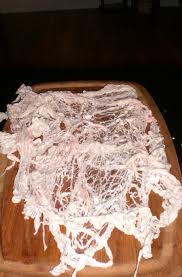
Caul fat is an inner organ lining the best of which comes from a pig. It is not greasy or smelly. In a ten pound box for example it will be squished together in a mass. Soak in a pan of water and start to separate the sheets. Lift a large sheet to a cutting board, and using a paring knife or scissors, cut 6 inch squares. (I pack what I don't use in small freezer bags). It won't be neat. It doesn't have to be. You can place a couple ounces of stuffing in the center, press to from a disk and fold the caul over. You can spread filling, tube like, across the caul and roll it like a frank. Fry over medium heat. The caul will melt away or leave just a trace of gorgeous netting. Once you have caul in your system you will discover a variety of uses. Here are pics of the ultimate chicken loaf.

Monday, August 2, 2010

Tomatoes

Tis the season.

Tomatoes are in and I want to help to keep things simple. A good first principle is that canned tomatoes are for cooking and fresh tomatoes are to be eaten fresh. Most of us will simply cut or slice a fresh tomato and add it to a salad or sandwich. Here is a preparation that takes longer to write about then perform and will significantly improve your summer tomato pleasure.


Filleting a tomato. The pics are self explanatory. Here are some essentials. Just barely score the flesh. Immerse in boiling water for no more than a minute (you will notice the skin start to curl).


The point is not to cook the tomato. Plunge in a bowl of icy water. Remove center core. Peel.


Cut from the top to the bottom of the tomato at the point where the flesh is thickest. Err on the side of thicker. You can always remove excess with your fingers. Sometimes you will create a quarter piece or often the whole will remain intact.


These fillets are obviously dryer and thus better on bread, lack uggies which freak most kids and some adults, and can also be sliced and or diced for a variety of uses. Your salsa will improve at once.


Collect the uggies in a sieve and press and strain them for juice.

Here is a fabulous recipe: Under cook 1/2 pound of pasta by a minute. Save a half cup of cooking water. Heat retained 1/2 cup juice in saute pan, add pasta, swirl in hot water as needed to moisten, stir till absorbed (about a minute), turn out. Top with sliced fillets of tomato, oil, some shredded basil, a crack of black pepper or red flakes, a sprinkle of salt, serve 4.

A side dish: Roma style tomatoes are grown because they have thick flesh, a high meat to juice ratio and thus are perfect for cooking. There is no reason to grow your own given the producers do a great job of the whole process, including canning.
San Marzano "style" tomatoes are Roma type and unless labeled DOP are grown here. A lot of time and energy has been spent tasting different canned tomatoes and conclusions are reached that might have you going out and spending 5 bucks a can in the belief that an Italian San Marzano is a better tomato. If we were eating them from the can (we don't) the expense might be warranted. Given that, at least, we will smash a garlic clove, add a pepper flake, and cook our tomatoes in olive oil for at least 20 minutes I defy anyone to distinguish the difference in the source of the tomato once cooked. More important is to notice the amount of sodium added to the can. It varies widely and you don't need the extra salt. You can always add your own.
Consider how you want your canned tomatoes to perform and purchase the appropriate style. Crushed, sometimes labeled "kitchen ready" are the simplest for a basic sauce. Italians buy jars of "passata" for their sauce which are essentially crushed tomatoes passed through a sieve. You might want diced to hold up a little texture for a cooked TEX/MEX salsa, and whole tomatoes can stew with a chicken and hold up.
Many eschew tomato paste as something less then authentic. Big mistake. For years I couldn't discern what it was that smelled so rich emanating from the back of checkered tablecloth "Ity" restaurants. I couldn't duplicate that aroma and I knew it was key to a successful sauce. Roberto Donna of Galileo in D.C. finally clued me in. Caramelize a couple of tablespoons of paste in oil with garlic till just lightly brown and then proceed to add tomatoes etc. Ah the love.

Monday, July 12, 2010

World of Work

You know a problem is getting "serious" when the NYT does a feature on its front page, American Dream Is Elusive for New Generation. The story is a profile of the agonies of 2008 Colgate grad Scott Nicholson, the unemployed millennium gen, solid son of the solidly middle class. The latest example of an economy gone bad. Comments attached to the piece
and the letters to the editor that followed, give him and his family a pretty swift ass kickin. He appears self indulgent and his family enable him.

No one in this story, or the related comments, challenges any of the basic premises underlying Scott's predicament. He must be thankful for any job offer. He must get out of the house. He might move to Europe where the job possibilities might be better. Scott must get better at becoming a wage slave to a system that doesn't need or want him.

During the same week Alternet picked up a story from Psychotherapy Networker / By Mary Sykes Wylie, appropriately titled: Has the American Dream Become our Nightmare?

That title could be thought to be the first of a set of fundamental questions that needs to be asked and answered. Other questions that we all have to ask include: How might Scott spend his days in ways that don't make the rest of our lives materially worse? What is it that we need, if anything, that Scott might help us acquire? How might Scott evaluate what he really needs? What are Scott's lifetime ambitions; where does he want to be, with whom, and how many of his ambitions involve money? Obviously none of the answers to these questions or even how to pose them were part of Scott's education.

Colgate senses the angst in their graduates. Their response in justifying $54.000 in annual costs to attend include assisting the host community by buying up buildings and placing University offices within them, publishing studies that demonstrate the Colgate grads do better salary-wise then many peers, and bringing back Alumna with a job to share their experiences as a demonstration of "you too can do it." In this case the alum is a vp at MTV.

What Colgate might do: They could rethink their curriculum in terms of 21st century reality. They could sponsor teach-ins on the most critical issues of the day. They could assist their students in conceiving of and moving into a world that was sustainable, ethical, and elegant. They could strengthen their career counseling department. To be effective they have to anticipate the world their graduates are going to enter. The university could provide transitional housing for grads while they determined their next moves. They could incubate entrepreneurial alternatives to traditional job searches. The university might provide goods and services: health care, senior activities, child care, food service, art activities, to their neighbors, enriching the entire community. Any number of grads might be part of the delivery mechanism. Most importantly the university is going to have to become the well spring of alternatives to a system that is so fundamentally broken.

The best example of what is required is exemplified by the award winning documentary film, TEE Shirt Travels, embedded here.

Filmed in Zambia, this film explores the unintended consequences of western do-gooders shipping second hand clothing to a nation in "need". In the process we wiped out their indigenous textile industry and created a nation of re-sellers. It is heartbreaking. And just when you think you can't stand it any more you have the testimony of the stated dream of an unbelievably hard working Zambian young man. His ambition is to have a car. We have shortened the distance between the continents. We have shortened the timeline of civilization.