Friday, June 22, 2012

Prosperous


I am reproducing the following letter to the editor printed in the current issue of The New Yorker in which the author hits a new note in the on-going discussion regarding the "value" of college education. More to my purposes is to point out his concern regarding the vast numbers who won't live as "prosperous" as their parents. This has become such an accepted proposition that it needs to be examined.
RE: THE COST OF COLLEGE
A letter in response to Nicholas Lemann’s article (May 28, 2012)
JUNE 25, 2012
Nicholas Lemann concludes his piece on student debt with a few words extolling the societal benefits of higher education (Comment, May 28th). Perhaps, but the dollar value of a college degree for many students is not clear. While there is considerable debate over the numbers, it seems that about half of all jobs in the foreseeable future will require a four-year college degree. If our society needs half our workers to do skilled work that doesn’t require four-year degrees, our obsession with making college available to all seems destined to disappoint. There’s a flip side to the studies that promote the benefits of college: if college-educated workers are now making eighty-four per cent more than high-school graduates, up from forty per cent more in 1983, it means that those who can’t afford a college degree have fallen radically behind. We need to respect the fifty per cent of workers who do so many essential jobs, and we need to pay them a living wage. Part of the desperation for a college education is that the gap between the rich and the rest of society has grown so large that everyone except the very few winners in our brave new economy will lead lives that are much less prosperous than those of their parents.
Tim Butterworth,Associate Fellow.Institute for Policy Studies,Chesterfield, N.H.


My father owned a succession of Jew Canoes. His last was that 1972 Eldorado which he kept in its own house in Florida. When I met Carrie her daddy drove a 1956 Coupe-deville. Her grandfather drove a Chrysler 300. They all consumed an average of 7 mpg. Our first vehicle was a Lambretta motor scooter. Our first car, a Fiat 500. 


My father was a home builder. His house was a 2400 square foot rambler. He built much larger houses. Today they would be called McMansions. He referred to them as "Big-Mothas". Carrie's parents built a three level split with a two car garage.

My father would answer when asked, "how was the restaurant?" "It was fantastic, the steaks fell off the sides of the plate." My parents favorite restaurant was Momma Leones in NYC where you could order an antipasto that just kept coming, "and the shrimp. they never stopped bringing those shrimp". They lived large. It was the motif of their generations' lives."Do you want to be Queen for a Day?"

We met in college. Carrie stopped after her second year to earn the bread to keep us going. We studied liberal arts. I majored in American Thought. We were the first people in our families to go to college. We borrowed the money and paid our own way. 

Our first apartment was advertised in the Washington Post as a studio at a very uptown address for $75 a month. It was on the ground floor, past the laundry. A dentist had offices on this floor and controlled more space then he needed. He sub-leased a triangular space to us. The walls were 17 ft long leading to a bathroom at the apex. No kitchen. We put a "bar" piece in as a room divider and stored a hot plate, rotisserie (which blew fuses on the entire floor), and pots and pans on the one shelf. We did dishes in the shower. We had a cat. When we invited our parents over the first time, we cued the doorman to help with the joke. This building had a turnaround drive. It is still a prestigious address. Neither set of parents could believe we lived here. The doorman showed them in. They entered the apartment, "living room" and when they asked to see the rest, were led into the tiny bathroom. I remember my father's reaction, "people can't live like this."  We did until the city insisted that it was a non-conforming space and we had to leave to move into our next one room studio. 

When we bought a house it was 768 sq ft.We had a dog, a cat, and a child.   We expanded it to 1100 sq ft. over the thirty years we owned it. 
We ate ramen, mac and cheese, and a lot of iceberg. We never, here comes the cliche', ever, felt poor. Our fortunes rose and fell, we moved. We ate better. I don't know how to measure our "prosperity". Clearly we didn't share our parents life style. Today you would measure our btu footprint as a fraction of our parents and it would be celebrated in some quarters as ecologically correct.

It is critical that we challenge the generally accepted definitions of "prosperity". The facts are that all over the world, the desire to live large as individuals, and to grow as nations looks all too similar to how our parents, and most of my gen live. We can't sustain that life-style. We have to change the paradigm. It begins by challenging the terms that set the tone, for what constitutes a prosperous life. 


Thursday, June 14, 2012

Latkes by any other name


Potato pancakes are commonly associated with traditional cuisines of Luxembourg (gromperekichelcher), Latvia(as kartupeļu pankūkas), Lithuania (as bulviniai blynai), Austria, Belarus (as draniki), Germany (e. g. as Kartoffelpuffer), Poland (as placki ziemniaczane), Ukraine (as deruny), Ashkenazi Jewry (as latkes or latkas (Yiddish: לאַטקעס, Hebrew: לביבה levivah, plural לביבות levivot)), Hungary, Slovakia, Persia and the Czech Rep. (as bramborák or cmunda), although other cuisines (including those of India and Korea) have similar dishes, such as Gamjajeon. It is also the national dish of Belarus. In Ukrainian, Belarusian and Russian cuisines, potato pancakes are commonly known as deruny (Ukrainian: деруни) or draniki (Russian: драники, Belarusian: дранікі). Throughout Germany, potato pancakes are also very common under the names Reibekuchen or Kartoffelpuffer, and they are eaten either salty (as a side dish) or sweet with apple sauce, blueberries, sugar and cinnamon; they are a very common menu item during outdoor markets and festivals in colder seasons; a traditional favorite in southern Indiana during holiday festivities.

The Rösti from Swiss cuisine differs insofar as it never contains egg or flour.

In the North-East of England (particularly County Durham), there is a popular dish known as tattie fish- "tattie" being the local slang for potato, and "fish" because the pancake resembles a deep fried piece of fish. The pancake consists of flour, eggs, shredded potatoes and onions. Some people add tomato or cheese to the mix, depending on taste.

A form of potato pancake known as boxty is a popular traditional dish in most of Ireland. It is made in a similar way but using more starch.

The Swedish version of unbound potato pancakes is called rårakor. When prepared with a batter of wheat flour, milk, egg, and shredded potatoes and fried like thin pancakes, they are called raggmunk, the word "ragg" means crispy and "munk" derives from the Swedish "munkpanna", which is literally translated as donutpan. Both kinds are enjoyed with fried pork and lingonberry jam.

As I was perusing an otherwise great food book, "From Harvest to Heat", I came  upon a recipe for "hash browns" that resembled latkes. I know hash browns and as you read in the above there are many variants of latkes but hash browns ain't one of them. To further the insult the recipe has you grate the potatoes. I found that many recipes for potato pancakes begin with; grate some potatoes. Think of the difference between a shredded carrot and grated parmesan and you get my point. You want to shred your potatoes. There is a shredding disk in most food processors. The manual square steel combo kitchen tool has a shredding side, a slicer, and a grater. Use the shredder for long, an inch or so, crispy threads. 

I make latkes from any potato but russets which are just too starchy. Gather a pound, three or four medium or two large potatoes. Shred them and cover the shreds in a bowl of water. Swirl with your hands for a few seconds and drain into a sieve. Dump the shreds into a large clean tea towel. Gather up the corners and form a tight ball. Over the sink, squeeze the towel until most of the water is expelled from the potatoes. 

In a large mixing bowl crack and stir an egg. Add a tablespoon of flour. Now things get interesting. I add a couple tablespoons of my favorite dried thai shallots, you can add shredded onion raw or fried, scallions, a shredded carrot, some shredded celeriac or zucchini,  crumbled cheese, s/p. paprika, garlic, herb, you get the idea. Add the potatoes to your bowl and stir throughly. We use two non stick pans so we can do many at once. Crank to medium high heat and add lipid of choice. We use duck fat but any fat will do. Gather a large spoonful or ice-cream scoop of mix and gently plop into pan, press with spatula. Repeat leaving space between to make flipping easier.


 When edges start to turn brown (the crispy bits are critical) flip and let finish, browned. Drain on a paper towel, place in warm oven while you finish the rest.
 I double this recipe and have leftovers refried with a poached egg for breakfast. As many variants as there are for flavoring you can have just as much fun with toppings. Sour cream and applesauce are standard. Consider minced corned beef, or bacon, smoked salmon, caviar & creme fraiche,  melted cheese topping, or a burger (an open faced sandwich). And for a real open ended option consider using any shreddable veg; beets, parsnips, sweet potatoes, for the pancake. Or, and I do this, make some spaghetti, drain it, season it and cook as above. 
Recession, what recession?


Tuesday, May 8, 2012

Occupy Facebook

 "Devil or Angel I can't make up my mind"

Wing makers and diadem polishers are busy, glow sticks are being fueled as new members of the pantheon of Mammon are about to be welcomed into the fold. What's most difficult for me is my inability to be clear about their belief system. The same people whom we sanctify as good guys, known by their support for OWS, expanded democracy, and the redistribution of wealth, are this very minute checking their insider status, their stock allocations, and lock-up dates for their soon to be public shares of Facebook. Many new members of the soon to be fabulously wealthy are exploiting the very systems that they decried last MayDay. 

Those not lucky enough to be insiders are calling their brokers looking for shares, checking the institutions that they own in their 401s to see if they are going to get any shares, and planning to get the jump on the trading as soon as it starts. Warren Buffett isn't going to play. He can't place a value on the company but he knows that all the noise is creating a "sense of value" that has no intrinsic worth. ( "Bubbles" aren't revealed when they burst. Bubbles are the everyday nature of a stock market that makes prices on a multiple of  expectations of unpredictable future activity). He may also have noted that insiders are selling nearly half of the offering shares. It is usually a negative sign when insiders express so little faith in the future fortunes of their company that they want to rush to the doors to sell their shares. 

Many of the so called "good guy funds", for this post I took Calvert, an early and successful cluster of funds that markets that they invest in sustainable and moral corporations, if history is any guide (they own Google, Apple, and many other new media cos) will be at the trough buying from Morgan Stanley (lead underwriter). JPMorgan Chase & Co., Goldman Sachs Group Inc. (GS),Bank of America Corp., Barclays Plc (BARC) and Allen & Co. also will help with the IPO, Facebook said in the filing. 

The story of Sheryl Sandberg's migration from the Treasury Dept under President Clinton, who she worked for along the way before becoming COO of Facebook, is documented on Bloomberg here
So now, if you have clicked away, you know that Facebook is Wall-Street and that only the most naive believe that Facebook is in the social change business, here or abroad. The temporary exploitation of Facebook as a tool to organize a meet-up, should not be confused with the greater and longer lasting function of Facebook as a means to expand through their advertising sales, the ever increasing materialism of new markets. 

"Money for nothing, chicks for free"

As for the expansion of democracy, the implicit understanding that shareholders after all control the companies they invest in, is contradicted by Facebook  using a little known means to retain control: Zuckerberg adopted a dual-class structure in 2009. He has 10 votes for every other shareholder’s single ballot. 


The larger picture is just as morally confusing. What does it mean when we invest almost 100 billion dollars in an activity as vacuous as Facebook. Discussions of the policy of less or more government, investment in infrastructure or education, or the military for that matter, become meaningless against the backdrop of a culture that expresses its true sentiment, aspirations and dreams, by entering the casino and betting up the value of Facebook. Cuz that is what you are doing. Investors have become suckers in the largest ponzi scheme on earth. 

The shortest course in the mechanics of an IPO: An individual or group begins some form of activity that has economic value, or the potential of profit. They can organize that activity in a variety of forms. One could form a partnership, a co-op, a non-profit, or a closely held corporation. Facebook chose stock corporation. Lawyers develop documents which register the company formally, describe the activity, where it will function and the initial owners and board members of that company. Other docs spell out meetings and elections, formats etc. Stock is registered and distributed. Most is kept "on the shelf". In the case of Facebook there are 2.48 billion shares registered at a value of 6 cents a piece. (337.4 million are going to be sold through this IPO). When an insider is awarded shares in lieu of salary, or for a bonus, that 6 cents is their basis price. At some point, enough activity has taken place that someone initiates a conversation about taking the company public. That is selling shares either from the shelf, or from insiders to raise capital. That capital might be used to expand the company, liquidate debt, make acquisitions, or enrich insiders who decide to sell their shares. A set of sell side "bankers" goes through a process of due diligence and writes up the findings. The corporation and their bankers make judgements about how they might price these shares, and how they are going to word the "red herring" the offering document to the public. If you ever read a red herring you will note that they say nothing but the worst about the fortunes of said company. They are not allowed to hype without evidence. It is the wink in the process. The company goes on a road show attracting investors to the IPO and obtaining subscriptions, commitments to purchase x shares. On a date specific the company under the auspices of the SEC offers the shares. The initial shares are distributed and then trading moves to the markets where those less fortunate are allowed to buy and sell shares. There is often a pop created by either a perfectly legal agreement on the part of the bankers to commit to purchase shares in the after market, or a purposeful shortage of shares available determined by bankers guessing the demand, and then not satisfying it. Insiders whose shares are not part of the initial IPO are locked out of sales for 6 months. Their sales into the market after lockout are the first wave of dilution, that is selling more shares of a company into a market after a price per share is being determined on a trading platform. Remember those millions of shares that Facebook retained on the shelf. They too can and will be sold in "secondaries" to raise yet more money and dilute the shares further. 


It is getting so hard to maintain even the semblance of liberalism in the face of such temptation. Before you sell your soul, or wish that you had I think it is important to consider one small excerpt from Wendell Barry's Jefferson lecture: excerpt from Wendell Berry's 2012 Jefferson Lecture 

"That we live now in an economy that is not sustainable is not the fault only of a few mongers of power and heavy equipment. We all are implicated. We all, in the course of our daily economic life, consent to it, whether or not we approve of it. This is because of the increasing abstraction and unconsciousness of our connection to our economic sources in the land, the land-communities, and the land-use economies. In my region and within my memory, for example, human life has become less creaturely and more engineered, less familiar and more remote from local places, pleasures, and associations. Our knowledge, in short, has become increasingly statistical.
Statistical knowledge once was rare. It was a property of the minds of great rulers, conquerors, and generals, people who succeeded or failed by the manipulation of large quantities that remained, to them, unimagined because unimaginable: merely accountable quantities of land, treasure, people, soldiers, and workers. This is the sort of knowledge we now call “data” or “facts” or “information.” Or we call it “objective knowledge,” supposedly untainted by personal attachment, but nonetheless available for industrial and commercial exploitation. By means of such knowledge a category assumes dominion over its parts or members. With the coming of industrialism, the great industrialists, like kings and conquerors, become exploiters of statistical knowledge. And finally virtually all of us, in order to participate and survive in their system, have had to agree to their substitution of statistical knowledge for personal knowledge. Virtually all of us now share with the most powerful industrialists their remoteness from actual experience of the actual world. Like them, we participate in an absentee economy, which makes us effectively absent even from our own dwelling places."


Wednesday, May 2, 2012

May 2

Greeks protest their government's austerity measures, May 2011

Last October the far-right party Chrysi Avgi, also known as Golden Dawn, won its first seat in Athens city council. Since then it has held several anti-immigrant rallies in areas with large migrant communities. Fascist activists are also alleged to have carried out random revenge attacks on innocent migrants after a Greek man was stabbed to death in central Athens in March.
‘I never come out of the house during the night, because I’m afraid of the fascists,’ says Abolzar Jalily. ‘I came from Afghanistan to be safe.’ Jalily left his home after receiving death threats because he worked as an interpreter for foreign forces. Now he faces a fresh threat from a violent fascist movement operating with near impunity in downtown Athens, where Jalily lives with his family.
‘In one attack the fascists killed some refugees and injured more than 150 people. They beat them very badly and they could not go to the police because they would do nothing for them,’ he says.
Tania, a Bulgarian immigrant who has lived in Greece for 10 years, says she is too afraid to travel downtown after hearing stories about Albanians being randomly attacked. ‘There are some fascist organizations that are trying to blame foreigners for many things that happen here, one is taking their [Greeks’] jobs.’
Conditions for migrants in Greece are likely to deteriorate further. The new austerity measures will mean greater penury for those who are already last in line for state support and living wage jobs.
‘I am a single mum and I have no help from the government,’ explains Tania, who is a maths and physics graduate, but works as a cleaner and nail technician. If you are a foreigner here, you have no social services to help you.’

Sound familiar? Far right candidate Marie Le Pen garners 6 million French votes in the latest national election. Alabama, Arizona, and other states implement punitive anti-immigration laws. All of this has the effect of diverting our attention away from the looming debt crisis that will consume us all.  How quickly we forget. 

Pundits and politicians like to send up the Greek example as one to be avoided. Here is an excerpt from ABC news intended to enlighten us.

 Why is Greece in debt?
Like any state (or person, for that matter), it spent more money than it took in. After the switch to the euro, the traditionally strong Greek public sector saw wages rise to ultimately unsustainable levels. To compound this, the retirement age in the country is low (by Western standards) and benefits are generous.
But that alone is not enough to sink an economy.
Mass tax evasion, on the other hand, can certainly do the trick. And it did in Greece. When people and businesses don’t pay their taxes, it limits revenue. So when the money inevitably ran out, Athens turned to European banks for loans. Soon, the government was borrowing billions and those debts, like subprime mortgages in the United States, were often repackaged as complex commodities  and sold off around the continent. Everyone, especially banks in France and Germany, wanted a piece. Now they have it.

They had help. From wiki: (Goldman is being criticized for its involvement in the 2010 European sovereign debt crisis. Goldman Sachs is reported to have systematically helped the Greek government mask the true facts concerning its national debt between the years 1998 and 2009.[71] In September 2009, Goldman Sachs, among others, created a special credit default swap (CDS) index to cover of high risk of Greece's national debt.[72] The interest-rates of Greek national bonds have soared to a very high level, leading the Greek economy very close to bankruptcy in March and May 2010 and again in June 2011.[73] Lucas Papademos, Greece's new prime minister, ran the Central Bank of Greece at the time of the controversial derivates deals with Goldman Sachs that enabled Greece to hide the size of its debt.[74] Petros Christodoulou, head of Greece's debt management agency began his career at Goldman Sachs.[74] Mario Monti, Italy's new prime minister and finance minister, who heads the new government that took over after Berlusconi's resignation, is an international adviser to Goldman Sachs.[74] So is Otmar Issing, former board member of the Bundesbank and the Executive Board of the European Bank.[74] Mario Draghi, the new head of the European Central Bank, is the former managing director of Goldman Sachs International.[74] António Borges, formerly head of the IMF's European Department is a former vice chairman of Goldman Sachs International.[74] Peter Sutherland, former Attorney General of Ireland is a non-executive director of Goldman Sachs International. Karel van Miert, former EU Competition Commissioner is an ex-international adviser to Goldman Sachs.[74] These ties between Goldman Sachs and European leaders is an ongoing source of controversy.[74] )

Why does Europe — indeed, the world — care so much about Greece’s debts?
One of the perceived perks when Europe got together on a single currency (Greeks, for instance, gave up the drachma for the euro) was that a strong Europe could prop up an individual state in a time of need. But what’s happened is that Europe itself has become too weak, in the aftermath of the global financial meltdown, to bite the bullet on a country like Greece. A default would shatter otherwise monetarily strong countries like Germany. The Germans, like the Americans, would be left with a host of “too big to fail” banks ready to do just that. 


It is critical that we remember how we got here. We can't be blinded by big numbers. We can't scapegoat the 'immigrant" as the walls of our institutions collapse around us. They didn't create this monster. They didn't benefit from it. The pigs who did are being driven to work where they continue to push this horrific system to the breaking point.  And most of us live in the false sense of security that it won't effect us. It has, it is, and it has only just begun. The very same forces and institutions that are foreclosing on homes are foreclosing on countries. The "bond vultures " as they are known in the trade will be paid. An example:

 In the past three months, US asset managers Loomis Sayles and BlackRock, Swiss private bank Julius Baer, French asset manager Natixis, German investment fund StarCap and Luxembourg-based Ethenea Independent Investors were among a raft of funds to have bought Greek sovereign debt in the secondary market.
Between them, they acquired around €150m (£133m) of Greek debt, public filings on Bloomberg show. Market sources said there is still a lot of activity in Greek debt, despite the crisis, with data from public filings just the tip of the iceberg.
On average, Greek debt is trading at around 50% of face value, but markdowns are smaller for short-dated bonds and larger for longer-term debt. If bonds are redeemed at par as part of a second bail-out, vulture funds may as much as double their money, debt traders said. The Telegraph. 
In plain English:  These vultures win if the government pays the bond holders at face value. The government is desperate to satisfy these bond holders demands because if they don't, if they default, it takes them out of the system for the future. But lets name it. There is no "government entity" that pays as we are witnessing. It is the Greek people who are out the money. They will sacrifice jobs, pensions, health care so that these vultures can feed. The profits of these vultures is at the expense of the Greek citizenry. It is of course perfectly legal. It is what capitalism is all about.

This is one tiny trade. Imagine when the calls come in ( the bonds are due) to retire the outstanding debt ( bonds) that is on the books. The Economist publishes a debt clock here.  This indicator of where the 40 trillion dollars of debt is located only identifies the numbers on the books.  
Read the story of the 300 trillion dollars worth of derivitives here.  No one knows who holds these instruments nor,  how they will be cleared. 

OWS organizers bristle when outsiders tell them what they might want to focus on, what are the issues to be addressed, and what they might propose to alleviate the problems.  They want to keep the movement amorphous, open and horizontal. May Day is over. The "black block"  has wreaked its havoc, peaceful demonstrators have made their presence felt,  and nothing, nothing has been done to alleviate the problem. Turn away, leave it to the bankers to be the only ones who know how this game is played, and we will be consumed by their greed.  We have to get smarter. We have to do the hard work of averting  this disaster. It isn't going to happen as a result of a one day protest. We have to build a new economy. 


Monday, April 9, 2012

9 Museums, 30 Days


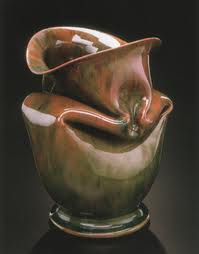
We had clear objectives when we plotted the roll-around. We had known of the work of George Ohr, the mad potter of Biloxi, but had missed the opportunity to visit his studio before Katrina struck. We were elated to hear that a new studio rose on the shore and retained examples of his work. That was our intended end point. The best laid plans are always subject to change and so it was.


The first stop was Asheville, N.C. Carrie had made the Skyline Drive potter's studio tour some 20 years ago. Now there were collection points where galleries have assembled works from those studios making the work more accessible. The most impressive gallery, in scale, in Asheville is Blue Spiral 1. The story is told of a John Cram who comes to town when it is broke and buys a lot of real estate. He opens the store fronts individually and then integrates the second stories creating a gallery of enormous proportions. This space defies easy description as it is as much museum as gallery. In that regard we were blindsided by the discovery of an artist that we mooned over. Will Henry Stevens

is finally gaining some recognition and the curators of the gallery made us feel less ignorant by screening a movie for us of the man considered the greatest unrecognized artist in the country. We were told that they were the controllers of his estate and that a major portion of his work was held by the Ogden Museum in NOLA. More later.


We had planned to stop in Chattanooga Tn. but the weather closed in around us so we hightailed it to Texas. The cliches are easy. Big Texas money, buys big art, and if you stop there you miss the point. Yep downtown Dallas is dominated by big money museums, but, as you know, the entire country is developing communities with art district themes. In Dallas the hot new gathering place for the young, the hip, and the creative class is the Bishop Arts District.


There we met people, in the great tradition of the best travel is a pinball game, who touted us onto FT Worth. Cowtown? Really? Off we went. Let wiki describe the overview of what it feels like to be on the campus of the: Ft. Worth Cultural district

  • The Modern Art Museum of Fort Worth, founded in 1892, is the oldest art museum in Texas. Its permanent collection consists of some 2,600 works of post-war art. In 2002, the museum moved into a new home designed by Japanese architect Tadao Ando.
  • The Kimbell Art Museum houses works from antiquity to the 20th century. Artists represented in its holdings include Caravaggio, Fra Angelico, Picasso, Vigée-Lebrun, Matisse,Cézanne, El Greco, and Rembrandt. The museum's home was designed by American architect Louis Kahn.
  • The Amon Carter Museum of American Art focuses on 19th and 20th century American artists. It houses an extensive collection of works by Western artists Frederic Remingtonand Charles M. Russell, as well as an impressive collection of 30,000 exhibition-quality photographs. It also includes works by Alexander Calder, Thomas Cole, Stuart Davis,Thomas Eakins, Winslow Homer, Georgia O'Keeffe, John Singer Sargent, and Alfred Stieglitz. American architect Philip Johnson designed the museum's home, including its expansion.
  • The National Cowgirl Museum and Hall of Fame is the only museum in the world that is solely dedicated to honoring women of the American West who have demonstrated extraordinary courage and pioneer spirit in their trail blazing efforts.
  • The Fort Worth Museum of Science and History - One of the largest Science and History Museums in the Southwest. It includes the Noble Planetarium and the Omni Theater.
  • Will Rogers Memorial Center - a multi-purpose entertainment complex and world-class equestrian center housed under 45 acres (180,000 m2) of roof spread over 85 acres (340,000 m2) in the heart of the Fort Worth Cultural District. Each year approximately 800,000 people attend the three week event known as the Southwestern Exposition and Livestock Show, formerly called the Fort Worth Stock Show & Rodeo.
  • Casa Mañana - The nation's first theater designed for musicals "in the round". A controversial renovation completed in 2003 turned the once unique "House of Tomorrow" into a traditional theater and abandoned the round design. The building's unique silver dome remains.
  • Museum Place is an 11-acre (45,000 m2), mixed-use development in construction that includes ground level retail, office space, and residential space. The main buildings in this development will be an eight-story brick and glass low rise, a modernized flatiron style building and a new post office that will feature damaged metal from the 2000 tornado as an art display.
  • 7th Street is the main street for the cultural district, since it will feature the Museum Place development, the existing residential So7 and Montgomery Plaza, West 7th (another mixed-use development which will feature office, residential, retail, hotel, and a movie theater), and there are even talks of a streetcar route in the near future.

We stopped in the Amon Carter.


What happened there proved to be indicative of what happened throughout the journey. The employees, volunteers, the staffs of these spaces all, to a person, went out of their way to approach us, assist us, engage us in discussions of what we were about. They were as interested in us as we them. So in the case of the Amon Carter which was mounting a huge installation of Charles Russell watercolors, the curator and author of the book/catalogue of this show was bulk signing copies for later sale. He stopped what he was doing and we talked about the rigors of mounting such an exhibition. He had time for us.


Years ago, when we all lived in D.C. Walter Hopps was as approachable as he was affable. When he got the commission to curate the Menil in Houston in the late seventies we all pledged we would visit. It took us 30 years to fulfill the promise. The deMenils intended this collection of buildings to be in and of the neighborhood.


They achieved that end by buying most of it and retaining the character of the housing stock which includes studios, study centers, and lecture spaces. The effect is to integrate their collections into the city in a way I have never experienced. The world class architecture doesn't promote ART is here and you are smaller, it levels the viewing field, making the art all the more democratic. It is also free.


Off to Louisiana, MardiGras, Lafayette style, a living, breathing, collection of many arts in many forms. Of the people, for the people, by the people.


The exhibition Hard Truths, the works of Thorton Dial had travelled from Indiana to the NOMA.

All, so called outsider art, challenges you to think hard about what the process of art making, collecting, and what the business is all about. Mr. Dial was the subject of a 60 minutes interview years ago and when it was over he hit the roof because of what he interpreted as the slight of having so called experts pigeon hole him as naive, or uneducated. He withheld his work for years.


The Ogden

in downtown NOLA had a few paintings by Stevens on exhibition but not as many as we had hoped. It seems they don't respect him as much as they might given history of his life in New Orleans. So it goes. And then the second aha! Why had I, a minor in American art history, never heard of Enrique Alferez. Once before the art market had been explained to me as having limits. When discussing the colorists of Washington D.C. of whom 6 were prominent, I was made aware there were others but no room for them in important exhibitions. So while we know of the top three Mexican born muralists we know less of Mr. Alferez. We are thrilled to fill in the gap.


Down the road a piece and we were finally at the Ohr-O'Keefe museum. Do click here as no still pic can do justice to what you find along the road. I'll skip Bilbao Spain for Biloxi. A four acre campus of American Museums designed by Frank Gehry. Oh Yeah.


Finally to Chattanooga to see if the hype that another major industrial disaster area can be reborn. Don't take my word for it. For me the magic of America writ large is the ability for and the execution of second acts. Pittsburgh, Brooklyn, Oakland. Now add Chattanooga to the list.. It would do better if it was named Ile something, or Casa something. It will have to stand on its American roots. And stand it does. Flying off a cliff above the Tennessee River is the Hunter Museum. The new wings clearly owe a dept to the Gehry look as stainless steel clads the building and bent wood defines the interior spaces. A fabulous collection of American art graces these walls and gives the town an identity that vaults it squarely into the 21st century.


For all of highs, the oohs and aahs, the discovery of new places and spaces, I am still burdened by a gnawing knowledge of how this world operates, and how little the majority of us realize that what we experienced was built on the backs of the American taxpayer. Read this brief history of Andrew Mellon, the benefactor the National Gallery of Art. What you are not told is that he was being pursued by the fed on tax evasion charges regarding art. It may just be a coincidence that he endowed the Gallery at exactly the same time a grand jury was convened, and that subsequently the charges were dropped. What we do know is the tax code allows the following: A member of the 1% buys a collection of works of art by a relatively unknown artist. Of course the art is on the cheap. He prevails upon a museum to accept a piece as a gift. The painting will appear in a new acquisitions exhibit. The artist's value is now enhanced as is the collection of the buyer. The buyer waits. Other museums want to own work by this artist. His portfolio grows. The original buyer watches as his collection's value skyrockets. He has choices. One of the most profound is to donate a big chunk either in his lifetime or upon his death and gain the tax deductible value of the gift, at its current value. So let's use real numbers. Painting bought for 1000 dollars. Painting donated at value determined by museum (the beneficiary) is now 250 thousand dollars. Tax benefit now applies to other income to the tune of 250K. We make up the difference.


In addition we are asked to pay admission to most of these institutions. It is one thing for a modern deMedici to commission a work, pay for it, enjoy the market value appreciation, or the self aggrandizing. It is quite another for us to run to the museums and reinforce the process of making all of them yet wealthier. Leave a buck at the MET. Don't feel guilty.


Thursday, March 29, 2012

Adrienne Rich, in her own words

Adrienne Rich "Why I Refused the National Medal for the Arts" Los Angeles Times Book Section -- August 3, 1997

Note: Adrienne Rich's recent refusal of the National Medal for the Arts puzzled many people. The debate over the proper relations between the state and the artist, between the realms of the public and the private, continues unabated. Book Review invited Rich to explain why she refused the presidential honor.

The invitation from the White House came by telephone on July 3, just before the national holiday, a time of public contention about the relationship of government to the arts. After several years' erosion of arts funding and hostile propaganda from the religious right and the Republican Congress, the House vote to end the National Endowment for the Arts was looming. That vote would break as news on July 10; my refusal of the National Medal for the Arts would run as a sidebar story in the New York Times and the San Francisco Chronicle.

In fact, I was unaware of the timing. My "no" came directly out of my work as a poet and essayist and citizen drawn to the interfold of personal and public experience. I had recently been thinking and writing about the growing fragmentation of the social compact, of whatever it was this country had ever meant when it called itself a democracy: the shredding of the vision of government of the people, by the people, for the people. "We the people--still an excellent phrase," said the prize-winning playwright Lorraine Hansberry in 1962, well aware who had been excluded, yet believing the phrase might someday come to embrace us all. And I had for years been feeling both personal and public grief, fear, hunger and the need to render this, my time, in the language of my art.

Whatever was "newsworthy" about my refusal was not about a single individual--not myself, not President Clinton. Nor was it about a single political party. Both major parties have displayed a crude affinity for the interests of corporate power while deserting the majority of the people, especially the most vulnerable. Like so many others, I've watched the dismantling of our public education, the steep rise in our incarceration rates, the demonization of our young black men, the accusations against our teenage mothers, the selling of health care--public and private--to the highest bidders, the export of subsistence-level jobs in the United States to even lower-wage countries, the use of below-minimum-wage prison labor to break strikes and raise profits, the scapegoating of immigrants, the denial of dignity and minimal security to our working and poor people.

At the same time, we've witnessed the acquisition of publishing houses, once risk-taking conduits of creativity, by conglomerates driven single-mindedly to fast profits, the acquisition of major communications and media by those same interests, the sacrifice of the arts and public libraries in stripped-down school and civic budgets and, most recently, the evisceration of the National Endowment for the Arts.

Piece by piece the democratic process has been losing ground to the accumulation of private wealth. There is no political leadership in the White House or the Congress that has spoken to and for the people who, in a very real sense, have felt abandoned by their government.

Hansberry spoke her words about government during the Cuban missile crisis, at a public meeting in New York to abolish the House Un-American Activities Committee. She also said in that speech, "My government is wrong." She did not say, I abhor all government. She claimed her government as a citizen, African American and female, and she challenged it. (I listened to her words again, on an old vinyl recording, this past Fourth of July.) In a similar spirit, many of us today might wish to hold government accountable, challenge the agendas of private power and wealth that have displaced historical tendencies toward genuinely representative government in the United States. We might still wish to claim our government, to say, This belongs to us--we, the people, as we are now. We would have to start asking questions that have been defined as non-questions--or as naive, childish questions.

In the recent official White House focus on race, it goes consistently unsaid that the all-embracing enterprise of our early history was the slave trade, which left nothing, no single life, untouched and was, along with the genocide of the native population and the seizure of their lands, the foundation of our national prosperity and power. Promote dialogues on race? Apologize for slavery? We would need to perform an autopsy on capitalism itself. Marxism has been declared dead. Yet the questions Marx raised are still alive and pulsing, however the language and the labels have been co-opted and abused. What is social wealth? How do the conditions of human labor infiltrate other social relationships? What would it require for people to live and work together in conditions of radical equality? How much inequality will we tolerate in the world's richest and most powerful nation? Why and how have these and similar questions become discredited in public discourse?

And what about art? Mistrusted, adored, pietized, condemned, dismissed as entertainment, auctioned at Sotheby's, purchased by investment-seeking celebrities, it dies into the "art object" of a thousand museum basements. It's also reborn hourly in prisons, women's shelters, small-town garages, community college workshops, halfway houses--wherever someone picks up a pencil, a wood-burning tool, a copy of "The Tempest," a tag-sale camera, a whittling knife, a stick of charcoal, a pawnshop horn, a video of "Citizen Kane," whatever lets you know again that this deeply instinctual yet self-conscious expressive language, this regenerative process, could help you save your life. "If there were no poetry on any day in the world," the poet Muriel Rukeyser wrote, "poetry would be invented that day. For there would be an intolerable hunger." In an essay on the Caribbean poet Aime Cesaire, Clayton Eshleman names this hunger as "the desire, the need, for a more profound and ensouled world." There is a continuing dynamic between art repressed and art reborn, between the relentless marketing of the superficial and the "spectral and vivid reality that employs all means" (Rukeyser again) to reach through armoring, resistances, resignation, to recall us to desire.

Art is both tough and fragile. It speaks of what we long to hear and what we dread to find. Its source and native impulse, the imagination, may be shackled in early life, yet may find release in conditions offering little else to the spirit. For a recent document on this, look at Phyllis Kornfeld's "Cellblock Visions: Prison Art in America," notable for the variety and emotional depth of the artworks reproduced, the words of the inmate artists and for Kornfeld's unsentimental and lucid text. Having taught art to inmates for 14 years in 18 institutions (including maximum security units), she sees recent incarceration policy overall as rapidly devolving from rehabilitation to dehumanization, including the dismantling of prison arts programs.

Art can never be totally legislated by any system, even those that reward obedience and send dissident artists to hard labor and death; nor can it, in our specifically compromised system, be really free. It may push up through cracked macadam, by the merest means, but it needs breathing space, cultivation, protection to fulfill itself. Just as people do. New artists, young or old, need education in their art, the tools of their craft, chances to study examples from the past and meet practitioners in the present, get the criticism and encouragement of mentors, learn that they are not alone. As the social compact withers, fewer and fewer people will be told, yes, you can do this, this also belongs to you.

Like government, art needs the participation of the many in order not to become the property of a powerful and narrowly self-interested minority. Art is our human birthright, our most powerful means of access to our own and another's experience and imaginative life. In continually rediscovering and recovering the humanity of human beings, art is crucial to the democratic vision. A government tending further and further away from the search for democracy will see less and less "use" in encouraging artists, will see art as obscenity or hoax.

In 1987, the late Justice William Brennan spoke of "formal reason severed from the insights of passion" as a major threat to due-process principles. "Due process asks whether government has treated someone fairly, whether individual dignity has been honored, whether the worth of an individual has been acknowledged. Officials cannot always silence these questions by pointing to rational action taken according to standard rules. They must plumb their conduct more deeply, seeking answers in the more complex equations of human nature and experience."

It is precisely where fear and hatred of art join the pull toward quantification and abstraction, where the human face is mechanically deleted, that human dignity disappears from the social equation. Because it is to those "complex equations of human nature and experience" that art addresses itself. In a society tyrannized by the accumulation of wealth as Eastern Europe was tyrannized by its own false gods of concentrated power, recognized artists have, perhaps, a new opportunity to work out our connectedness, as artists, with other people who are beleaguered, suffering, disenfranchised--precariously employed workers, trashed elders, throwaway youth, the "unsuccessful" and the art they too are nonetheless making and seeking.

I wish I didn't feel the necessity to say here that none of this is about imposing ideology or style or content on artists; it is about the inseparability of art from acute social crisis in this century and the one now coming up. We have a short-lived model in our history for the place of art in relation to government. During the Depression of the 1930s, under New Deal legislation, thousands of creative and performing artists were paid modest stipends to work in the Federal Writers Project, the Federal Theatre Project, the Federal Art Project. Their creativity, in the form of novels, murals, plays, performances, public monuments, the providing of music and theater to new audiences, seeded the art and the consciousness of succeeding decades. By 1939, this funding was discontinued. Federal funding for the arts, like the philanthropy of private arts patrons, can be given and taken away.

In the long run, art need to grow organically out of a social compost nourishing to everyone, a literate citizenry, a free, universal, public education complex with art as an integral element, a society without throwaway people, honoring both human individuality and the search for a decent, sustainable common life. In such conditions, art would still be a voice of hunger, desire, discontent, passion, reminding us that the democratic project is never-ending. For that to happen, what else would have to change? I hope the discussion will continue. * * *

July 3, 1997Jane Alexander The National Endowment for the Arts, 1100 Pennsylvania Avenue, Washington 20506

Dear Jane Alexander, I just spoke with a young man from your office, who informed me that I had been chosen to be one of twelve recipients of the National Medal for the Arts at a ceremony at the White House in the fall. I told him at once that I could not accept such an award from President Clinton or this White House because the very meaning of art, as I understand it, is incompatible with the cynical politics of this administration. I want to clarify to you what I meant by my refusal. Anyone familiar with my work from the early Sixties on knows that I believe in art's social presence--as breaker of official silences, as voice for those whose voices are disregarded, and as a human birthright. In my lifetime I have seen the space for the arts opened by movements for social justice, the power of art to break despair. Over the past two decades I have witnessed the increasingly brutal impact of racial and economic injustice in our country. There is no simple formula for the relationship of art to justice. But I do know that art--in my own case the art of poetry--means nothing if it simply decorates the dinner table of power which holds it hostage. The radical disparities of wealth and power in America are widening at a devastating rate. A President cannot meaningfully honor certain token artists while the people at large are so dishonored. I know you have been engaged in a serious and disheartening struggle to save government funding for the arts, against those whose fear and suspicion of art is nakedly repressive. In the end, I don't think we can separate art from overall human dignity and hope. My concern for my country is inextricable from my concerns as an artist. I could not participate in a ritual which would feel so hypocritical to me. Sincerely, Adrienne Rich

cc: President Clinton

Monday, March 12, 2012

Departures

Thirty days in the middle; on the road, sucking ribs, looking people in the eye, being on three shop floors, and being touched, no really touched, by southerners for whom the body is not a taboo, has had the effect of forcing me to consider what I think I know, and what I'm going to do about it.


Carrie took this pic from the car, on the road to Lockhart from Austin While the controversy rages in Texas the point missing from the conversation as I read it is, "Does anyone need this highway?" This from wiki: State Highway 130, also known as SH 130 and Pickle Parkway, is a tollway from Interstate 35 (I-35) in Georgetown to US 183 and SH 45 at Mustang Ridge in Central Texas. Portions south of Mustang Ridge are now under construction [As of 7/2010]. When completed, SH 130 will run in a 89-mile (143 km) corridor east and south of Austin, Texas. It parallels I-35 and is intended to relieve the Interstate's traffic volume through the San Antonio-Austin corridor by serving as an alternate route.... The highway was developed in response to the tremendous surge in truck traffic on the I-35 corridor brought on by the North American Free Trade Agreement during the late 1990s, especially truck traffic originating from Laredo, where the Texas Department of Transportation reported 150 trucks entering the United States every hour. A proponent of the highway's development, Capital Area Transportation Coalition, said that congestion along the I-35 corridor is costing businesses more than $194 million a year in higher operating costs and lost productivity.

State Highway 130 will initially be a four-lane highway, quickly expandable to six lanes.


Observe the pic again. No trucks, one car, no development, no nothing, but this sculptural fly-over to no-where.

What you don't see in the rear view mirror is the dually, 6 wheeled, 7 mpg pickup barreling up my butt, driven by a pony tailed blond on her way to her piece of no-where. She and 200 million others are taking to the road, to hell with 4 dollar gas. What I know: This way of life is not going to be rolled back. She and all those other millions who don't live in NYC or Boulder, or the other Portland, have no options. Any and all attempts by policy wonks inside Washington's or any other capitol beltway, have no idea what they are talking about when discussing moderating climate change by changing behavior.

As they said all Mardi Gras week in Louisiana, "laissez les bon temps rouler". This party, this worldly obsession with motion, (automotive, bodily, or emotional roller coasters) will rock on till it drops. And few give a second's thought to "what then". Those that do voice concerns are out of touch, derided as elite, and locked away in bastions of privilege. What hypocrite is going to haul Rick Santorum over the coals for his rant against the elite. Sure he gets it wrong. A true populist could, in one paragraph, blow his critics away. So you are going to tell me that all that coaching, pre-testing, c.v. inflating, application writing to "those elite colleges" which you are willing to mortgage your house for, are about having your child join the ranks of the hoi polloi. If you are not kidding, you're lying. He has got the issue and he doesn't know how to use it. The elite colleges produce elites who could build a road to nowhere, conceive of cap-trade, wage war on Iraq, and break all the banks.

The madness of bureaucrats begins with the reduction of people to numbers and the disregard for the fact that in the end, there are real names and faces and beating hearts who comprise their calculations. People are going to be impacted by the decisions of these technocrats. Obvious? Then why the millions of people hitting the streets as a reaction to austerity measures around the globe? Surely a government in touch with or truly representing their people would reflect their wants and needs. The disconnect between the elite and the governed has never been more obvious.

Applicants are standing outside a food processing plant in LA. The plant foreman tells me he can't get anyone to work full time anymore. He pays them minimum wage and the perk pack is full, but now they face having to contribute to their health care if they are full time and they can't afford it. Easier to work part time, deny the package, and find supplemental work. Only distant bureaucrats could conceive of a plan that could be so disruptive. Now workers across the country have to figure out how to "get over" yet more intrusion in their lives.

Lest you think that the bureaucracy is a big government based set of institutions you might find the following exemplary of something that you may have experienced. Ted and Lynn are hand building their own home. As they advance into their dotage they anticipate that one of them might be wheelchair bound. Ted designed and built a shower in their bathroom that was pitched in such a way as to allow proper drainage, and because it had no curb, will allow a person to wheel themselves into the area without assistance. Great idea. No says the local building inspector, "a shower must have a curb." His is a political appointment. He may well decide after luxuriating in his little fiefdom, to run for public office, expanding his empowerment. This is where it starts and where we should start to throw the bastards out.

I wasn't in Wendy's B&B in NOLA an hour when she said I was probably "over-educated." I don't remember what occasioned the crack but I'm sure I got the tone. I had said something that suggested I was out of touch with her and her kin up the river. She holds more degrees that I do, she is a nurse, but she is in touch with her roots and celebrates them. She never left for higher ground. She laughs with derision at the antics of the pols. She doesn't believe they can improve her lot. She will survive despite them. She has a support group of family. Family helped her improve her house, family gathers as often as they can, family is cooperating to care for mom. They didn't leave for the coast.

Four generations of family gathered on Fran and Major's lawn in Lafayette for Mardi Gras. Three generations ate "family style" in Monel's in Nashville. Sister Jane is there for Hedge as he negotiates his hospitalization (they live next door to each other). It is just these types of behaviors that are derided by the elite press that captions the return to family as "boomerang", the parents as "babygloomers" and the kids as suffering "delayed life transitions". Many are forced into these survival strategies. Others of us might consider mutual aid as a preferred way to live, even in better times.

I think the only smart move for those of us who want to survive a world managed by idiots is to reread Kafka from the perspective of the cockroach and appreciate that what he portrayed as a horror is a technique that will well serve those who adopt the metamorphous. Calamity is rarely total. Adaptive behavior is going to be the survival technique for the next gen. For the first time in 45 years we are rethinking the possibility of going it alone. I have no confidence that any official or his paid for service private sector replacement has our welfare at heart. Our families are either gone or scattered to the wind. We are going to seek out others who might have learned something from the prior failed attempts at communalism, and test the possibility that some intentional communities might have the wisdom to construct a viable alternative to madness.