Wednesday, May 26, 2010

Never Again


I don't want to see this picture ever again. Not this one, or any like it. As we in America inch ever closer to the maelstrom that has already destabilized many world capitals we have to insure that our children are safe from the excesses of "crowd control". As the truth about the damage that has been done to the economy that our children inherit becomes clearer to them, I full well expect that their scattered and relatively quiet reactions are going to bloom into full scale uprisings.

What is now confined to college campuses, where tuition increases and class closing seem to be the issues of the day, is going to migrate as more and more graduates carry debt and no job prospects into their future. Their plight will move off the cartoon pages and onto the front pages. And we, their parents and teachers, and friends, are going to ask them to do the heavy political action.

I have never understood the psychology of those who are given the guns and bayonets when they turn on their own. Simply following orders doesn't seem to do it. And I don't believe there is a great ideological divide between kids in uniforms and their brothers and sisters on the street. Yet it happens over and over. Kids are asked to pummel and shoot each other. In the name of law and order.

I think we have time to get in front of this curve. Every one of those kids in uniform has a parent, a guardian, a relative, a friend who knows them well enough to broach the subject. Every person who knows someone on the force, in the guard, or full time enlisted, ought to begin a campaign to sensitize them to the fact that they are not the handmaidens of the oligarchy. No one joined to protect the vested interests of the bankers against the citizenry. This is not an issue that will break down on party lines. People who are suffering at the hands of this regime ought to have the right to protest against it. They have the right to demand and effect change. And those sworn to protect and defend them must respect that solemn oath.

Wednesday, May 19, 2010

What to do, What to do?


anonymous asks; what to do, what to do?

An excerpt from a recent post of Les Leopold:
The ultimate insanity of our current moment is that the richest investors and the largest bankers in the world just crashed our system, got bailed out by taxpayers, grew even larger, and now are back to earning record profits and bonuses. They caused the biggest jobs crisis since the Great Depression and drove the entire global economy into a ditch–and they could do it again any minute. And now they’re telling us to tighten our belts and act more responsibly? from:

Les Leopold is the author of The Looting of America: How Wall Street’s Game of Fantasy Finance destroyed our Jobs, Pensions and Prosperity, and What We Can Do About It Chelsea Green Publishing, June 2009.


This from the NYT:
“This bailout wasn’t done to help the Greeks; it was done to help the French and German banks,” said Niall Ferguson, an economic historian at Harvard. “They’ve poured some water on the fire, but the fire has not gone out.”

"How to learn nothing from crisis"
is a must read article by Doug Henwood

Hero watch: Al Gore just added a forth estate to his collection, a 9 million dollar ocean view estate in Montecito Ca.

The above are just some of the latest in the continuing saga that is the documentation of our current crisis that spurs cries of; "what to do, what to do?".

What I am going to suggest we all do is get smarter. We have to understand how some of the fundamentals work so that we can either exploit them to our personal advantage or demand that they be reformed.

We have to learn to follow the money. When you read that the IMF is putting up a trillion euros to support the EU you have to understand that 25% of those monies are your dollars. Once again the beneficiary of your generosity is not the people, but the banks who hold the notes on the paper that blew up.

We have to know what really drives the markets and how to play them. The Fed is handing the banks profits, leveraged on our money. The "carry trade" is the trade that banks can employ that has them borrow our money at 3/4% (today's rate) and then, in a no risk trade, buy a 30 year treasury that yields 4.23 on 95% leverage.
Why would they lend to you and me and tie their money up when they can reverse this trade on a second's notice. Hedge funds don't get quite the same deal, but close.

Why does this matter to you and me? The most obvious answer is that in order to generate bank profits and make them whole again, we are expanding our debt. Second, and trickier, is those same hedge funds that brought us the last disaster, are leveraging into all manner of asset classes with cheap money. Thus the stock market, gold, oil, wheat markets, rise. Ride the pony if you dare. Here is the key proviso. When the Fed announces its first rate change, of policy, or worse an actual rate change, (the beginning of unwinding the carry trade) those of us holding any security must sell, that second. It is going to be a race to the door and it will precipitate the next crash. For a nation of people whose response to the last crash was not to open their quarterly financial reports this is asking a lot. You might want to get in front of the curve and be in cash, I-Bonds, TIPS, or a laddered portfolio of short term bonds.

For those who don't think they invest, and live within the confines of their cash flow, they must learn to recognize the impacts of a public policy that may harm them. Arizonians just voted for an increase in their sales tax. People in Maine are being asked to do the same. Here in Maine it is couched within a bill that reduces income taxes and is thus argued as neutral. Wrong! A sales tax, and God help us a VAT tax is regressive. Even the average citizen can shelter or delay some tax consequences on their income. 401's are not as sophisticated as the tax avoidance schemes of the rich but they help. But there is no escaping a sales tax. It is regressive. We are being asked to shoulder the burden of debt relief, not those who profited from the debt creation. This issue is high on the agenda of Europeans who have surfaced the fact that the rich are not paying taxes, and they are demanding justice. It is what they are demonstrating about.

All of the markets are indicating there is no risk of inflation. Why would you invest money in a 30 year treasury at 4+% if interest rates were going to rise? The principle on that investment will disappear. Trust the markets? Skip three paragraphs.

If we do enter an era of inflation, then you are going to have to learn an entire new skill set. An early trial balloon was sent up in California with the printing of scrip as a cash substitute and it didn't work. It did work in Argentina. Of course they were smarter about how they designed the system and paid a premium to holders of their funny money. Argentina is but one example of how a citizenry acted to protect itself. Those with money moved it off shore and into other nations currency. The same is happening in Europe today. The flow of euros to dollars is one of the factors keeping our interest rates low. (Fear that the Chinese will devalue the Renminbi keeps it from becoming an international reserve currency).

Another survival skill is the ability to index. Persons holding or dealing in any commodity are creating indexes to hedge the value of their commodity against devaluations. Iron ore futures are just the latest. When Argentines demanded to get paid daily for their labor and then exchanged their wages into another currency or bought a commodity they needed with that money, they were effectively hedging the costs of those commodities. No one wants to hold anything being devalued.

The lesson to learn is not to enter into long term contracts that fix your remuneration without effective, unconditional COLA adjustments built in. And you must demand independent third party regulators to determine the actual rate of inflation, be you a Social Security beneficiary, teacher, cop, WalMart employee, or seemingly secure IT worker.

It may be time to consider tax boycotts. Counties are considering boycotting state revenues, while real estate tax boycotts are spreading. The key to any such activity is to appreciate the need for solidarity. When it finally becomes clear that the persons getting shafted by this kleptocracy are us, then we may find we have more in common with the disenfranchised than we could imagine. When showdowninamerica.org gets their act together to identify the bankers, and protest their actions, it is not enough for us to sit in front of the TV and murmur or write a check. If we are really concerned about what to do we have to begin to join those coalitions we can tolerate and actually get in line.

Learn a new language set. Come to terms with "walkaway, bankrupt, boycott, self interest, tax avoidance, yuan".

"Yes Magazine" has been promoting a set of alternative behaviors. Peruse their splash page and determine where and how you might find ways to act to resolve this morass.

Wednesday, May 12, 2010

Bill Moyers Redux


Bill Moyer's final broadcast has aired. The complete transcript of that show and the blog for future reference is here. I excerpted his farewell editorial from that broadcast:


BILL MOYERS: "You've no doubt figured out my bias by now. I've hardly kept it a secret. In this regard, I take my cue from the late Edward R. Murrow, the Moses of broadcast news.

Ed Murrow told his generation of journalists bias is okay as long as you don't try to hide it. So here, one more time, is mine: plutocracy and democracy don't mix. Plutocracy, the rule of the rich, political power controlled by the wealthy.

Plutocracy is not an American word but it's become an American phenomenon. Back in the fall of 2005, the Wall Street giant Citigroup even coined a variation on it, plutonomy, an economic system where the privileged few make sure the rich get richer with government on their side. By the next spring, Citigroup decided the time had come to publicly "bang the drum on plutonomy."

And bang they did, with an "equity strategy" for their investors, entitled, "Revisiting Plutonomy: The Rich Getting Richer." Here are some excerpts:

"Asset booms, a rising profit share and favorable treatment by market-friendly governments have allowed the rich to prosper...[and] take an increasing share of income and wealth over the last 20 years..."

"...the top 10%, particularly the top 1% of the US-- the plutonomists in our parlance-- have benefited disproportionately from the recent productivity surge in the US...[and] from globalization and the productivity boom, at the relative expense of labor."

"...[and they] are likely to get even wealthier in the coming years. [Because] the dynamics of plutonomy are still intact."

And so they were, before the great collapse of 2008. And so they are, today, after the fall. While millions of people have lost their jobs, their homes, and their savings, the plutonomists are doing just fine. In some cases, even better, thanks to our bailout of the big banks which meant record profits and record bonuses for Wall Street.

Now why is this? Because over the past 30 years the plutocrats, or plutonomists — choose your poison — have used their vastly increased wealth to capture the flag and assure the government does their bidding. Remember that Citigroup reference to "market-friendly governments" on their side? It hasn't mattered which party has been in power — government has done Wall Street's bidding.

Don't blame the lobbyists, by the way; they are simply the mules of politics, delivering the drug of choice to a political class addicted to cash — what polite circles call "campaign contributions" and Tony Soprano would call "protection."

This marriage of money and politics has produced an America of gross inequality at the top and low social mobility at the bottom, with little but anxiety and dread in between, as middle class Americans feel the ground falling out from under their feet. According to a study from the Pew Research Center last month, nine out of ten Americans give our national economy a negative rating. Eight out of ten report difficulty finding jobs in their communities, and seven out of ten say they experienced job-related or financial problems over the past year.

So it is that like those populists of that earlier era, millions of Americans have awakened to a sobering reality: they live in a plutocracy, where they are disposable. Then, the remedy was a popular insurgency that ignited the spark of democracy.

Now we have come to another parting of the ways, and once again the fate and character of our country are up for grabs.

So along with Jim Hightower and Iowa's concerned citizens, and many of you, I am biased: democracy only works when we claim it as our own. "

I would add that as we watch Greece implode and their citizens' reaction to being asked to suffer the burden, and as this process spreads to the rest of Europe, you take the time to place Moyer's words in context and realize it is but a matter of time until such policies are implemented here.

Friday, April 30, 2010

Two Views


Robert Irwin, the west coast artist most famous for his designs for the Central Garden at the Getty, said in an interview (Robert Irwin, "The State of the Real, Part 1," conversation with Jan Butterfield, Arts 46, no. 10 (June 1972), p. 48.) that he felt as if he was straddling a mountain; one leg placed him in "now time", the other in "real time." An example of what that meant to Irwin was the controversy that exploded when he "finished" the build out of the garden in 1997 and it was opened to the public. The public howled at what appeared to be the absence of plants, the lack of green, the barrenness of the landscape in "now time". Irwin had allowed for the garden to grow, to fill in, in the fullness of "real time", and now of course it is appreciated as one of the great gardens of the world.

We are burdened by two great calamities occurring in tandem. The links between the environmental and economic crisis are obvious when we have a "now time" event like the gulf oil spill threatening the shore line, and what are surely going to be the economic consequences of slowing down off-shore drilling.

What hinders resolution of either of the "real time" crisis, the profound problems of the environment or the world's economy, is the fact that the problems are even harder to imagine then Irwin's garden. It is hard for the average citizen to imagine the consequences of his/her acts. Even harder is imagining how invisible co2 emissions are warming the planet. The images that reinforce an "Inconvenient Truth" are either too removed; impacts are 50-100 years off, too remote; Greenland, or too special; polar bears, to have any profound impact on the way we live.

There is the attendant problem of denial when the implications are that one must change his or her behavior, exacerbated by "deniers" who supply an alternative reality. I learned not to jump to any quick conclusions about who those deniers might be. When I moved to Maine on a grant to work within the University of Southern Maine, I was asked from time to time to speak to groups of students. In every case I was forewarned NOT to be the bearer of bad news. Their faculty felt that the students couldn't take a nightmare scenario of environmental change.

We are learning that the effects of the economic crisis are more immediate. As troubling as the nightly "now time" news is, limited though it may be, a daily dose of evidence of job losses, foreclosures, and the failure of sovereign states, doesn't seem to have the impact on personal behavior that one might imagine. I believe that the same conspiracy of silence prevails among the chattering classes who fear that if the citizenry were aware of the depth of the "real time" problem, they would amplify the problem by say, saving, or scaling back their consumption. Their protest and rejection of the current regimes that brought them the end, if indeed it is the end, would be louder and uncontrollable. An example of a news organization at least trying to inform its public is evidenced by the BBC airing a story that all three of the parties running in the current election are underestimating how they would achieve fiscal responsibility by a factor of at least three. That is too say that each party's proposals to cut expenses and tax to raise revenues misses the mark by two thirds. Their burden of debt is not being addressed. The British will not have to face their real problems, yet.

If you are willing to dig a little deeper on matters of debt, toxic assets, and exposure you will find The International Monetary Fund is forecasting that global bank losses from the financial crisis will total $2.28 trillion, in 2010, a drop of $533 billion from an estimate made last October.


As this plays out on the world stage the NYT blog Economix asks if Europe can save itself? (answer no). By now you can see the similarities to those eco-issues that seem of another place, another time. They do not effect us.

And if we can't absorb the scale and meaning of the current crisis what of the potential of the next real crisis. This is even harder to imagine as the masters of the universe let us know in their congressional testimony. Included in that mind numbing exercise was a statement by one master that only the hedge fund guys know how it works, the "buy what the rating agencies endorse players" won't know. FYI that includes pension funds, trusts, endowments, states, the institutions we depend on to secure our lives.

An even larger example of what we can't get our heads around is the following: The WorldBank calculates that the world's GNP is roughly 60+ trillion dollars.

Now consider that the Bank for International Settlement, that keeps track of these things, calculates that the OTC Derivatives Market "Notional amounts of all types of OTC contracts rebounded somewhat to stand at $605 trillion at the end of June 2009, "

The value of these derivatives are ten times the world economy on any given day and they are not regulated. The potential for the next blow up is enormous. But I can't see it, I can't touch it, I still have a job, my house is still here, the cars run, the planes fly. Why worry? The nightly news reports the markets are up, consumer confidence is raising, home prices are stabilizing.

Sen. Alan Simpson got to the issue last night as he spoke about the new commission he co-chairs to deal with our national debt crisis:
"If we don't solve this problem, its not like we won't be here. We'll still be here. Its just that everything we know and love won't."

Tuesday, April 20, 2010

The Great Divide

You can go home again. It just won't be the same. So it was discovered as we roamed our old neighborhood, the now "notorious" upper west side of Manhattan. In the day the neighborhood's notoriety came from being sketchy, slummy, and home to a disproportionate number of half-way houses. Columbia hadn't expanded beyond its gates and classic prewar 6 room apartments were divided and sub-divided into "affordable" housing for smaller families.

Notorious now for being described as a bastion of knee jerk liberalism by jerky journalists looking for an easy way to malign the city, the facts on the street are far more complex and interesting. Carrie and I chose Columbus Ave. for a northward stroll from 79th street. The avenue contains all of the trendy and smart shops and restaurants indicative of gentrification, with a particular emphasis on child related toys, clothes, and services. The numbered streets contain the mix of tenants that have been there forever with new families gaining a foothold. As we gazed further up the avenue it was shocking to see new towers standing in what had been the worst of the old hood. The store fronts of this project starting at 97th street contain a block long Whole Foods.


If you turn west on 100th street you enter the great divide. The block contains the 24th police precinct, a library, health center, church playground, and social service center. On the corner of Amsterdam Ave. is a new see thru condo project (apartments start at 1.5 million).


Behind the precinct, to the north, stands the Fredrick Douglass housing project. The original portion of the complex consists of 17 buildings — 5, 9, 12, 17, 18, and 20-stories tall — completed on May 31, 1958 on a 21.76-acre (88,100 m2) site. The development includes 2,054 apartments housing some 4,588 residents. The Frederick Douglass Addition, completed on June 30, 1965, is a 16-story building with 306 residents on .55-acre (2,200 m2) on Amsterdam Avenue between West 102nd and West 103rd Streets.[1]


I don't think there is anyplace where the economic conditions change as fast as they do in NYC. Standing in the middle of this class divide two officers in plain clothes from the 24th are shooting the breeze on the ramp leading into the precinct house. As we approach them with the intent of having one or two questions asked and answered, Dave starts profiling us to his friend. He's funny and clever. He tags us as: "coulda been rich but gave it up for causes, getting along well together, been married forever, probably once lived here and want to find out what's up". All of this is conveyed with a big warm smile, cracking up his friend, a community liaison officer named Phil. I am speechless, a rare condition. "Am I right, Am I right? Gottcha didn't I? And you are way left, liberal, well Ok, not too far left but left right?" I'm looking for pins or some other clues. We are both wearing slacks and light sweaters. "Me I'm in the center. Don't vote. Gave up on them. They're all crooks."

"Hi, I'm Will and this is Carrie, and we did want to get a scope of what has happened and figured you could name it. But what's with this won't vote thing?"

"So you voted, and now you are happy with Obama? Let me guess, Not so." I just got there sooner than you did."

A very special NY minute turns into over an hour of what's happened in the neighborhood, the city, the country. We meet the morning shift as they arrive for work Dave hauls them over to make a point or emphasize one of his. These guys, (the only woman we meet is in fact the captain of the precinct and she can't stay) are sharp, tough, and getting it done (the one murder in the precinct has them all crazy with why. There used to 38 a year on average). Suddenly there is a subject shift. Dave points down to Carrie's sneakers and asks her what she paid for them? Before she can answer he asks me and points down to his own year old no name tennis shoes. He turns us around to point out the woman walking down the street and sotto voce' suggests that her shoes cost hundreds. The small group mumbles their affirmations. We are in the shit now and Will rises to it.


I'll spare you the obvious opening salvos of class war and get to the quick of it. "Once again you guys have missed the target. You are going to lay the blame for the deterioration of this country on a poor black woman's back. That might play in Iowa, but here every day you have visible reminders of who's zoomin who and I don't see any perp walks. One, One of those bankers not 2 miles from here rips off more of your money than every so-called welfare queen in these projects, combined, and you don't raise your voice or cry for justice." Eddie joins the fray: "We have to enter the project for an investigation, enter one of their apartments, there it is, 47 inch TV, cell phone, boy friend with a beemer. Don't tell me they aren't ripping off the system."

"Ok Eddie, lets add it up. Let's take every one of the 5000 residents of these projects, give them all you said, what's it add up to? How about 100 thousand per person. That's 500 million dollars. One guy, one, former Lehman boss Dick Fuld, was paid $485m in salary, bonuses and options between 2000 and 2007. And he destroyed the company. And we are bailing him and his pals out. "

"Don't give me this "but, and" argument, what are you going to do to solve this problem?"

"Here's the problem. If these two parts of the city get any further apart, if the rich keep getting richer leaving these people in despair, and they act out, where are you going to be. History tells me that if the rich man tells you to suppress the poor you're gonna do it. You can't imagine that you have more in common with that poor woman then the guy in Wall Street. You have bought the myth that these poor, lazy, shiftless people are tearing you down. But let me point out the fact that millions of new poor, who thought they had it made, have joined their ranks this time, and they look like you. Are you going to put them down?"

I think we made a tiny inroad. As we left they were less a chorus and more a discussion.

Thursday, March 18, 2010

It's Your Money


We took a long weekend in NYC, (before the no-name storm), to eat some Chinese, see the Tim Burton show at the Modern, look for the breaking crocus buds in the park, and catch up with old friends. Dinner at their studio in the way east fifties included some folks who worked at the UN and were preparing for International Woman's Day. A lively conversation ensued in which the definitions of, and objectives of "development" were discussed. It was generally agreed that what we all required was a value shift. That simply having women join the elite crowd of those doing business as usual wasn't acceptable. At this table, as I am sure tables around the world, "Unacceptable" practices focused on the bonuses being distributed to the masters of the financial universe. The scale of this transfer of wealth was incomprehensible. From the article: "How about this. Currently, according to news reports, just 23 top investment banks, hedge funds and other Wall Street firms will get $140 billion in bonuses this year, a sum almost exactly equal to the estimated $142 billion in budget shortfalls for all 50 states in fiscal 2010. Or to put this another way, approximately 300,000 lucky rascals who fiddle with other people’s money on Wall Street are getting bonuses roughly equal to what 300 million Americans will lose for countless needed state services, or pay in the form of higher state taxes to cover state shortfalls. And these bonuses, please remember, are above regular salaries at these 23 Wall Street firms."

To add an international note to the scale of the taking consider the news that the cost to repair Haiti has come in at 11.5 billion.

We are all schooled in the excessive behavior of the wealthy and powerful. From David down we have read of the great, falling for the pretty young thing, building ridiculous palaces, squandering their nation's capital, venturing off on land grabs. Nothing seems to compare with the current excess, and the hubris that accompanies it, of those who mismanage the world's collective wealth, and get paid for their mistakes. They may have destroyed the world as we know it.

Dinner was concluded on notes of bafflement. The best guess as to how the world was going to solve this economic crisis was that we would inflate our way out of it. But no one could imagine what was in the minds of the men who took so much off the table.

We needed to walk off dinner. We were staying on the upper west side and we chose to walk cross town to catch an uptown train. We didn't map our route. It was governed by the pattern of red lights. Walk west, hit a light, turn north, hit another light, walk west again. In the course of this chicane we passed The NY Palace Hotel, The University Club, The Peninsula Hotel, and The Metropolitan Club. All haunts of the super rich. I paused outside the iron gates. "What was consistent to all of these places," I asked. And there they were. Double parked up and down the block: The limos, the town cars, the black pariahs. In a world in which any smart rap singer can acquire the house on the hill, drink the DP, get tickets to a Yankee's game, it is obvious that the last vestige of privilege is the ability to park where you want. This is the most exclusive club as civic employees have learned. No more will they be allowed to abuse their "official business", right to park placards, they toss on their dash-boards. Nothing pisses off the public more than to know parking rights are being abused. Seinfeld learned the hard way that wealth and fame just don't cut it when it comes to the ultimate perk. He was called out when his driver abused the privilege.


So that's it? That's what the hundreds of millions a year buys? That's all there is?

Not quite. The next morning our stroll to the station was interrupted by the screaming sirens of not one, but tens of cop cars preceding and following the blacked out GMC. We couldn't see in but the smart money was on Hillary. Clearly the ultimate perk isn't having the place to park, It's the motorcade.The ability to avoid red lights, stop traffic, and have the path cleared for you on your race to the next fundraiser.

Monday, March 1, 2010

Social Studies


I wasn't prepared for my visit to Taos Pueblo. I had been schooled in all the proper cliches; cowboys and indians as a child, giving way to the tougher reality of Russell Means and the American Indian Movement as a radical younger man. I have experienced first hand the relative poverty of the Seminole in the swamps of the Everglades, and witnessed the growth of the casino culture that now permeates the tribes. I had my Native American education. While traveling in the Southwest I resisted the traditional expressions of Native culture, the "craft stores", the fry bread stands. It seemed all too scripted. I was more impressed with an installation in Santa Fe, "Art Without Reservation".
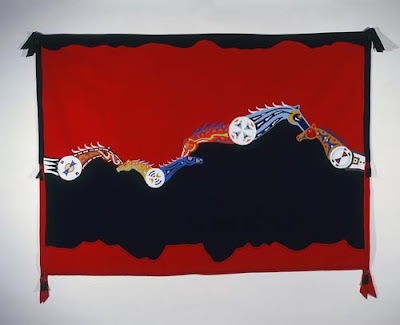


Here were new artists, drawing on their traditions but now clearly "modern" and integrated into mainstream culture.

I was talking to locals in Santa Fe, old friends, about this experience and they advised the trip to Taos. http://www.taospueblo.com/ I feared a Disney ride. "Stay away from the casino," they warned, the rest is the real deal. It's been occupied for 1000 years" For me the real deal was our guide, a 20 something college student on summer break and very secure in who he was. What he understood about the artists on display in Santa Fe was that their art was for us, the white guys with the money. They were about breaking through, crossing over, being respected on our terms. What he wanted Carrie and me to see, and touch, and taste was the core of his tradition. He wanted us to dip into Red Willow Creek, the stream that provides all the water for the Pueblo. He took us inside the jewelry studio of a wizened old craftsman, crafting the silver that the tribespeople wore. He feed us a "pickle" and sweet drink sold from a jug on a board spanned across two plaster buckets. "You are going to hear a ton of BS." he assured us "No one lives here anymore, everyone left for the creature comforts, that kind of thing." "Truth is people come and go. But they never leave the tribe." He showed how they powered everything they needed with propane. Told us they had been given exclusive rights to graze and harvest buffalo for a commercial meat market. He made sure we walked through the adobe buildings, "America's first condo", he joked, and then sped off in his pick-up at the end of his shift. It was complicated.

This from the wiki:
"The deep feeling of belonging to a community, summed up in their phrase, “we are in one nest,” has held the Taos people together. Both men and women are expected to offer their services or “community duties,” when needed. One should be cooperative and never allow their own desires to be destructive of the community’s interest. One of Taos’s strongest institutions is the family. Descent on both the father and the mother’s side of the family is equally recognized. Each primary family lives in a separate dwelling so when a couple gets married, they move to their own home. With relatives so near by, everyone is available to help care for the children. The elderly teach the young the values and traditions that have been handed down, which protects the integrity of the Taos culture."


It got more complicated when our friends suggested that we attend the annual corn dance in the Santo Domingo Pueblo. We were cautioned to appreciate the fact that what we were about to experience was not for our benefit. This was a centuries old tradition, not a pow-wow for consumption by gringos.

Hundreds of visitors sat on a berm on the edge of the plaza fronting the pueblo. Two elders walked carefully over the ground, I'm going to guess 4 acres, picking up small stones, anything that might impede the dancers. Then the sound, the roar of drums is heard. The drummers from one tribe enter the space. Then the babies appear. The children led by their elders, are adorned in tribal dress, some of their bodies are painted in adobe mud, and they are moving in the dance step they have mastered as young as three. Soon the plaza is filled with dancers, hundreds of family members, ranks and files, adorned with crowns, and bells, and rattles, and skins, all cued by the drums to move in an elaborate choreography, a thousand years in the making. Tribe yields the space to tribe (they have come from other pueblos) and the succession of dancers proceeds throughout the day. Suddenly it ends. We are not 4 feet from a row of dancers. A young man shape shifts before our eyes. He is back from the trance he has been in for the last hour and asks his buddy, "So I have to change and then we'll meet up, cool with you?"

The above is so not any piece of any curriculum I have been exposed to. This trip into the American reality is a must do for any and all of us and would be a critical "field trip" for me and my fellow students of any age. What is happening with Native American Studies to a great degree is concerned with the integration of the
Indian kids into the mainstream, or protecting their culture. Reforming the teaching of Thanksgiving seems to be a big issue.

What is not happening is the wider exposure to the life lessons to be learned by example, of the multigenerational "dance" and the meaning for the rest of us.

When a Native American professor out of Yale develops a revised curriculum unit in American History for implementation in a New Haven magnet school. I get interested.
It is troubling to say the least when you scan the curriculum at the school for which the course was prepared and find no evidence that it is present.

C.A. Bower, a professor of great influence for those of us concerned with environmental studies, has bemoaned the loss of tradition, in the name of neo-liberal transformative education.

The following is an excerpt from an article posted on his web site:

Title: Is Transformative Learning the Trojan Horse of Western Globalization?
Author: C. A. Bowers, Adjunct Professor of Environmental Studies, University of Oregon


It is important to acknowledge that the rise of liberal/Enlightenment ideas in the late
18th and 19th century led to basic improvements in the lives of the people of Western Europe who had been oppressed by feudal ideas and institutions—and by the authoritarian political systems that were equally resistant to change. The emphasis on the authority and power of critical reflection to overturn unjust traditions, the idea that change can lead to social progress, the view of the individual as having the power of self-determination, and the idea that new forms of knowledge will mitigate the ravages of the illness and the stultifying nature of work, led to important advances. But it also needs to be kept in mind that the widespread acceptance in the West of these ideas also coincided with the rise of the Industrial Revolution. And more importantly, these liberal ideas had no self-limiting principle. That is,the dominant motivation has been to achieve more and faster progress, more reliance on critical reflection (increasingly by experts promoting the development of new technologies and markets), more labor saving technologies (and now the elimination of the need for workers), newer drugs (and the control of the American Congress to ensure the growing dominance of the drug industry), and more self-determination—including self-determination in the construction of knowledge and values. The lack of any self-limiting principles, which made these liberal ideas even more problematic when they were merged with the market liberalism of John Locke, Adam Smith, and, later, Herbert Spencer, becomes especially evident when we consider the current drive to turn every aspect of the environmental and cultural commons into market opportunities—and to convert the entire world to a survival of the fittest business mentality.

What from the beginning of human history has been understood as the commons, and
which exists today in various state of viability in the diverse cultures of the world, is the only alternative to the way in which the West’s industrial culture is creating greater dependence upon Western style consumerism and technologies. The nature of the commons varies from culture to culture, and from bioregion to bioregion. What they have in common is that much of the culture’s symbolic patterns as well as the natural systems of the bioregion are available to the members of the community on a non-monetary basis. That is, they have not been enclosed—that is, privatized, commodified, monetized, incorporated into an industrial process, and so forth. This general account of the commons does not mean that all of the culturally diverse commons where entirely free of political systems that gave certain groups
special advantages—including the right to restrict the commons to the bare essentials for sustaining life, such as access to water, soil for growing small crops, animals, traditions of ceremonies, patterns of reciprocity, intergenerational knowledge of how to use medical plants, preparing food, and so forth. To make the point more directly, the commons should not be understood as always free of status systems and the unequal use of power. On the other hand, many of the cultural commons have been and still are characterized by local decision-making—an important phenomena that is now being undermined by the World Trade Organization and capitalistic forms of enclosure where decision about the use of the commons is now made by corporations and private owners who are unaffected by their decisions. The enclosure (privatization) of municipal water systems, as well as the corporate ownership and sale of supposedly “pure” bottled water, are examples of how the process of enclosing the commons also undermines local democracy.

What we experienced in Taos is a living example of an authentic commons in action. There are lessons to be learned there.